By Staff Reporter
ISLAMABAD: Pakistan has moved past its electricity shortage era and now confronts a different challenge: what to do with too much power in the middle of the day and not enough after dark, according to the country’s power minister, who also said International Monetary Fund program restrictions are blocking a pricing overhaul that could ease the problem.
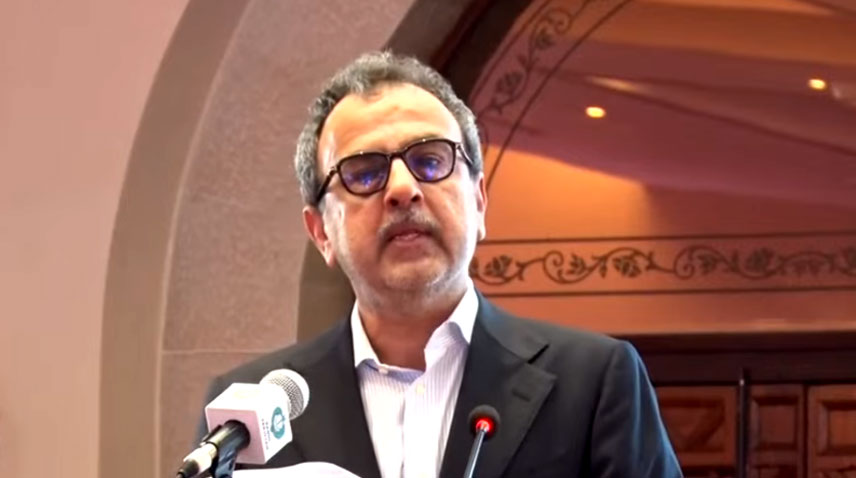
Awais Ahmad Khan Leghari, the minister for the Power Division, told an international conference in Islamabad on Tuesday that a wave of consumer-driven rooftop solar adoption has fundamentally altered the country’s power dynamics, eliminating the generation deficits that plagued Pakistan for years while creating a new problem of matching supply to demand across the day.
“Pakistan does not have a generation problem anymore,” Leghari said at the Solar Storage Flexibility 2026 conference. “In many hours of the day, we have a surplus. What we have is a flexibility problem” — the inability to shift abundant midday solar output into the evening peak, when solar generation drops and demand remains elevated.
The comments underscore a shift underway in Pakistan’s energy system, where households, farmers and businesses have installed rooftop solar panels at a rapid pace in recent years, largely to escape high electricity prices and repeated tariff increases rather than in response to any government program. The result has been a steep drop in daytime grid demand alongside persistent evening shortfalls, a pattern that has pushed battery storage and grid modernization to the top of the government’s energy agenda.
Renewable sources, including hydropower, nuclear, wind and solar, now account for 55% of Pakistan’s electricity generation, Leghari said. The government is targeting 90% clean energy by 2035, he said, and views battery storage as the mechanism that makes that target achievable rather than aspirational.
“Storage converts an ambitious target into an operable, bankable and very deliverable plan,” Leghari said. “Without storage our solar success risks becoming a curtailment problem. With storage it becomes a national asset.”
IMF Constraints Block Pricing Fix
Separately, during an interactive session at the conference, Leghari said limitations tied to Pakistan’s IMF program are preventing the government from introducing a time-of-use tariff system — a market-based pricing structure that would let electricity costs reflect the actual expense of generation at different hours.
The government has spent the past several months engaging with the IMF on the proposal, Leghari said, pointing to Australia as a model where utilities are permitted to charge less for electricity during periods of surplus generation, particularly in daylight hours when renewable output is highest. Pakistan has been unable to adopt a similar mechanism because of IMF program restrictions, he said.
Leghari argued that pricing daytime electricity at its marginal cost of roughly 6 rupees per unit would give consumers a financial incentive to invest in battery storage, banking cheap surplus solar power for use during costlier evening peak hours and easing pressure on the national grid. He said the reform would carry no fiscal cost for the government while improving grid efficiency by flattening demand peaks and encouraging greater renewable energy use.
The minister also called for substantial investment in digitizing Pakistan’s electricity network, including smart metering and real-time monitoring of power flows, which he said are prerequisites for modern tariff mechanisms and better integration of distributed solar generation.
Middle East Tensions Reinforce Energy Security Push
Leghari tied the storage push directly to global energy market volatility, citing the conflict between Iran and the United States as a reminder of how external shocks reverberate through energy markets.
“Oil price volatility, shipping risk through the Strait of Hormuz and uncertainty in the global fuel markets are not abstract concerns for policymakers in Washington or Riyadh,” Leghari said. “For a country like Pakistan, which still imports the bulk of the fuel that runs a large share of our thermal fleet, they are a direct threat to our fiscal stability and our people’s cost of living.”
He pointed to April as a real-world test of that vulnerability, when a disruption to liquefied natural gas supplies from Qatar forced Pakistan back into nighttime load shedding even as solar power kept daytime supply adequate.
“Every unit of electricity that we generate from an indigenous source is a unit that no foreign conflict, no shipping lane or no currency shock can take away from us,” Leghari said. “When we talk of battery energy storage systems today, we are not simply talking about a grid balancing technology. We are talking about insulating Pakistan’s economy from a volatile world.”
Domestic Manufacturing Policy in the Works
The government is preparing a policy to encourage local battery manufacturing rather than continued reliance on imported systems, Leghari said. The Ministry of Industries is finalizing a local manufacturing policy that will offer incentives for domestic production, he said, with the goal of moving Pakistani companies beyond simply importing battery technology toward assembling battery packs domestically, developing battery management software, manufacturing components and building engineering expertise.
To coordinate the sector, the government has established a National Steering Committee on Battery Energy Storage Systems, bringing together regulators, transmission and distribution companies, and technical experts, Leghari said. The committee is supported by technical and regulatory working groups tasked with developing commercial frameworks, pilot projects and national standards to attract investment.
Copyright © 2021 Independent Pakistan | All rights reserved