By Staff Reporter
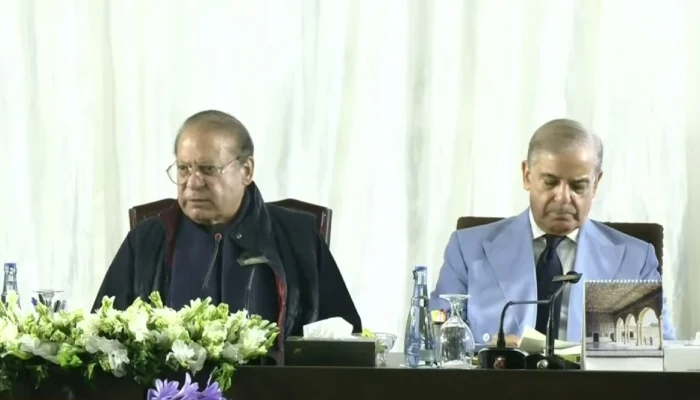
MURREE: Nawaz Sharif, the former prime minister and president of the ruling Pakistan Muslim League-Nawaz, has called for political rivals to set aside “animosity” as his party moves towards a majority in Azad Jammu and Kashmir’s fraught legislative assembly elections, a contest marked by weeks of unrest, an internet blackout and mounting allegations of rigging.
Addressing a party convention in the hill resort of Murree on Saturday, Sharif congratulated the winners of the elections while offering condolences to defeated candidates, in remarks that appeared directed at the PML-N’s increasingly strained coalition partner, the Pakistan Peoples Party.
“We have always maintained good relations with our opponents. There is always disagreement in politics, but it should not reach the point where it creates animosity,” he told the gathering. “This is unacceptable.”
Sharif said he had been personally troubled by the criticism levelled by the PPP, whose leadership has accused the AJK Election Commission of overseeing a process it branded “rigged and violent”. “I was upset over their losses, and I have good relations with them personally,” he said, adding that PML-N candidates who had lost seats deserved scrutiny of why they fell short rather than blame directed elsewhere.
“We can lose seats, but we cannot lose our spirit,” he said.
The former prime minister’s comments came as re-polling was carried out at 23 stations across two constituencies in Bagh district, the latest instalment in a staggered election that has unfolded against a backdrop of deadly clashes, boycott calls and disputed results. The PML-N has emerged as the dominant force in the 53-member assembly, having taken 24 of the seats declared so far against 10 for the PPP.
A vote conducted in phases, and in tension
The AJK Election Commission scheduled the vote in three phases for the region’s 45 assembly seats, including 12 reserved for refugees. The first phase, covering 13 constituencies in Mirpur division, was held on 27 July. The second, on 2 August, took in eight constituencies of Muzaffarabad division along with all 12 refugee seats — though two constituencies, LA-27 and a further Muzaffarabad seat, were postponed after heavy rain triggered landslides.
The third phase, originally intended to cover the whole of Poonch division, was scaled back after the Election Commission cited law and order concerns, confining polling on Monday to Bagh and Haveli districts. Even there, the count proved troubled: results in two constituencies, LA-15 (Bagh-II) and LA-16 (Bagh-III), were withheld after polling failed to take place at a combined 23 stations, prompting Saturday’s re-run.
Voting on Saturday ran without interruption from 8am to 5pm, according to the Election Commission, covering nine stations in LA-15 and 14 in LA-16. Officials said the process passed off without reports of violence, though turnout in both constituencies was described as negligible.
Provisional figures from Monday’s polling showed PPP candidate Sardar Ziaul Qamar leading in LA-15 with 16,637 votes, ahead of the PML-N’s Mushtaq Ahmed Minhas on 15,015 and Jamaat-e-Islami’s retired Brigadier Dr Muhammad Khan on 12,259. In LA-16, the PML-N’s Sardar Mir Akbar held a lead of 3,225 votes over the PPP’s Sardar Qamaruz Zaman with 19,515 votes counted. Candidates in both seats have accused their rivals of large-scale rigging.
Elsewhere in the third phase, the Election Commission declared Sajid Iqbal Abbasi of the Jammu Kashmir Awami Dost-o-Bazu Party the winner in LA-14 (Bagh-I, also known as Dhirkot), with a landslide 40,522 votes.
Contested result in Haveli
The most disputed seat of the phase has been LA-17 in Haveli, where the sitting AJK prime minister, Faisal Mumtaz Rathore of the PPP, was declared the returned candidate in a notification issued late on Friday and released to the media on Saturday, defeating the PML-N’s Mohsin Aziz.
The declaration reopened a dispute that had simmered since Wednesday, when the returning officer issued the formal result — known as Form 27 — naming Mr Rathore the winner. Mr Aziz has said he had been given assurances the result would not be announced until a complaint he lodged was examined by the Election Commission. He subsequently challenged the outcome before the AJK’s Chief Election Commissioner, retired Justice Ghulam Mustafa Mughal, who reserved judgment on Thursday after hearing both sides. The commission said on Saturday it would deliver its ruling on the petitions at 5pm.
PPP alleges rigging; Maryam Nawaz hits back
The PPP’s grievances go beyond individual seats. A high-level party meeting in Islamabad this week described the AJK elections as “rigged and violent” and voiced serious concern over the Election Commission’s conduct. A separate meeting chaired by Faryal Talpur, the PPP’s Women’s Wing president and the party’s AJK affairs in-charge, criticised the staggered nature of the vote and demanded that polling in the outstanding two districts and seven Poonch constituencies be completed swiftly so the assembly could be properly constituted.
Participants at that meeting also raised concerns over the suspension of internet services during polling, shortages of ballot material and staff at some stations, and what they described as inadequate security arrangements.
Punjab’s chief minister, Maryam Nawaz Sharif, dismissed the rigging claims at Saturday’s convention, telling delegates the PPP should “consider the logic” behind its allegations. “It is upsetting that they made false allegations of rigging against the PML-N. When they won in Gilgit-Baltistan, they made no claims of rigging; where they lost, they made these allegations,” she said, adding that the party’s record in Sindh gave it little standing to promise AJK voters new roads or a “clean atmosphere”. “They forgot that the government, administration, president, prime minister and staff were theirs,” she said. “They should consider logic when levelling allegations against others.”
Weeks of unrest behind the ballot
The vote has taken place against the backdrop of more than two months of tension between authorities and protesters linked to the Joint Awami Action Committee, a coalition that has organised demonstrations over political and economic grievances and called for the election to be boycotted. The JAAC was proscribed under Pakistan’s anti-terrorism legislation in June.
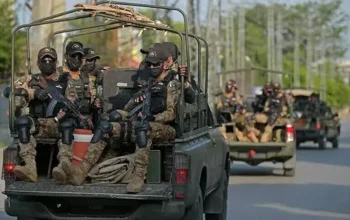
Deadly clashes broke out after the first phase of voting in late July, particularly around Rawalakot, with road closures and an internet blackout disrupting large parts of the region in the aftermath. The government has blamed armed protesters for the violence; the JAAC has accused the authorities of using excessive force.
In his address, Sharif described the atmosphere surrounding this year’s election as unprecedented in AJK’s recent history and attributed it to years of unmet public expectations under successive governments, regardless of party. “The expectations of the people and their wishes were not fulfilled by our governments, regardless of which party they belonged to,” he said.
He said his party now bore responsibility for addressing those failures and used the convention to press his younger brother, prime minister Shehbaz Sharif, who was present, to direct maximum federal funding towards roads, hospitals, employment schemes, tourism, industry and agriculture in the region.
“If, God forbid, despite our victory… we fail to deliver, then I think the people of Azad Kashmir will become angry, and the reason for their anger would be justified,” he said.
He called for the revival of China-Pakistan Economic Corridor projects in AJK and proposed new road and rail links running from Islamabad and Rawalpindi, via Murree, to Muzaffarabad. He also pointed to housing loan schemes already running in Punjab, saying he intended to press for their extension to AJK, along with agricultural credit lines modelled on the Punjab programme.
“People need to feel that they are being granted their rights,” he said. “The people of AJK look at Punjab’s roads, hospitals, and hope they are built in AJK; AJK’s children want laptops in their hands, and people should receive Kisaan cards and livelihoods.” “We have to bring development to Azad Kashmir, eliminate the problems here, and practically implement in Azad Kashmir what we are doing in Punjab,” he added. “Punjab is changing, and AJK should be changed in the same way.”
Copyright © 2021 Independent Pakistan | All rights reserved