By Staff Reporter
Five years after the Taliban swept back into Kabul, Afghanistan has entered a quieter phase of emergency. The desperate crowds at the airport are gone from the world’s front pages; so, largely, is the country itself. What has replaced the crisis that made headlines is a crisis that doesn’t: slower, less photogenic, and for that reason easier to leave unaddressed.
The quiet is not an accident. A government that produces no dramatic footage produces no pressure, and the Taliban seem to have grasped this rather better than most of their critics anticipated. Sirajuddin Haqqani, the interior minister, marked the anniversary this month by crediting the movement’s return to power to “morale, courage” and “divine assistance”. A more honest account might credit something less mystical: five years of a watching world that has, by and large, stopped watching.
The cost of that inattention is measured in numbers too large to sit comfortably in a headline, which may be part of why they don’t. An estimated 21.9 million people — very nearly half the population — will need humanitarian assistance in 2026. Some 11.6 million of them are children, of whom 3.5 million under the age of five are already acutely malnourished. Behind those figures sits a compounding of causes: successive droughts, an economy strangled by isolation, and a state policy of excluding half the population from work, education and public life.
The response from the countries once most invested in Afghanistan’s future has been to withdraw. The United States, which supplied more than $3bn in humanitarian and development assistance between October 2021 and December 2024, no longer counts among the country’s five largest donors. President Donald Trump’s suspension of humanitarian funding in January 2025 stripped out a source that had accounted for close to half of all aid at a stroke. Total humanitarian funding for Afghanistan has fallen by nearly 70 percent since 2022. More than 440 health clinics have closed or cut services as a result. The World Food Programme now turns away three in four acutely malnourished children who come to it for help, for the plain reason that it can no longer afford to feed them.
There is a particular cruelty buried in one detail of this retreat. Western governments continue to hold billions of dollars in frozen Afghan central bank reserves, held up as leverage against the Taliban’s record on women — and the ban on girls’ secondary education is consistently cited as one of the principal obstacles to releasing them. The money that once paid to educate Afghan girls is, in effect, now the money being withheld in the hope of shaming the Taliban into letting them return to school. Whatever this policy is achieving, it is not that.
Certainly nothing has moved on the substance. Afghanistan remains the only country on earth barring girls from secondary education — a genuinely unusual distinction, in a world short of genuinely unusual distinctions. UNESCO puts the number of girls currently excluded from school at 2.4 million. The restrictions have widened steadily since 2022: women barred from parks and gyms, then from speaking audibly in public, and this year from equality before the law itself, under a decree that also removes the minimum legal age for marriage and makes divorce close to unobtainable. More than 100 decrees targeting women and girls have been issued since the Taliban returned. Women’s labour force participation has fallen from roughly one in six before 2021 to about one in twenty now. The UN’s own human rights mandate — an assessment written in the flattened, careful language of international law, which makes it more damning rather than less — has concluded that what is under way in Afghanistan amounts to the crime against humanity of gender persecution.
That word, persecution, is worth sitting with, because it describes something organised rather than incidental: a policy pursued with the same institutional seriousness a functioning state applies to tax collection or border control, not a set of prejudices that might loosen with time or economic pressure. Mahbouba Seraj, one of the very few prominent Afghan women’s rights activists who stayed in Kabul after 2021, told CNN this month that she is now considering leaving the country, because in five years of trying she has been unable to help a single Afghan woman who needed her. Five years is a long time for an activist as determined as Seraj to conclude that the door has simply been welded shut.
The Taliban’s own defence deserves to be heard before it is dismissed, if only because dismissing it out of hand is part of how the last five years went wrong. Foreign Minister Amir Khan Muttaqi argues that states which have engaged with his government have benefited from doing so, and challenges those that have not to name what abstention has actually achieved. It is not, on its face, a foolish challenge. Five years of near-total isolation have moved the Taliban not at all on the question of women, so why not test whether engagement succeeds where isolation has failed? It is the logic that has drawn China deeper into Afghan lithium, copper and oil, and that led Russia to become, last year, the first state to formally recognise the Taliban government.
The trouble is that this argument has already been tested, and it failed the first time round. During the Doha negotiations, the Taliban spoke fluently in the language international engagement wanted to hear — amnesty, respect for women’s rights “within the framework of Sharia”, balanced relations with the world. Diplomats heard moderation. Afghanistan’s own former deputy defence minister has since testified that, in reality, peace talks and Taliban military expansion were advancing on entirely separate tracks throughout, with no relationship between what was being promised at the table and what was happening on the ground. Engagement did not fail by mismanagement or bad luck. It failed because it mistook an ideological movement, for which government exists to enact religious conviction rather than to secure legitimacy in its own right, for an ordinary political actor open to negotiation. Governing has not moderated the Taliban’s ideology in five years for much the same reason that water does not wear down stone by sitting quietly beside it.
That is not, in turn, a vindication of the sanctions-and-silence approach that has broadly defined Western policy since 2021. Isolation has failed to alter Taliban conduct on women exactly as completely as engagement failed to during Doha; two opposite strategies have produced one identical result. What isolation has achieved with certainty is to starve the population that the policy was supposedly designed to protect, while leaving the government responsible for their situation almost entirely undisturbed. Both things can be true simultaneously: that formal recognition of the Taliban would be a moral failure, and that withholding it has not altered their behaviour either, at a cost now measured in shuttered clinics and malnourished children. What currently passes for principled restraint is, on the evidence of five years, simply a failed policy that has not yet been called by its name.
One fact from this anniversary complicates any account of total failure, and is worth including precisely because it doesn’t fit the pattern. Afghan opium production has fallen by roughly 95 percent since the Taliban’s 2022 cultivation ban, among the steepest declines in illicit drug production recorded anywhere in modern history. It proves the Taliban can govern effectively when a goal happens to align with their priorities — which only sharpens the question of why almost nothing else has been allowed to succeed. Nor is it an unqualified achievement: the ban removed a primary income source for rural households with little offered in its place, and the UN now warns that methamphetamine production is filling the gap the poppy left behind. Effective governance, it turns out, is well within Taliban competence. It is simply outside their priorities, except where it happens to serve them.
What does this leave, five years on? At the least, honesty about which failed strategy is currently in use, and why. If frozen reserves are being held as leverage on girls’ education, those holding them owe some account of what, after five years of identical results, would make the same posture succeed going forward. If humanitarian funding is being cut regardless of whether that leverage ever works, then the pretence that aid policy here is rights-based should be dropped, rather than left standing as cover for what is, in practice, abandonment. And if a genuine alternative exists — sustained humanitarian funding held apart from political recognition, matched with sustained pressure aimed specifically at the architecture of gender persecution rather than at “the regime” in the abstract — then five years is a long time not to have attempted it properly.
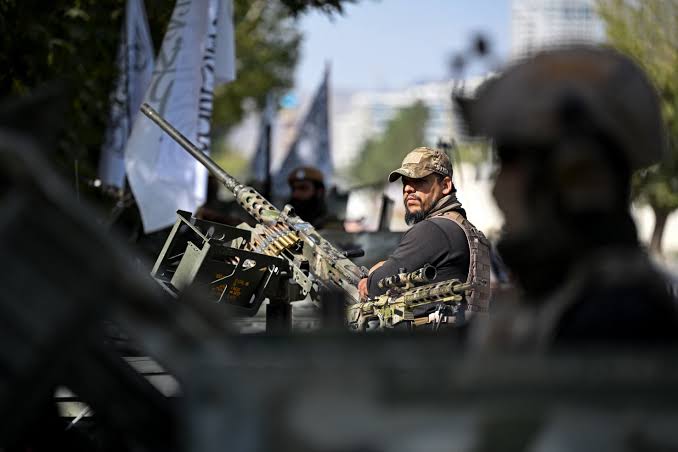
The Taliban will mark their sixth anniversary much as they marked this one: with parades outside the shuttered American embassy, with talk of divine victory, with the absence of a single woman from the platform. And Fatima is 28. After the Taliban returned to power in 2021, she fled to Iran, where she was able to keep working as a make-up artist — a job the Taliban had already banned women from doing at home. Last year she was deported back to Afghanistan. “Every morning, I wake up wondering how I will cover my basic living expenses,” she says, “and every night I close my eyes with worries about my child’s future.” Five years of diplomatic argument about engagement versus isolation, leverage versus legitimacy, comes down, in the end, to whether an answer can be found for Fatima before her child is old enough to ask why one never was.
Copyright © 2021 Independent Pakistan | All rights reserved