By Staff Reporter
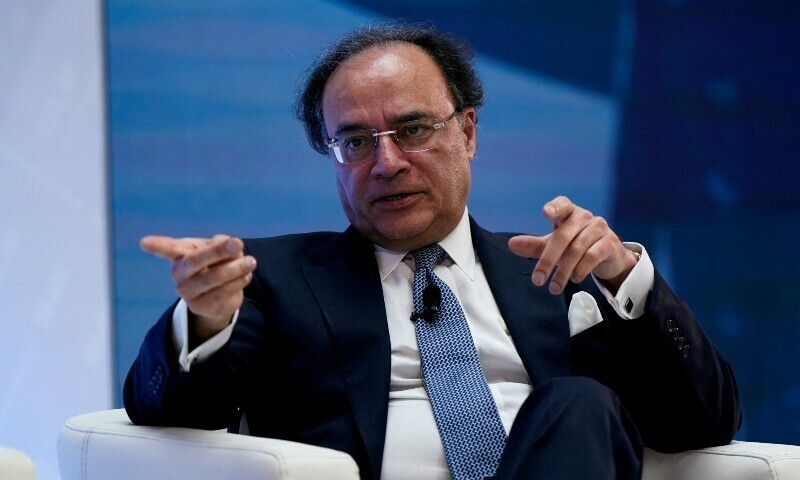
ISLAMABAD: Pakistan has formally asked the United States for a $10 billion facility designed to shore up confidence in the rupee, Finance Minister Muhammad Aurangzeb said, as Islamabad tries to convince investors it no longer needs the emergency bilateral support that has propped up its reserves for years.
The request, lodged with the US Treasury Department, seeks what officials are calling an Exchange Stabilisation Support Facility — a mechanism Aurangzeb was careful to distinguish from a conventional loan or credit line. Speaking to media in Islamabad, he said the facility’s purpose is to reassure capital markets about Pakistan’s currency and foreign-exchange stability, not to plug a financing gap.
“This is not about a credit line or a loan or whatever,” Aurangzeb said. “This is a signal about our currency stability, a signal about our foreign exchange stability, and that in turn also allows us that we can go to the market.”
Aurangzeb said he expects some response from either the Export-Import Bank of the United States or the Treasury by the end of September. Talks remain preliminary, he cautioned, with no resolution yet reached.
The request comes weeks after Pakistan played a role in brokering discussions during the US-Iran conflict, a diplomatic turn that raised Islamabad’s profile in Washington and fueled speculation it might convert that goodwill into economic support. Reuters has reported the request is for $10 billion.
If granted, the facility would represent a rare use of a US Treasury tool typically reserved for a handful of sovereign clients. Exchange stabilisation facilities, routed through the Treasury’s Exchange Stabilisation Fund, supply dollars, currency swaps or guarantees to help countries defend their reserves and stabilize their currencies. They are structurally distinct from the standing dollar swap lines the Federal Reserve maintains with major central banks — a separate mechanism that functions as an ongoing international dollar supply line.
Precedent is thin. Argentina received a new facility in 2025, the first such arrangement extended to a foreign government since Uruguay in 2002. Mexico has held a standing swap line since the 1940s, now sized at $9 billion, but that arrangement predates the modern stabilisation-facility structure and is generally treated as a separate case.
Rollovers give way to ratings push
Aurangzeb tied the US request to a broader shift in Pakistan’s financing strategy: a move away from the short-term bilateral rollovers that have kept the country afloat since it narrowly avoided default in 2023, and toward the kind of longer-dated market borrowing that investment-grade and near-investment-grade sovereigns use.
Central to that strategy is Pakistan’s sovereign credit rating, which Aurangzeb said has been effectively frozen since 2003-04. The government is working with rating agencies to push the country toward a B+ rating, he said, a level that would open access to five-, seven- and 10-year market maturities and reduce Pakistan’s dependence on the rollover cycle.
“Our effort and desire, Alhamdulillah, is that we have now achieved a rating status. We want to move at least towards a B+ rating,” Aurangzeb said.
He said the government has already appointed three arrangers to help it return to international debt markets, building on recent issuances that included a Eurobond, an Islamic sukuk and a dollar-settled, rupee-linked bond. Those deals, he said, demonstrate that Pakistan can execute market transactions even before a rating upgrade materializes.
Separately, Aurangzeb said Pakistan is negotiating with bilateral creditors to extend the maturity of existing loans, potentially stretching repayment periods out to 10 years. He said “various options” are under discussion, without elaborating, and that talks with the US Export-Import Bank and other institutions are continuing alongside the ESF request.
Reserves still leaning on Gulf, China support
Pakistan remains under a $7 billion International Monetary Fund program that has forced the government to raise taxes, restrain spending and push through economically painful structural changes — measures that have generated domestic political backlash even as they’ve helped stabilize the currency and rebuild reserves.
The country avoided default in 2023 through a $3 billion IMF standby arrangement, later replaced by the current $7 billion Extended Fund Facility. A separate $1.3 billion climate-resilience loan has added to Pakistan’s external financing since then.
But the reserve build-up remains fragile and highly dependent on continued goodwill from China and Gulf allies. That dependence was laid bare in April, when Pakistan repaid roughly $3.5 billion — about a fifth of its total reserves — to the United Arab Emirates, a repayment that would have strained the country’s buffers had Saudi Arabia not stepped in with $3 billion in fresh deposits.
The State Bank of Pakistan said in January it expects reserves to climb toward $20 billion by the end of 2026, which would put them close to the record levels last seen in 2021.
Copyright © 2021 Independent Pakistan | All rights reserved