By Staff Reporter
ISLAMABAD: Jailed former prime minister Imran Khan was returned to Adiala prison in the early hours of Friday after a night-time medical examination, following a chaotic sequence of events in which the government appeared to sidestep a Supreme Court order requiring his transfer to a private Islamabad hospital.
Khan, 73, was examined at the state-run Pakistan Institute of Medical Sciences (PIMS) rather than Shifa International Hospital, the private facility the Supreme Court had explicitly named earlier in the week. Information minister Attaullah Tarar confirmed the change of venue on Friday morning, saying doctors from Shifa had nonetheless been present at PIMS during the examination.
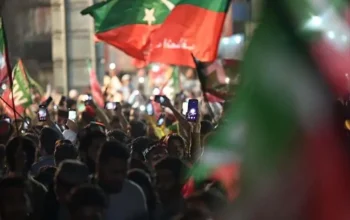
The clarification followed hours of confusion. Khan’s Pakistan Tehreek-e-Insaf (PTI) party had said on Thursday night that he had been moved to Shifa, and heavy security was visibly mounted around the private hospital and the roads leading to it, feeding reports that he was being treated there. Tarar’s statement on Friday, posted on X, corrected the record: the examination, he said, “was conducted at PIMS Hospital, where doctors from Al-Shifa Hospital were also present.” He attributed the last-minute switch to a “security situation” created by PTI supporters gathering on the route to and outside Shifa.
By the time journalists visited Shifa International Hospital on Friday morning, the previous night’s heavy police presence had been stood down and the roads around it, cordoned off hours earlier, had reopened to traffic.
The decision to conduct the examination at a government facility rather than the private hospital specified by the court is likely to prompt scrutiny of how closely the authorities adhered to the Supreme Court’s instructions. Political observers in Islamabad suggested the overnight arrangement may have been designed to satisfy the letter of the court’s order — and avoid the risk of contempt proceedings — while curbing both the length of time Khan spent outside prison and the possibility that his hospital visit would turn into a rallying point for his supporters. The government has not characterised its actions in these terms.
Court order, then a retreat
The Supreme Court had ruled on Tuesday that authorities must transfer Khan to Shifa International Hospital within 48 hours for specialist examination and treatment, to be overseen by a medical board that included his personal physician. Judges said he could remain there until 16 September, depending on the board’s recommendations.
A three-member bench led by Justice Shahid Waheed, sitting with Justices Naeem Akhtar Afghan and Ishtiaq Ibrahim, delivered the ruling in a packed Islamabad courtroom after hearing several petitions calling for Khan’s hospitalisation and for expanded family access. “We are mindful of the constitutional and legal obligation of the state, and consequently of the Supreme Court, to safeguard the life, health, dignity and security of persons in custody,” the order stated. “A prisoner does not, by reason of his incarceration, cease to be entitled to humane treatment and necessary medical care.”
On Wednesday the government filed a petition seeking a review of the ruling, arguing that allowing a convicted prisoner treatment at a hospital of his choosing could invite similar demands from other inmates, and that the order exceeded the court’s jurisdiction. The petition, filed by Islamabad Advocate General Naveed Hayat Malik, also cited Rule 197 of the Pakistan Prison Rules, 1978, which governs the transfer of prisoners to hospitals, arguing the court should have consulted medical experts before ordering the move on health grounds. The Supreme Court registrar’s office returned the petition on Thursday, citing incomplete paperwork.
“Medically fit”
According to Tarar, a medical team including an ophthalmologist, a cardiologist and a physician examined Khan in detail and declared him “medically fit.” Khan’s sister, Uzma Khanum, was present throughout, the minister said, adding that Khan was returned to Adiala jail at approximately 5am on Friday, roughly the deadline set by the court’s 48-hour window.
PTI reacted with dismay. Party chairman Gohar Khan told reporters in Islamabad that the Supreme Court’s instruction had been unambiguous. “That is why to shift Khan there [Shifa International Hospital], to keep him there and to carry out tests there was in accordance with the law and the Supreme Court’s decision,” he said. “It is very unfortunate what happened.”
PTI secretary-general Salman Akram Raja said it would be premature to speculate that Khan might eventually be moved from hospital to his Bani Gala residence, though he noted that any building could in principle be designated a sub-jail if medical experts judged that a return to prison would harm his health. He said the report submitted to the court had indicated that prison conditions were contributing to Khan’s anxiety.
Months of concern over his health
The episode capped weeks of mounting concern, both from Khan’s family and from the court, about his physical and psychological state in custody. A report submitted to the Supreme Court by the Adiala jail superintendent, ahead of Tuesday’s ruling, said medical officers visited Khan three times daily, monitoring his blood pressure, heart rate and oxygen levels, and that adequate healthcare was being provided to him and his wife.
An annexure to that report told a more troubling story. Dr Akhtar Ali Bandeshah of PIMS, who examined Khan on 1 August, recorded complaints of uncontrolled and fluctuating blood pressure, palpitations, headaches and restlessness, which Khan attributed partly to infrequent meetings with his wife and family and the absence of newspapers and television. The doctor recommended more frequent family visits, access to reading material, a CT coronary angiography and an increase in his blood pressure medication, warning of a risk of complications.
A further examination on 10 August, by a medical board of PIMS specialists, followed complaints of heaviness in the head and palpitations. The board recommended a daily hour-long walk, a relaxation of his prison routine, and access to newspapers, magazines, television and books, along with more frequent contact with his immediate family to help manage his anxiety and blood pressure.
Khan has also been treated at PIMS for central retinal vein occlusion in his right eye, a condition that can impair vision; the report noted his sight had largely returned to normal following treatment by senior ophthalmologists. His sons told CNN this month that they were worried about his health and said they had been unable to visit him, while his family and legal team have said he lost most of the vision in that eye. The government maintains he has received appropriate medical care throughout his imprisonment, and has rejected accusations of neglect.
Extraordinary security
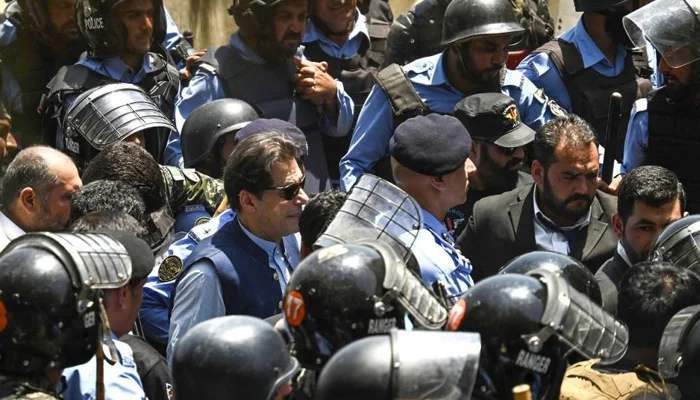
The scale of the security operation mounted around Shifa International Hospital on Thursday night was, by most accounts, unusual even by Islamabad’s standards. Roughly 800 personnel from various law enforcement branches were deployed in and around the hospital, in Islamabad’s Sector H-8, following a formal security audit of the building. Islamabad’s police chief, Syed Ali Nasir Rizvi, visited the site twice to oversee preparations, and a security order seen by Dawn newspaper listed the deployment’s objectives as protecting the “life, property and dignity of citizens,” guarding against “terrorist acts,” maintaining public order and keeping traffic moving.
Pitras Bukhari Road and Service Road South, both of which run past the hospital, were cordoned off, with images from the scene showing barricades and a substantial police presence. Local reporting noted that security arrangements of this scale had last been seen in the area during the Panamagate proceedings against former prime minister Nawaz Sharif, held at the nearby Federal Judicial Academy.
PTI had urged its supporters to stay away. Sheikh Waqas Akram, the party’s information secretary, wrote on X on Thursday that Khan would “insha’Allah” be transferred to hospital that day, adding: “We are fully aware of the sentiments of Imran Khan’s supporters, who are eager to catch a glimpse of their leader” — but asked them to keep their distance for the sake of his treatment. Asad Qaiser, a former speaker of the National Assembly and close Khan ally, went further in the early hours of Friday, warning on X that any party worker who gathered outside the hospital in defiance of the instruction “would have no affiliation with the party.”
A deepening standoff
Tuesday’s hearing also brought a rare moment of family access. Khan’s sister Noreen Niazi was granted a meeting with him for the first time this year — the first, jail sources said, since 4 November last year — during which the two discussed his health in the prison’s conference room. She declined to speak to journalists afterwards, pressing a finger to her lips as she left. The last confirmed meeting before that had been with another sister, Dr Uzma Khan, on 2 December 2025, after which Uzma said Khan’s physical health was acceptable but that he was enduring “mental torture” in isolation.
Federal minister Tariq Fazal Chaudhry has separately raised the possibility of Khan being sent abroad for treatment, though no formal process appears to have been initiated.
Zulfikar Bukhari, a senior PTI figure, told Reuters that Khan, if freed, would not seek confrontation with the military leadership. “If Imran Khan was released tomorrow, hypothetically, he wouldn’t do anything that would effectively damage the country,” Bukhari said, describing him as “magnanimous” and adding: “You control your own hurt. You curb your own pain. You swallow it for the betterment of your country.” He called the Supreme Court’s ruling a “new ray of hope” and said senior party figures who had gone into hiding might soon re-emerge. Bukhari said party leaders had last spoken to Khan eight months ago.
From cricket captain to prisoner
Khan’s imprisonment marks an extraordinary reversal for a man who led Pakistan to its only 50-over Cricket World Cup title, in 1992, before entering politics and eventually becoming prime minister in 2018. He was removed from office in April 2022 following a parliamentary vote of no confidence, a moment that set in motion the political and legal battles that have consumed the years since.
He has been in custody since August 2023, initially over allegations that he concealed the proceeds of state gifts — the so-called Toshakhana case — and is currently serving a 14-year sentence in the Al-Qadir Trust case, a £190 million corruption matter in which he is accused of securing land worth billions of rupees through a corrupt arrangement with a property developer while in office. He faces more than 100 other cases in total. Khan and his party say the prosecutions are politically motivated efforts to keep him out of public life; the government denies persecuting him.
His relationship with Pakistan’s military, once cordial, collapsed after his removal from power, producing one of the most bitter standoffs in recent memory between a mass political movement and the armed forces. Khan has accused the military of engineering his downfall and imprisonment, and, in an interview with the Guardian following his brief arrest and release in May 2023, accused army chief Field Marshal Asim Munir of harbouring a “personal grudge” against him. The military denies interfering in politics or playing any role in his prosecution.
Despite more than three years largely out of public view, Khan remains one of Pakistan’s most popular political figures, retaining a large and highly mobilised base of support, particularly among younger voters — a following that continues to make his health and treatment one of the most closely watched and politically charged issues in the country.
Copyright © 2021 Independent Pakistan | All rights reserved