By Staff Reporter
ISLAMABAD: Imran Khan, the jailed former prime minister, was transferred from his cell in Adiala jail to a private hospital in Islamabad in the early hours of Friday, after days of legal wrangling in which the government resisted a supreme court order to move him.
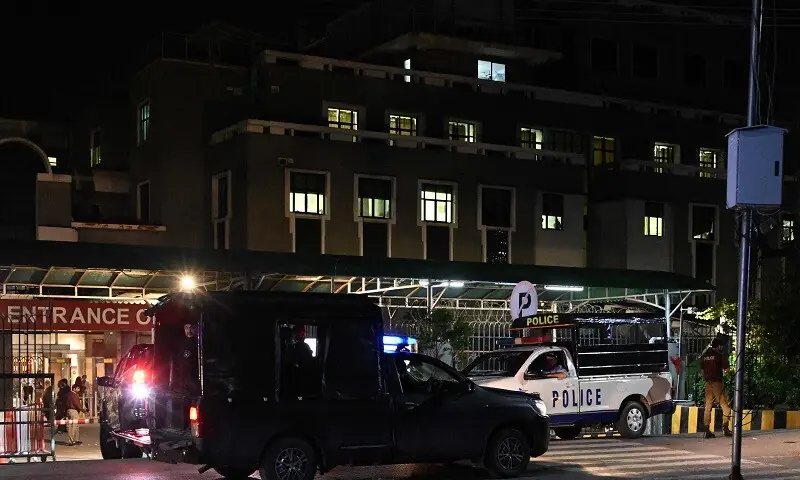
The 74-year-old was driven under armed escort to Shifa International Hospital, entering through a side gate on Patras Bokhari Road as hundreds of police sealed off the surrounding streets. His arrival, confirmed by security sources shortly before dawn, came almost 48 hours after judges had told the government it had two days to act — a deadline the authorities missed by hours, prompting Khan’s lawyers to threaten contempt proceedings.
The move follows more than a month in which Khan’s family and supporters have raised increasingly urgent concerns about his health, including uncontrolled blood pressure, palpitations and headaches, which doctors examining him have linked partly to prolonged isolation from his wife and relatives.
Khan has been in custody since August 2023, when he was arrested on charges of concealing the proceeds of state gifts, and is currently serving a 14-year sentence over what has become known as the Al-Qadir Trust case, in which he and his wife, Bushra Bibi, were convicted of receiving land and money worth an estimated £190m in exchange for favours to a property developer while he was in office. He and his party, Pakistan Tehreek-e-Insaf, maintain the case and others brought against him since his removal from power in a no-confidence vote in April 2022 are politically motivated.
The supreme court’s order on Tuesday followed a hearing that laid bare, in unusually blunt terms, the extent of the government’s obligations towards prisoners in poor health. A three-judge bench led by Justice Shahid Waheed ruled that the state’s duty to protect the “life, health, dignity and security” of those in its custody did not lapse simply because a person was imprisoned, and directed that Khan be moved to Shifa International within 48 hours for assessment by a specially convened medical board.
That board is to include a cardiologist, an eye specialist and a general physician, alongside Khan’s own doctor, Faisal Sultan, and his sister Uzma Khan, a physician herself. The costs of his care are to be met by the family, the court ordered, warning that any breach of its directions could result in privileges currently extended to Khan being withdrawn.
A day after the ruling was handed down, the government lodged a petition asking the court to review and recall the order, arguing it was “discriminatory” and had been issued in excess of the court’s jurisdiction. Lawyers for the state pointed to prison regulations governing the transfer of inmates to hospital and argued that judges ought to have consulted medical experts before intervening. By Thursday, however, the supreme court registrar’s office had returned the petition to the government, citing incomplete paperwork — and by Thursday night, with the original deadline having elapsed, Khan had still not been moved. His lawyer, Khalid Yousaf Chaudhry, said he intended to pursue a contempt of court application over the delay.
Behind the legal argument lies a starker picture of Khan’s condition inside Adiala. A medical report submitted to the court, and an accompanying assessment by a doctor from the Pakistan Institute of Medical Sciences who examined him on 1 August, recorded complaints of fluctuating blood pressure, palpitations, headaches and restlessness, along with a warning that his age put him at heightened risk of complications. The doctor recommended more frequent contact with his wife and family, access to newspapers and television, and further cardiac investigation. A separate medical board that examined Khan on 10 August after he reported heaviness in the head reached similar conclusions, recommending a daily hour of walking and a relaxation of his prison routine.
Uzma Khan, who last saw her brother in early December, said afterwards that while his physical health held up, he was enduring what she called mental torture, kept apart from visitors and cut off from news of the outside world. Another sister, Noreen Niazi, was granted a rare meeting with him on Tuesday — her first this year — during which she updated him on the court’s ruling. She left the jail without addressing waiting reporters, declining to speak beyond a gesture for silence.
The government has rejected claims that it has denied Khan adequate care. Rana Sanaullah, an adviser to the prime minister, told the Senate that Khan was receiving the best treatment available from specialists in line with the law and the court’s own instructions. Pakistani authorities have pointed to regular medical checks, including three visits a day by prison doctors, and treatment for an eye complaint that has reportedly restored much of his vision.
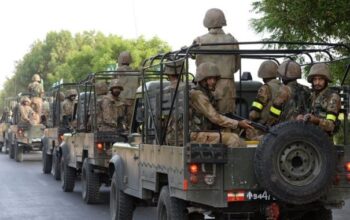
The scale of Friday’s security operation reflected both the sensitivity of the case and the government’s evident anxiety about crowds gathering. More than 800 personnel were deployed under a police order that set out four objectives: protecting the safety and dignity of citizens, guarding against terrorism, maintaining public order and keeping traffic moving. Roads leading to the hospital were closed and lined with barricades, parked vehicles were cleared using tow trucks, and Islamabad’s police chief, Ali Nasir Rizvi, visited the site twice — once on Thursday night as preparations were finalised, and again after Khan’s arrival to review the arrangements in person. A hospital floor typically reserved for patients requiring specialist care, and previously used to treat a former prime minister, Shahid Khaqan Abbasi, was made ready to receive him.
PTI’s information secretary, Sheikh Waqas Akram, urged supporters in a social media post to stay away from the hospital, acknowledging that many would want to catch sight of their leader but appealing for restraint for the sake of his treatment. The party’s leadership has echoed that message publicly, though it has also used the moment to press its case that Khan’s imprisonment has been designed to isolate him from public view.
Zulfi Bukhari, a close ally of Khan, told Reuters that Khan would not seek confrontation with the military leadership if he were freed, describing him as someone capable of setting aside personal grievance for the country’s sake. Bukhari called the court’s ruling a source of renewed hope for the party and said senior figures who had gone underground amid a wider crackdown on PTI were likely to begin re-emerging.
Whether Khan’s stay at Shifa International marks a lasting change in his circumstances remains unclear. Salman Akram Raja, PTI’s secretary-general, cautioned against speculation that he might eventually be moved to his family home in Bani Gala, noting that while any building could in principle be designated a sub-jail, that would depend on medical advice about the risks of returning him to prison. Under standing procedure, should Khan be formally admitted for treatment, Islamabad’s chief commissioner would need to declare the relevant ward a sub-jail, with staff from Adiala deployed to the hospital to maintain custody throughout his stay.
Copyright © 2021 Independent Pakistan | All rights reserved