By Staff Reporter
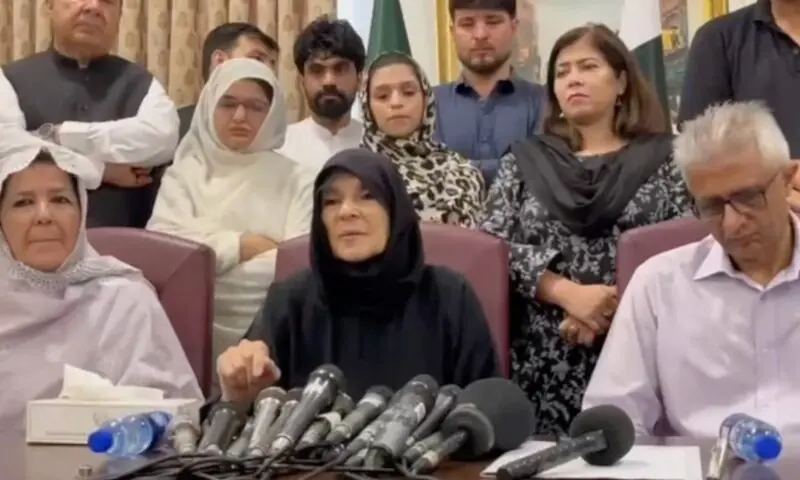
ISLAMABAD: Uzma Khan, the sister of jailed former Pakistani prime minister Imran Khan, gave a detailed and at times bewildering account on Friday of the events surrounding her brother’s overnight hospital transfer, telling reporters in Islamabad that police repeatedly withheld information from her and that she was left waiting in darkened corridors before finally being reunited with him — an account that has fed a sharpening political row, with PTI’s chairman accusing the government of violating a Supreme Court order and warning the party could withdraw from parliament altogether.
Speaking at a press conference alongside Khan’s personal physician, Dr Faisal Sultan, Uzma said the former prime minister had complained, citing his doctors, of health complications linked to prolonged solitary confinement. She had been present for his medical examination earlier that day, after Khan was taken from Adiala jail under a Supreme Court order requiring his transfer to a private hospital for treatment.
That order specified Shifa International Hospital. Information minister Attaullah Tarar later confirmed that Khan had instead been examined at the government-run Pakistan Institute of Medical Sciences (PIMS), a discrepancy that has drawn sustained criticism from Khan’s party, PTI, and is now further complicated by his sister’s account of how the transfer itself unfolded.
A summons, then silence
According to Uzma, she and Dr Sultan received a phone call on Friday instructing them to go to Adiala jail. “So we reached the Adiala jail at around 8-8:30pm,” she said. On arrival, the pair were taken to the office of a deputy superintendent of police she identified as Sibtain.
What followed, in her telling, was a process marked by separation and unexplained instructions. Sibtain asked Dr Sultan to step outside with him, leaving Uzma alone in the room. After what she estimated was ten to fifteen minutes, a female assistant sub-inspector arrived and took her to a car. She said that throughout this period, police declined to answer her questions, including repeated enquiries about the whereabouts of Dr Sultan.
She was then driven to PIMS. “I asked them why you have brought me here; the SC has instructed for [Imran’s] treatment at Shifa International Hospital,” Uzma recounted. “At that, they told me we were there for a follow-up regarding Imran’s eye.” Khan has been treated at PIMS on several previous occasions for right central retinal vein occlusion, an eye condition that first came to light in late January and has significantly affected his vision.
“There was darkness all around”
Uzma’s description of arriving at the hospital that night was stark. “There was darkness all around,” she said, adding that she was guided to an office by a man using his mobile phone as a torch. She said she believed the office belonged to a PIMS department head, though she was not told so directly.
After waiting there, she was taken upstairs — where she found her brother already present, and evidently as startled by the encounter as she was. “When I went upstairs, Imran was sitting there. He too was a little surprised. He then stood up, he was in shock,” Uzma said. “He told the doctors who were with him that she is my sister and we were meeting after 10 months.”
The reunion, coming after ten months without direct contact between the siblings, appears to have taken both of them by surprise, according to Uzma’s account — with neither, she suggested, having been clearly informed in advance that the other would be present. She said she told him the visit was for a checkup and that he would subsequently be taken to Shifa International Hospital, in line with the court’s order. She said she again asked about Dr Sultan’s whereabouts at this point but received no answer.
Doctors unfamiliar with his prescriptions
The group was then taken to an office, where an examination of Khan’s eye was conducted. Uzma said two or three doctors were present, but that she recognised none of them by name, aside from being introduced to a Dr Arif. “There were two to three doctors there, but I was not familiar with any of them,” she said. “They introduced me to Dr Arif, but I did not know any of the others.”
What struck her, she said, was that the doctors present appeared unfamiliar with Khan’s existing treatment. “They asked, ‘Khan sahib, which eye drops do you use?'” she recalled. When she asked whether the drops previously prescribed for him were noted in their own records, none of the doctors could confirm that they were.
One doctor said Khan needed an immediate test to check a blood vessel, according to Uzma, who said she reminded them that he was due to go to Shifa International Hospital for a full examination and checkup regardless. The group was then moved again, to a further location, where doctors said Khan needed to be given an injection. Additional tests were carried out, with doctors telling Uzma that his eye condition and an associated haemorrhage had shown improvement.
A doctor subsequently checked Khan’s blood pressure, which Uzma said was recorded at around 120 over 80, or possibly 70, before he was given the injection for his eye. “He asked me what was happening, and I told him he would be taken to Shifa International Hospital for complete examination and, if required, any treatment. He was happy with that,” she said.
Throughout the encounter, Uzma said, her brother repeated one thing to her above all else: that he had been subjected to “cruelty.”
PTI accuses government of breaching court order
Uzma’s account was reinforced hours later by a forceful intervention from PTI chairman Barrister Gohar Ali Khan, who told reporters outside parliament ahead of the National Assembly session that the government’s handling of the transfer amounted to a clear breach of the Supreme Court’s directive.
“The Supreme Court’s order has been violated,” Gohar said, arguing that the court’s instructions had contained no ambiguity. “What happened was very unfortunate. We did not expect this. There is someone who does not want any solution to the problems. We made a great effort,” he said, adding that he had personally verified the arrangements beforehand and had been assured the order would be implemented as written.
“There was absolutely no expectation that he would be shifted to another hospital, or which hospital he would be shifted to, or that it would not even be told which hospital he had been shifted to,” Gohar said. He questioned what tests had actually been conducted on Khan, what the former prime minister had said during the examination, and why his family had been left waiting for information throughout the night — echoing, in substance, the confusion Uzma had just described from inside the process itself.
Gohar noted that the government had had a separate avenue available if it disagreed with the court’s ruling. “If there had been any ambiguity in it, a review could have been sought,” he said — a reference to the government’s own review petition, filed a day after the original order and calling it “discriminatory in nature,” which the Supreme Court’s registrar office returned on Thursday morning citing objections with the filing.
Warning over parliament
Gohar’s criticism extended beyond the hospital transfer itself to the broader state of engagement between PTI and the government, which has recently included overtures from the prime minister for talks. He was sharply dismissive of how those overtures had been handled. “You do not shake hands like this. Negotiations do not happen like this,” he said.
He went on to question whether Pakistan’s political system could be said to be functioning at all if a court order involving a major party could simply go unimplemented. “If you are not giving such a major leader and such a major party this much space, and if it is difficult to shift him to a hospital, and if it is difficult to implement an order of the Supreme Court, then democracy does not work like this,” he said.
Speaking later inside the National Assembly, Gohar raised the possibility of PTI withdrawing from parliament entirely. “Perhaps you do not want us to remain part of this system,” he told the chamber. “Perhaps after a few days, we will no longer be part of this assembly.” He said the party would take a decision on its continued participation within the coming days, while maintaining that PTI remained committed, in principle, to resolving political disputes through negotiation rather than confrontation.
Reporting restrictions
The circumstances take on additional significance given that the Supreme Court, in issuing its original order, had specifically directed that Khan’s medical reports and health information should not be used for political purposes — a stipulation now under strain as the transfer becomes the subject of dueling accounts from the government and PTI, and as the party’s leadership signals it may escalate the dispute well beyond the hospital gates.
Copyright © 2021 Independent Pakistan | All rights reserved