By Staff Reporter
ISLAMABAD: Opposition parties said on Friday they would approach the Supreme Court to demand implementation of its order on Pakistan Tehreek-e-Insaf founder Imran Khan’s medical treatment, after the government took the jailed former prime minister to a state-run hospital overnight rather than the private facility the court had named.
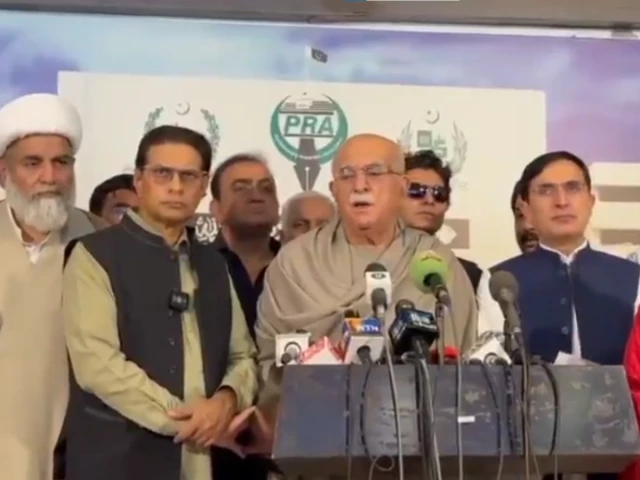
The decision was taken at a meeting of opposition parliamentary parties at Khyber Pakhtunkhwa House in Islamabad, chaired by National Assembly Opposition Leader Mahmood Khan Achakzai. Those present included Senator Raja Nasir Abbas, PTI chairman Barrister Gohar Khan, Asad Qaiser, Khyber Pakhtunkhwa chief minister Sohail Afridi and PTI secretary general Salman Akram Raja.
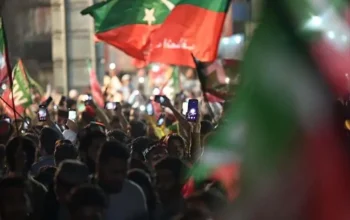
A statement issued after the meeting said participants had expressed “deep concern” over Khan’s health and would make no compromise on his treatment. They accused the government of staging a “drama” over the matter and said the failure to implement the Supreme Court’s ruling amounted to contempt of court. The opposition will go to the court on Saturday to press for the order’s implementation, and reaffirmed a “full-fledged” protest and long march on Islamabad for 27 September, to which all opposition parties will be invited.
The meeting also agreed to step up a public mobilisation campaign in Punjab and nationwide, and said future political and parliamentary decisions would be taken through joint consultation. Participants endorsed the Grand Opposition Alliance and said they wanted to see it made more active, welcoming the possible involvement of Jamiat Ulema-i-Islam-Fazl chief Maulana Fazlur Rehman and other parties, on the basis that a wider alliance would give the opposition a stronger voice in parliament.
Confusion over transfer
The meeting followed a night of confusion over Khan’s whereabouts. The Supreme Court had ordered on Tuesday that he be moved from Adiala jail to Shifa International Hospital in Islamabad for several days of treatment, with weekly family visits to follow. Heavy security was mounted around Shifa on Thursday night, with roads leading to the hospital sealed off with barbed wire and the Islamabad police chief among senior officers stationed outside. But when Khan’s convoy left Adiala shortly after midnight, travelling via Chakri, he was instead taken to the state-run Pakistan Institute of Medical Sciences.
Information minister Attaullah Tarar said Khan had been examined at PIMS by a team including an ophthalmologist, cardiologist and physician, with doctors from Shifa also present, and had been declared medically fit. His sister, Dr Uzma Khan, was present throughout, Tarar said, and Khan was returned to Adiala at around 5am on Friday. Tarar said the change of venue followed “the security situation created by PTI workers on the route to and outside Shifa Hospital.” Parliamentary affairs minister Tariq Fazl Chaudhry gave a similar account, citing an “unusual rush and security situation” outside the private hospital.
PTI has rejected that explanation. Speaking on a private news channel, Chaudhry later said the decision to divert Khan to PIMS had been taken by security agencies while he was already en route to Shifa, after arrangements had been made there and Khan had left the jail. “When he was en route, our security institutions assessed the situation, and the police and law enforcement agencies decided that they could not control the law and order situation,” he said, adding that the decision “is not a political decision.” Asked why Khan’s personal physician, Dr Faisal Sultan, had been left waiting at Shifa for hours while Dr Uzma Khan was with her brother at PIMS, Chaudhry said he had not known Sultan was there until later.
Raja disputed the account of security disruption around Shifa in a post on X on Thursday, saying the roads to the hospital had not been closed because of any rush, and noted that Sultan had himself travelled to Shifa in a vehicle with tinted windows, surrounded by police. Dr Uzma Khan, addressing a press conference in Islamabad alongside Sultan, gave her own account of the night. She said the two had been called to Adiala jail at around 8-8.30pm on Thursday and taken to the room of a deputy superintendent of police she identified as Sibtain. After some minutes, she said, Sibtain asked Sultan to step outside with him, leaving her alone in the room; roughly ten to fifteen minutes later, a female assistant sub-inspector took her to a car, and she was driven to PIMS without her questions about Sultan’s whereabouts being answered.
PTI’s information secretary, Sheikh Waqas Akram, told Geo News the medical board formed by the government did not meet the terms of the court’s order, saying Dr Uzma Khan did not know the doctors on it and that Sultan had not been included. He said the government could still avert a contempt petition by moving Khan to Shifa before PTI filed one.
“Tantamount to treason,” says Achakzai
Addressing reporters at Parliament House alongside PTI lawmakers, Achakzai said squandering the chance to ease Pakistan’s political crisis was “tantamount to treason against this country.” He said there had been hope the situation might improve — “better late than never” — before it deteriorated again overnight. “Whether anyone accepts it or not, Imran Khan’s is Pakistan’s most popular party, and we all know that he is currently a prisoner of conscience who is standing firm on his principles. Imran Khan has not broken,” he said.
Achakzai said PTI had cooperated fully with the court’s order, instructing supporters nationwide to stay away from the hospital and avoid any slogans or gatherings. “If Imran Khan had remained in a hospital bed instead of a prison cell for a week and doctors had properly examined him, what would have happened?” he asked. He said he had been glad to hear overnight that Khan had reached a hospital, expecting he would stay for treatment, “however, in the morning, I found out that the situation had deteriorated further.”
Achakzai said Khan had told his sister he was being treated as former Egyptian president Mohamed Morsi had been, kept in isolation and, in his account, subjected to torture. He said the opposition’s dispute was not personal — not with any soldier, nor with Prime Minister Shehbaz Sharif or Nawaz Sharif — but with “those forces that do not accept the supremacy of the Constitution and an independent judiciary in Pakistan, and those who do not arrange bread and water for the poor people.” He said the Tehreek-e-Tahafuz-e-Ayin-e-Pakistan and its allied parties stood “100 per cent in solidarity” with PTI, and that work was under way towards forming a “united opposition.”
Later in the National Assembly, Achakzai said there had been widespread jubilation when it became known Khan was being moved to Shifa in line with the court’s order, “but at night, we found out that, under the cover of darkness, the PTI founder had been taken to another hospital.” He alleged Khan’s sister had been confined to a separate room at the hospital, and suggested elements within government might be working to sabotage relations between PTI and the state, saying that whenever conditions favourable to dialogue emerge, “unknown forces come in and sabotage it.”
Speaking separately to reporters at Parliament House, Raja said PTI would file its contempt petition on Saturday. “The medical board that the SC had ordered to be constituted was never formed,” he said, adding that the party’s political and parliamentary committees were meeting on Friday to determine its next steps. He was also critical of the response to his sister’s press conference, which he said was being portrayed as running counter to the Supreme Court’s decision.
Gohar questions future of talks
Barrister Gohar Khan, speaking to reporters outside Parliament before the National Assembly sat, said the government’s handling of the transfer had undermined PTI’s efforts to pursue dialogue. “What happened was very unfortunate. We did not expect this. There is someone who does not want any solution to the problems. We made a great effort,” he said. He argued the court’s order had left no room for interpretation. “If there had been any ambiguity in it, a review could have been sought. There was no ambiguity in the SC’s order,” he said, adding that he had personally checked on arrangements and been assured the order would be carried out. “There was absolutely no expectation that he would be shifted to another hospital, or which hospital he would be shifted to, or that it would not even be told which hospital he had been shifted to.”
He questioned what tests Khan had undergone, what he had said during the examination, and why his family had been left without information, adding: “But the Supreme Court’s order has been violated.” On the prime minister’s offer of talks, Gohar said PTI remained open to a political solution but objected to the government’s approach. “You do not shake hands like this. Negotiations do not happen like this,” he said, asking how democracy could function if the state could not extend space to a major political party or comply with a Supreme Court order.
Later, addressing the Assembly, Gohar suggested PTI could reconsider its place in the legislature. “Perhaps you do not want us to remain part of this system,” he said. “Perhaps after a few days, we will no longer be part of this assembly.” He said the party would decide within days whether to continue its participation.
Government files fresh review petition
The dispute has also played out in the courts. The government’s initial review petition, filed after Tuesday’s order and describing it as “discriminatory in nature,” was returned by the Supreme Court on Thursday over an objection that the required paper books had not been completed. The Islamabad chief commissioner has since filed a fresh petition, arguing the order contains legal errors and conflicts with prison rules — specifically the Pakistan Prison Rules, 1978, which the petition says make no provision for admitting prisoners to private hospitals and permit treatment only at jail, civil or district headquarters facilities. It also argues that a private-hospital transfer raises security risks and the risk of outside influence, and that government doctors available to prisoners are already senior specialists.
The petition further contends the chief commissioner was never made a party to the original proceedings or issued notice before the order was passed, which it says breaches the right to a fair trial under Article 25 of the Constitution, and argues that granting Khan two international calls a week breaches Rule 265 of the Prison Rules. It also objects to what it calls the granting of final relief on an interim basis, and warns that accommodating one prisoner’s request for private treatment risks encouraging similar demands from others.
Tuesday’s order followed a medical board report and a report from the Adiala jail superintendent, submitted on Monday, recommending more frequent family visits to help manage Khan’s blood pressure and anxiety. A three-member bench headed by Justice Shahid Waheed, hearing cases on Khan’s access to his sisters, his personal physicians and his medical records, ordered that Sultan be granted access to him and directed the formation of a medical board comprising an eye specialist, a general physician and a cardiologist alongside Sultan, with Dr Uzma Khan also associated with the board. The court ordered Khan’s family to bear the cost of treatment, and directed that his medical report be kept confidential, with Justice Naeem Akhtar Afghan instructing that no political activity, media talks or press conferences take place outside the hospital. “There are other patients in the hospital,” Justice Afghan said, adding that they should not be affected. Raja and PTI parliamentary secretary Shahid Khattak assured the court that political activity would be kept entirely separate. The court also ordered that arrangements be made for Khan to speak by phone with his children, and said the order could be withdrawn if its terms were breached, while inviting any party to return to court if it believed the directives were not being followed.
Afridi: protest target to double
Sohail Afridi told a press conference on Friday afternoon that Khan had personally instructed him, via his sister, to intensify the planned protest campaign. “Imran Khan has specifically instructed me to intensify the movement,” Afridi said. “God willing, the movement will be more intense than before.” He said he would travel to Hangu on Saturday and Buner on Sunday before taking the campaign across the country, and that the party’s public mobilisation target for the 27 September march — previously set at two million people — would now be doubled. “The pressure has not shifted. The pressure will now double,” he said, rejecting the government’s account of a security threat around Shifa and denying PTI had issued any instruction for supporters to gather near the prison.
Khan, 73, has been in custody since August 2023 and says the cases against him are politically motivated, an allegation the government denies. PTI has held repeated rallies demanding his release, including a November 2024 march on Islamabad that ended in clashes with security forces after supporters reached the capital’s fortified government district.
Copyright © 2021 Independent Pakistan | All rights reserved