By Staff Reporter
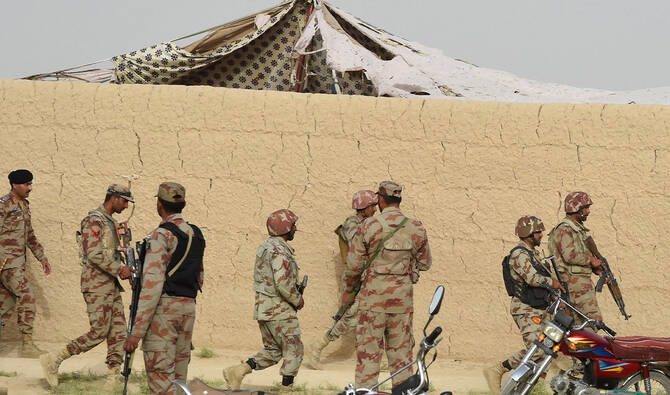
ISLAMABAD: Security forces killed 49 suspected militants in a wave of intelligence-based operations across Khyber Pakhtunkhwa and Balochistan over the past several days, the military said on Friday, in the latest escalation of a counter-terrorism campaign that has coincided with the bloodiest month of violence the country has recorded this year.
The Inter-Services Public Relations (ISPR), the armed forces’ media wing, said the raids were carried out jointly with police as part of a “relentless counter-terrorism campaign” against Indian backed militants . The statement used the terms “Fitna al-Khawarij” for the banned Tehreek-i-Taliban Pakistan and “Fitna al-Hindustan” for Balochistan-based separatist groups — labels the Pakistani state has increasingly deployed to frame domestic militancy as externally directed by India.
In Khyber Pakhtunkhwa, the military said 12 terrorists were killed during operations in Bannu, North Waziristan, Orakzai and Khyber districts. Troops recovered explosives, remote detonators for improvised explosive devices, weapons, ammunition and motorcycles from the scene, all of which were subsequently destroyed, according to ISPR.
The larger toll came in Balochistan, where the military said 37 militants were killed across ten separate operations in Mastung, Mach, Khuzdar and Panjgur districts. Security forces seized and destroyed a substantial quantity of weapons, drums of explosives and remote detonation equipment, the statement said.
ISPR said further “sanitisation operations” were under way to clear the areas of any remaining fighters, and pledged that the campaign — conducted under the banner “Azm-e-Istehkam”, the counter-terrorism vision endorsed by the Federal Apex Committee on the National Action Plan — would continue “at full pace” until foreign-backed militancy was eliminated from the country.
Prime Minister Shehbaz Sharif praised the security forces’ conduct of the operations in a statement carried by state broadcaster PTV, saying Pakistan remained “determined to eradicate terrorism completely.” President Asif Ali Zardari also commended the forces, saying externally sponsored terrorism would “never succeed in harming the country’s peace and stability” and that operations would continue “with full force until the complete elimination of terrorism.” Zardari added that he believed the day was approaching when Balochistan and Khyber Pakhtunkhwa would be “rid of terrorism,” restoring peace and development to both provinces.
Friday’s announcement extends a run of large-scale operations disclosed by the military this month. On 12 August, ISPR said 18 militants had been killed in Balochistan’s Surab district; three days earlier, it reported 15 killed in multiple operations elsewhere in the province. A separate engagement in Khyber Pakhtunkhwa on 7 August left ten militants dead, the military said. Earlier operations this week in Balochistan’s Ziarat, Harnai and Surab districts, conducted under a campaign designated Rad-ul-Fitna-3, killed at least nine more, according to security sources, who said ammunition, magazines, hand grenades, walkie-talkies and a motorcycle were recovered from the dead.
The intensity of the crackdown mirrors a sharp deterioration in the underlying security situation. Data compiled by the Pakistan Institute for Conflict and Security Studies, an Islamabad-based think tank, shows that July was the deadliest month of 2026 so far, with 205 people killed, including 112 members of the security forces. Balochistan accounted for the steepest rise, with fatalities climbing 241 per cent from 109 in June to 372 in July. Khyber Pakhtunkhwa followed closely, with deaths increasing 105 per cent, from 75 in June to 154 in July.
The two provinces have borne the brunt of Pakistan’s militant violence since the Taliban’s return to power in neighbouring Afghanistan in 2021, a shift widely linked to a resurgence in cross-border attacks. A separate analysis by the Centre for Research and Security Studies found that Khyber Pakhtunkhwa and Balochistan together accounted for nearly 96 percent of all violence-related deaths nationwide in the second quarter of 2026, with Khyber Pakhtunkhwa the worst affected: more than 61 percent of the quarter’s fatalities, or 475 deaths, were recorded there, against 34 percent, or 265, in Balochistan. Khyber Pakhtunkhwa also logged the highest number of violent incidents nationally, with 151 cases, or 57 percent of the total, while Balochistan recorded 94 incidents, or 35 percent.
Copyright © 2021 Independent Pakistan | All rights reserved