By Staff Reporter
QUETTA: Prime Minister Shehbaz Sharif has promised that Balochistan’s vast reserves of copper, gold and other minerals will benefit local people before anyone else, as fresh figures revealed a sharp escalation in violence across the resource-rich but restive province.
Sharif told a gathering of officials, tribal elders and religious leaders in Quetta on Friday that Balochistan was, by his own reckoning, the wealthiest province in Pakistan, though its riches remained largely untapped beneath its mountains.
“Today, if I were to say that Balochistan is Pakistan’s richest province, I wouldn’t be wrong,” he said. “But our precious metals and minerals are still buried under mountains in massive quantities.”
He told the closing session of the Balochistan National Workshop that there should be “no doubt” the wealth belonged to the province’s residents, whatever part of Balochistan they called home, whether Makran, Lasbela or Chaman.
Extracting that wealth, he acknowledged, was another matter entirely. Sharif said the scale of investment and expertise required meant Islamabad and the provincial government would need to work in tandem, so the benefits reached “the people of Balochistan first, and then to the people of Pakistan.”
The prime minister used his address to catalogue the practical difficulties facing the province, Pakistan’s largest by area, where the sheer distances involved make delivering schools, hospitals and roads a persistent struggle. He argued the problems were not unique to Balochistan and could only be resolved through consensus and a fairer share of national resources.
“So how do we solve these issues? Through mutual consensus and the fair distribution of the available resources so that all provinces benefit,” he said. “If there are challenges, they need to be resolved through mutual dialogue.”
But he was unequivocal that grievances, however legitimate, could never justify violence. He pointed to migrant labourers who had travelled to Balochistan for work only to be killed by militants because of their ethnicity or home province.
“As far as terrorism in Balochistan is concerned, there is no doubt Fitna al Khawarij are benefiting from hostile nations and martyring the innocent,” he said, invoking the label the Pakistani state uses for militant groups it accuses of receiving foreign backing.
He praised the security forces confronting the insurgency, saying they had “kept hundreds of millions of children safe at the expense of their lives,” and that their sacrifice must not be forgotten.
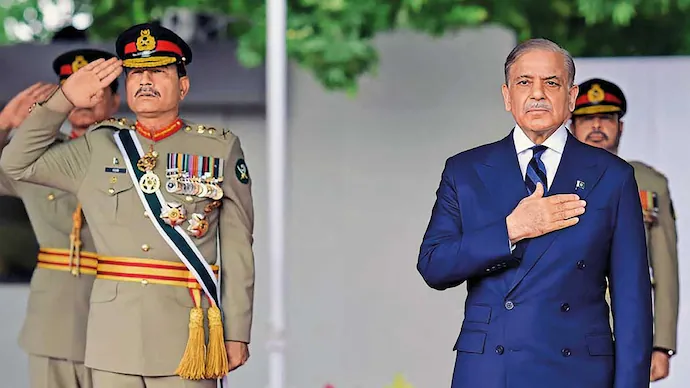
His remarks followed similar comments earlier the same day from Field Marshal Asim Munir, Pakistan’s army chief and chief of defence forces, who vowed to crush foreign-backed efforts to sabotage development in Balochistan, telling tribal elders and political leaders in the restive province that its future was inseparable from that of the country as a whole.
The present and future of Balochistan and Pakistan were “one and forever,” the field marshal told those gathered, according to a statement released by the military’s media wing, the Inter-Services Public Relations (ISPR), adding that lasting peace and stability were the essential ingredients for unlocking the province’s economic potential and drawing in the investment needed to convert its natural wealth into prosperity for ordinary residents.
Balochistan, he said, was home to people who were talented, resilient, patriotic and proud, and its young population represented one of the most promising segments of Pakistani society. Munir told the gathering that opportunities for that youth to contribute to national progress would remain central to any sustainable development strategy for the province.
Inimical designs
The field marshal reserved his sharpest language for Fitna al-Khawarij and Fitna al-Hindustan, terms it uses to describe militant networks it accuses of being sponsored from abroad. Fitna al-Khawarij is the government’s designation for the banned Tehreek-e-Taliban Pakistan, while Fitna al-Hindustan is the label Islamabad has applied since last year to armed groups it accuses New Delhi of backing as part of a wider proxy campaign in Balochistan.
These networks, Munir said, were being used by hostile actors to destabilise Balochistan, stall its development and drive a wedge between the province’s people and the Pakistani state. He said such schemes would be defeated through what he called the collective resolve of the nation, backed by an unwavering and decisive response from the state.
The general also praised the province’s tribal elders and community leaders for the part they had played in promoting peace and social cohesion, and urged them to confront hostile propaganda and false narratives without hesitation, arguing that the true story of Balochistan’s potential and progress needed to be told more forcefully. The destiny of the province, he said, rested solely with its own people.
Those in attendance responded by pledging their support for the state and its armed forces, reaffirming their commitment to peace and development in Balochistan and vowing to stand against what they characterised as foreign-sponsored threats to stability. They said they remained committed to development that placed local people at its centre, with the aim of building a peaceful and prosperous province.
A mounting security challenge
Munir’s remarks come against the backdrop of a marked rise in militant violence across Pakistan. Figures compiled by the Armed Conflict Location & Event Data Project (ACLED), which tracks conflict incidents worldwide, show the number of attacks recorded in the country climbed from 658 in 2022 to 2,425 last year, a near fourfold increase. Attacks attributed to the TTP rose even more sharply over the same period, increasing more than sevenfold from 118 to 838.
While Khyber Pakhtunkhwa has borne the heaviest toll, Balochistan has also been repeatedly targeted, with attacks frequently aimed at both civilians and military installations in the province. On the final day of 2025, gunmen attacked civilians in the Gwadar and Kharan districts, killing eighteen people, among them women, children, elderly residents and labourers.
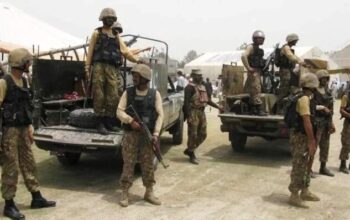
Pakistani forces have continued operations across the province against groups they describe as Indian-sponsored, under the banner of Radd-ul-Fitna-3, a campaign the military says is intelligence-driven and aimed at rooting out these networks. Despite the scale of the operations, militant groups have continued to strike civilian and defence targets.
The pace of such operations has been intense in recent weeks. On Tuesday, security forces said they had killed more than nine militants in raids across the Ziarat, Harnai and Surab districts. The day before, six were reportedly killed in separate raids, four in the border area between Ziarat and Harnai and two more in Killi Zaik.
Further back, on August 16, seven fighters affiliated with Fitna al-Khawarij were reported killed and others wounded in a raid in the Lajay area of Kharan district, according to security sources. Four days earlier, on August 10, forces said they had killed five militants in Panjgur district, including a commander identified only as Wazir, son of Jamal, in an operation in the Sarkeni and Chidgi areas.
On August 9, security forces reported killing fifteen militants in coordinated raids spanning Mastung, Bolan, Washuk, Awaran, Sibi, Khuzdar, Harnai and Noshki. Officials said the operations had yielded a substantial haul of weapons and ammunition and had significantly disrupted militant networks’ ability to move across the province.
Copyright © 2021 Independent Pakistan | All rights reserved