By Staff Reporter
ISLAMABAD: The government on Saturday moved to counter what it described as misleading foreign media coverage of the imprisonment of former prime minister Imran Khan, issuing a detailed rebuttal that touched on his living conditions, family access, and a medical dispute now before the country’s Supreme Court.
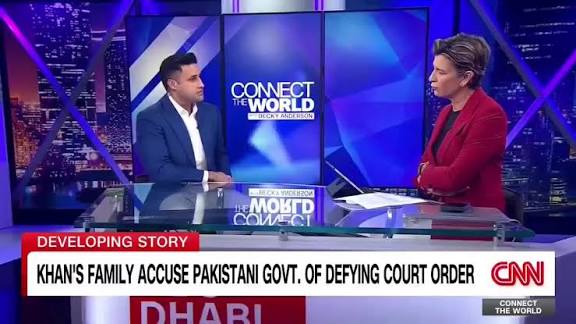
The statement from the Ministry of Information and Broadcasting followed a television interview in which CNN anchor Becky Anderson spoke with Zulfi Bukhari, a former aide to Khan, the founder of the opposition Pakistan Tehreek-e-Insaf party. Anderson later posted the ministry’s response on social media platform X.
The dispute centers on Khan, 73, who has been imprisoned since August 2023 and is at the center of a widening legal and political battle over his health and treatment behind bars — one that has drawn in Pakistan’s highest court, his own family, and a government that insists it has done nothing wrong.
In its statement, the ministry said Khan is not being held under executive detention but is serving time following criminal convictions reached through judicial proceedings, and that he retains the right to pursue all legal remedies available under Pakistani law. His imprisonment, the ministry said, is governed by the Pakistan Prison Rules and by security arrangements it described as appropriate for what it called a high-profile prisoner.
The government’s account directly contradicts claims from Khan’s family and party that he has been kept in punitive isolation and denied basic necessities. The ministry rejected those allegations outright, saying Khan has continued to receive visits, phone calls, reading materials, and home-cooked meals. His living quarters, the statement said, consist of a seven-cell compound with separate areas for sleeping, sanitation, and exercise.
The ministry also disputed assertions that Khan has been cut off from his family and political allies. According to the statement, he has held weekly meetings with his wife, Bushra Bibi, who is imprisoned at the same facility, Adiala jail outside Rawalpindi — most recently on Aug. 4. Since his incarceration began, the ministry said, prison records show roughly 198 separate visitation sessions involving more than 900 individual visitor entries, including Khan’s sisters, relatives, lawyers, physicians, and political representatives.
Prison records also document phone, landline, and WhatsApp contact with family members in Pakistan and abroad, the ministry said, citing a recorded call with one of Khan’s sons on March 21 and meetings with his sisters on Aug. 18, 19, and 25.
Medical dispute reaches the Supreme Court
The most consequential thread in the government’s statement concerns Khan’s medical care — an issue that has now become the subject of direct Supreme Court intervention and an allegation that the government defied the court’s own order.
On Aug. 18, a three-member Supreme Court bench ruled on pleas concerning Khan’s health and directed authorities to transfer him to Shifa International Hospital, a privately run facility in Islamabad, for examination and treatment. Instead, in the early hours of the following Friday, authorities took Khan not to Shifa but to the Pakistan Institute of Medical Sciences, a state-run hospital, where he was examined by a panel of doctors before being returned to prison. Information Minister Attaullah Tarar said Khan’s sister, Dr. Uzma Khan, was present for the examination.
The discrepancy between where the court ordered Khan to be taken and where he was actually examined has become a central point of contention. Uzma Khan filed a petition with the Supreme Court last week accusing authorities of violating the Aug. 18 order. On Tuesday, PTI resubmitted that petition to the court’s registrar, and Uzma Khan filed a separate application seeking an expedited hearing on a contempt petition against government officials. She filed a further application Thursday renewing that request.
The government, in Saturday’s statement, maintained it had complied with the court’s directions and that the medical and administrative arrangements made for Khan were consistent with what the court required.
The ministry said Khan has undergone approximately 30 medical examinations since his imprisonment began, conducted by specialist teams and medical boards from institutions including PIMS, Shifa International, Shaukat Khanum Memorial Cancer Hospital, and Al-Shifa Trust Eye Hospital, in addition to routine visits from the prison’s own physician.
Much of that care has centered on an eye condition — right central retinal vein occlusion — that surfaced in late January. According to the ministry, Khan received specialist treatment for the condition, including five intravitreal anti-VEGF injections, along with retinal imaging, medication, and follow-up examinations. The ministry said specialist assessments conducted last month and on Aug. 21 found Khan to be oriented and stable, with no signs of acute or unmanaged deterioration.
The ministry also cited Uzma Khan’s own assessment of her brother following the PIMS examination, saying she described him as “100 per cent fit,” noted normal blood pressure readings, and said his eye condition had almost completely healed. She also praised the treating eye specialist, according to the ministry, which argued that her account undercuts allegations of deliberate medical neglect.
Government accuses opposition of politicising health issue
The ministry argued that Khan’s physical health “should not be politicised,” stating that the federal government has never approached the matter with disrespect and has no interest in turning his medical condition into a political issue. It said the broader controversy has been presented in an unnecessarily politicised manner that does not adequately account for the documented record on Khan’s detention, family access, and treatment.
The statement noted that the Supreme Court had specifically directed that Khan’s family, his party, and his lawyers refrain from disclosing or sharing his health condition or medical records with the media or the public while the case remains pending. The government, the ministry said, believes there is an important distinction between a prisoner’s right to appropriate medical treatment — which it says is fully respected — and the use of confidential medical information for political messaging.
Access to Khan, the ministry added, cannot function as an unrestricted platform for political communication or activity from inside prison, and reasonable regulation of visits and communication, consistent with prison rules and court orders, should not be characterized as a denial of access.
The ministry also addressed the potential return to Pakistan of two of Khan’s sons, Qasim and Sulaiman, noting that they hold National Identity Cards for Overseas Pakistanis and could therefore enter the country — though it cautioned that entry would not necessarily guarantee them access to visit their father in prison.
A leader facing multiple prosecutions
Khan has been jailed since Aug. 5, 2023, when he was convicted in the so-called Toshakhana case, involving allegations that he improperly sold state gifts. He is separately serving a 14-year sentence stemming from a corruption case involving roughly £190 million, was convicted in a second Toshakhana-related case in December 2025, and faces additional pending trials on terrorism charges connected to riots that broke out on May 9, 2023, following his initial arrest.
The government and PTI have traded accusations for months over the handling of Khan’s health. Opposition leaders and Khan’s sisters have accused the government of lacking transparency and of blocking his personal physicians from examining him, demands that have included his transfer to Shifa International Hospital and treatment in the presence of doctors of the family’s choosing. The government has denied those allegations and, in Saturday’s statement, reiterated that it has acted in accordance with the Supreme Court’s directions throughout.
With Uzma Khan’s contempt petition still pending before the court, the dispute over whether authorities complied with the Aug. 18 transfer order remains unresolved — leaving the central factual disagreement at the heart of this story, whether Khan was taken to the hospital the court specified, still before the justices themselves.
Copyright © 2021 Independent Pakistan | All rights reserved