By Staff Reporter
ISLAMABAD: Pakistan’s central planning authority recommended cutting the estimated cost of a long-delayed pipeline project supplying water from Mirani Dam to the port city of Gwadar by roughly 20%, as part of a broader package of infrastructure and education projects worth 60.26 billion rupees cleared or advanced on Sunday.
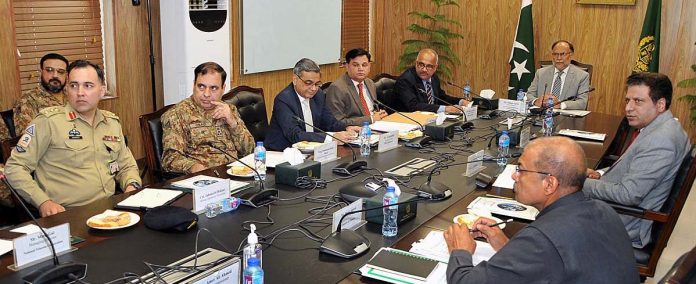
The Central Development Working Party, meeting under Planning Minister Ahsan Iqbal, approved three smaller projects outright at a combined cost of 11.714 billion rupees and referred two larger ones — together valued at 48.545 billion rupees — to the Executive Committee of the National Economic Council for final sign-off, according to a government statement.
The panel’s most consequential move came on the Gwadar water scheme, which had been submitted by the Balochistan provincial government at an estimated 29 billion rupees. Following a technical evaluation, Planning Commission staff recommended reducing that figure by approximately 20% to 23.82 billion rupees — a cut of roughly 5.2 billion rupees achieved by curtailing contractor overheads embedded in non-scheduled cost items, which account for close to 87% of the project’s base cost. Officials said the reduction would not require any change to the project’s design or scope.
The government’s own statement describing the referral to the executive committee listed the project’s cost at the original 29 billion rupees, without referencing the reduced figure — leaving unclear whether the committee will evaluate the scheme at its original valuation or the working party’s recommended, lower cost. [I flagged this in my notes below rather than picking one for you.]
The pipeline, which would run 125 kilometers to deliver water to Gwadar under the Balochistan Socio-Economic Development Projects Phase-III, still requires resolution of several technical questions before funds are released, the working party said. Those include water demand forecasts, hydrology data, confirmation of the source, procurement strategy, land acquisition status, and a plan for self-sustaining operations and maintenance.
Iqbal used the review to press Balochistan’s government on a related concern: wastewater treatment. The minister directed provincial officials to commission a study on treating Gwadar’s sewage, warning that the port city risks repeating the pollution problems that have affected Karachi’s coastline. He cleared the water project to proceed to the bidding stage in the interim, while barring any contract award until the executive committee grants formal approval.
Karachi Housing Project Advances
The working party also referred a revised 19.55 billion-rupee Karachi Neighborhood Improvement Project to the executive committee. The initiative, already nearing completion, is financed primarily through an $85 million World Bank loan — roughly 16.7 billion rupees — with the Sindh provincial government contributing 2.8 billion rupees through its annual development program.
Iqbal ordered the formation of a dedicated oversight committee, drawing members from the Planning Commission’s population and infrastructure divisions along with a representative from the Economic Affairs Division, to build a monitoring and accountability framework for foreign-financed development projects. The minister told officials that projects funded through external borrowing must demonstrate value for money and directed that mechanisms be established to ensure loan proceeds are spent efficiently and strictly for their intended purposes.
Education and Defence Projects Cleared
Among the smaller approvals, the working party signed off on a 4.924 billion-rupee medical and nursing college in Gilgit, a project first launched in 2017 that has faced repeated delays from inadequate funding. Iqbal called for the facility’s swift completion, describing it as a means of expanding healthcare training in Pakistan’s underserved northern regions and building a skilled local workforce for rural and mountainous communities.
The panel also approved a 2.75 billion-rupee campus for the National Defence University’s Faculty of Contemporary Studies at Islamabad’s Defence Complex. Iqbal directed the university to coordinate research with the Planning Commission in support of the government’s broader economic targets — a $1 trillion economy and $100 billion in annual exports by 2035 — and instructed both sides to formalize the collaboration through a memorandum of understanding. He also asked that planning ministry staff be enrolled in related training programs, telling university officials that research output should translate into evidence-based policy solutions.
Rounding out the approvals, the working party cleared a 4.037 billion-rupee road linking Zera and Daboori in Orakzai district, a 53.4-kilometer stretch that has been pending since 2016. Iqbal directed that remaining funds be disbursed before winter to keep the project on schedule, describing the federally financed road as central to improving connectivity in one of Pakistan’s merged tribal districts.
Under financial rules set by the National Economic Council, the working party has authority to approve projects valued up to 7.5 billion rupees on its own; anything above that threshold requires sign-off from the executive committee based on the working party’s technical recommendation.
Sunday’s session drew the Additional Secretary for Planning, the Chief Economist, the Vice Chancellor of the Pakistan Institute of Development Economics, Planning Commission members, federal secretaries, heads of provincial planning departments, and senior representatives from federal ministries and provincial governments, according to the statement. The approvals fall under the government’s Uraan Pakistan reform framework, which officials describe as targeting human capital development, infrastructure modernization, and inclusive economic growth.
Copyright © 2021 Independent Pakistan | All rights reserved