By Staff Reporter
ISLAMABAD: Three nations bound by a first-of-its-kind mutual defense pledge took their first concrete steps on Monday toward building the institutions of what officials are now calling the “Makkah Defence Alliance,” with Pakistan set to supply the bloc’s inaugural secretary general and Saudi Arabia hosting its headquarters.
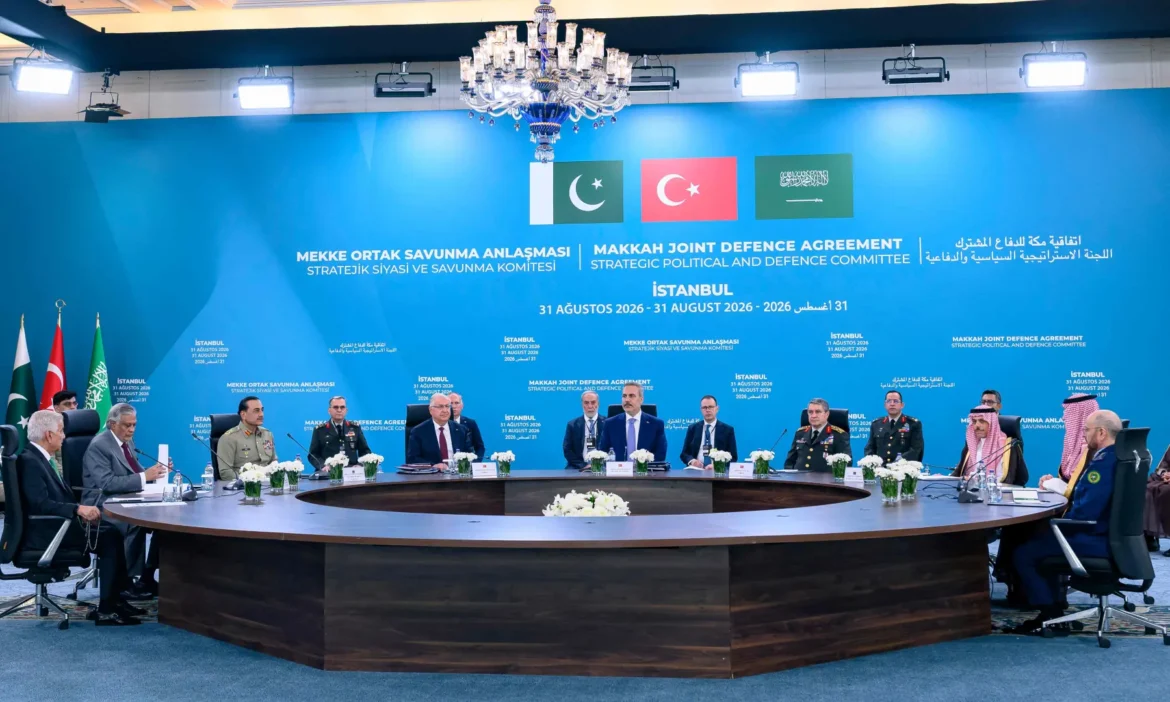
The announcement came from Turkish Foreign Minister Hakan Fidan, who briefed reporters in Istanbul following the first meeting of the alliance’s Strategic Political and Defence Committee, a body created under the trilateral security agreement that Turkey, Pakistan and Saudi Arabia signed in the Saudi holy city of Makkah on August 7.
The session, held at Istanbul’s Ciragan Palace on the Bosphorus, drew the foreign ministers, defence ministers and top military commanders of all three countries — a lineup that underscored how quickly the three governments are moving to turn a written commitment into a functioning organisation.
Pakistan sent Deputy Prime Minister and Foreign Minister Ishaq Dar, Defence Minister Khawaja Asif, and Field Marshal Asim Munir, the country’s chief of defence forces and army chief. Turkey was represented by Fidan alongside National Defence Minister Yasar Guler and Chief of General Staff Gen. Selcuk Bayraktaroglu. Saudi Arabia’s delegation included Foreign Minister Prince Faisal bin Farhan, Defence Minister Prince Khalid bin Salman, and Chief of General Staff Gen. Fayyadh bin Hamed Al-Ruwaili.
“As of today, we have started the process of establishing the institutional structure of the alliance,” Fidan told reporters, confirming that the pact would carry the formal name Makkah Defence Alliance going forward. “There is a secretariat that has been established in Riyadh, and the first secretary general will be appointed amongst our Pakistani brothers.”
The choice of a Pakistani secretary general, paired with a headquarters in the Saudi capital, appeared designed to balance the interests of the three founding members — a diplomatic architecture not unlike those seen in other multinational security arrangements, where leadership posts and institutional seats are distributed to reflect each partner’s stake in the enterprise.
A pact born of shared risk
The underlying agreement, signed by Turkish President Recep Tayyip Erdogan, Saudi Crown Prince Mohammed bin Salman and Pakistani Prime Minister Shehbaz Sharif three weeks ago, commits each signatory to treat an attack on any one member as an attack on all three — a mutual-defence clause that echoes the logic underpinning NATO’s Article 5, though officials were careful on Monday to note the new alliance is not meant to supplant existing commitments.
Fidan told reporters the Makkah agreement “did not eliminate our countries’ responsibilities to other agreements or alliances,” a pointed reassurance given that Turkey remains a NATO member and Saudi Arabia and Pakistan maintain their own separate security relationships with Washington and other partners.
The pact’s formation comes against a backdrop of significant regional turbulence, including the recent conflict between the United States and Iran, which has left governments across the Middle East and South Asia reassessing their security calculations. Fidan alluded to that unease on Monday, saying the absence of durable “alliances and trust” among regional states had itself become a source of instability.
“For the future of a secure, stable and prosperous region, this alliance is based on international principles such as respecting the sovereignty of other states, territorial integrity and not intervening in internal affairs,” Fidan said, adding pointedly that the bloc “was not against any country.”
He said the three governments intend the alliance to grow. “If an ally wants to join, the alliance should be functional in a proper manner by then,” Fidan said, indicating that membership remains open to additional countries willing to meet what he described as certain unspecified “conditions, rules and standards.” Bangladesh has already signaled interest in joining the pact, according to officials cited in earlier reporting.
Three powers, three roles
Diplomats and analysts have noted that the alliance draws together three countries whose strategic weight complements rather than duplicates one another. Pakistan is the only Muslim-majority nation to possess nuclear weapons. Turkey brings NATO membership and one of the region’s largest standing militaries. Saudi Arabia contributes deep financial resources and outsized influence across the Gulf.
According to Turkey’s state-run Anadolu Agency, Monday’s committee meeting was intended to chart strategic direction for the alliance going forward, with delegates discussing international security threats, efforts to build out each country’s defence capabilities, and ways to improve interoperability among their three militaries. The three sides also discussed deepening cooperation on defence manufacturing — including possible joint production and joint research and development programs — as well as expanding counterterrorism collaboration.
Officials said the meeting further sketched out a framework for the Riyadh-based secretariat and other coordinating bodies that will oversee the alliance’s work going forward, along with a roadmap for subsequent steps.
A charged exchange over Israel
The Istanbul gathering was not without a sharper political edge. Asked by a reporter about recent statements from the government of Israeli Prime Minister Benjamin Netanyahu characterising Turkey as a strategic threat, Fidan responded with unusually blunt language.
“Netanyahu, who has become a common enemy of humanity, the international community and security, is not a person to be taken seriously,” Fidan said. “The international system must fight against the Netanyahu threat.”
The remark reflected the deep strain in Turkish-Israeli relations amid the wider regional fallout from the war in Gaza and the more recent US-Iran conflict, and it offered a reminder that the new alliance is taking shape in a neighbourhood where old rivalries remain very much unresolved.
A full day of diplomacy
Monday’s committee session capped a busy stretch of bilateral diplomacy in Istanbul. Field Marshal Munir met separately with Turkey’s Guler ahead of the main meeting, a session the Turkish Ministry of National Defence documented in a video posted to social media. Guler also held a one-on-one meeting with Pakistan’s Asif, with Turkey’s Bayraktaroglu also in attendance; Radio Pakistan reported the two sides agreed to deepen joint defence cooperation. Turkey’s Fidan, separately, met with his Saudi counterpart on the sidelines of the broader gathering.
Dar and Munir had arrived in Turkey a day earlier, and Fidan met with Dar on Sunday, ahead of Monday’s full committee session.
In a statement issued on Sunday, Pakistan’s Foreign Office framed the country’s participation in the alliance as an extension of “historic bonds of friendship with the brotherly countries of Turkiye and Saudi Arabia,” and as evidence of Islamabad’s “desire for lasting regional peace and stability.” Dar, writing on the social platform X, called the gathering a “great inaugural meeting.”
After the Istanbul meetings concluded, Dar departed for Bishkek, Kyrgyzstan, traveling alongside Turkey’s foreign and defence ministers. There, he is expected to join Prime Minister Sharif and the rest of the Pakistani delegation for the Shanghai Cooperation Organisation’s Council of Heads of State meeting and the associated SCO Plus summit — the next stop on a diplomatic itinerary that shows little sign of slowing down.
Copyright © 2021 Independent Pakistan | All rights reserved