By Staff Reporter
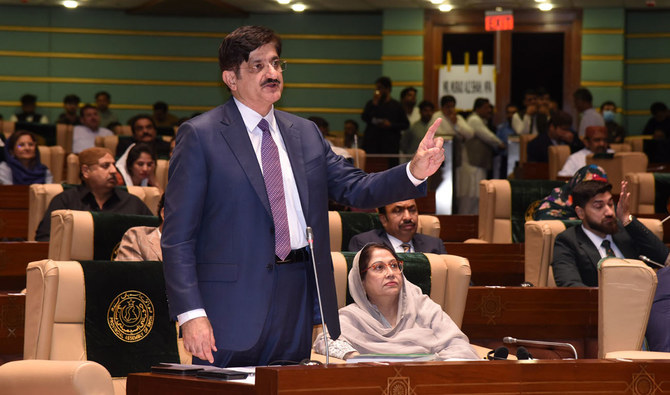
KARACHI: Sindh’s chief minister told the provincial assembly Monday that his province would never be split apart, dismissing calls for new administrative units as the work of outsiders rather than the people who would actually be affected.
“If you have the courage, bring a resolution for the division of Sindh and show us,” Chief Minister Murad Ali Shah said, addressing lawmakers directly. “As long as even one member among us is alive, the province will not be divided.”
The remark was aimed squarely at critics pressing for the creation of new provinces carved from Sindh’s territory — a proposal that has gained traction in recent weeks and pitted the ruling Pakistan Peoples Party against the Muttahida Qaumi Movement-Pakistan, the party that represents much of Karachi’s urban electorate.
Shah made clear he considered the matter settled by geography as much as by politics. Any decision on redrawing Sindh’s borders, he said, belonged to the people who live within them — not to critics broadcasting their opinions from studios or podiums elsewhere.
“No one will decide on division on TV or at a rally,” the chief minister said, adding that the debate belonged inside the assembly chamber, where lawmakers elected by Sindh’s residents could weigh in directly. He noted that division would be “made by members of the Sindh Assembly, not businessmen from Lahore” — a pointed reference to critics he suggested had no standing in the matter.
Shah also invoked Bilawal Bhutto Zardari, chairman of the Pakistan Peoples Party, who has said the party would act according to the wishes of the public. If that debate needs to happen, Shah said, it should happen properly — and if necessary, the assembly would simply reaffirm its position by passing another resolution against division, as it has done repeatedly over the decades.
He said the chamber had already rejected the idea once this year, after some members spoke in favor of splitting the province during an earlier session. His response was unequivocal: “Sindh will always remain one.”
That sentiment, Shah told lawmakers, is not new. He pointed to a string of resolutions passed by the Sindh Assembly opposing division of the province — in 1948, 2000, 2014, 2019, and again this year — arguing that the chamber’s position has been consistent across generations of Pakistani politics.
A broader fight over Pakistan’s provincial map
The chief minister’s remarks capped weeks of escalating rhetoric that began at the end of July, when federal Interior Minister Mohsin Naqvi called for the creation of additional provinces or administrative units nationwide, arguing that Pakistan’s governance structure needed an overhaul to deliver justice and opportunity, particularly for younger residents.
Shah rejected that framing almost immediately, pushing back on Naqvi’s suggestion that the existing system had broken down. He warned against any effort to force the issue through unrest.
“The people of Sindh say that the provinces will be built on our dead bodies. My brother, we will not let anyone’s dead bodies fall. Don’t dramatise it so much,” Shah said at the time, adding that the constitution already lays out a clear path: a two-thirds majority vote in a provincial assembly.
MQM-P, for its part, responded by proposing a broader national conversation among political parties on new provinces and administrative units, citing population growth, weak governance and an overconcentration of political power as reasons the country needs further devolution.
Mustafa Kamal, the party’s leader and federal health minister, framed the push as a matter of self-determination rather than an attack on the province’s Sindhi population. “Creating administrative units is not against Sindhis; it is for Sindhis,” he said, arguing that the government had failed to acknowledge younger generations of migrant families who settled in Pakistan decades ago. He also invoked the legacy of Pakistan Peoples Party founder Zulfikar Ali Bhutto, who introduced Article 239 governing constitutional amendments, saying that history undercut arguments against creating new units.
Farooq Sattar, another senior MQM-P figure, went further, warning that resistance to new administrative boundaries carried its own risks. “If the status quo is not ended, rebellions will emerge in different parts of the country,” Sattar said.
Provincial officials push back
The response from Sindh’s governing party was swift and pointed. Information Minister Nasir Hussain Shah dismissed MQM-P’s position as a symptom of the party’s own political troubles rather than a genuine policy proposal. “Sindh will not be divided, but I certainly see the Muttahida being divided,” he said, taking aim directly at the party’s internal cohesion.
Labour and Human Resources Minister Saeed Ghani echoed that opposition, saying Sindh’s political parties and residents were united against creating a new province within its borders. He argued that the constitutional authority to decide such matters rests with the people directly affected, and accused Kamal, Sattar and fellow MQM-P leader Khalid Maqbool Siddiqui of attempting to revive what he called a politics built on hatred.
That accusation was repeated Monday by Sharjeel Inam Memon, Sindh’s senior minister, in a statement issued through the provincial information department. Memon accused Kamal of trying to inherit the mantle of the party’s exiled founder, who has directed MQM’s politics from London for years.
“Mustafa Kamal also wants to fan hatred and become the successor to the London-based leader,” Memon said. “The MQM’s politics of hatred and division have now been rejected by the people.”
Memon rejected any suggestion that the ruling party had tried to divide Karachi along ethnic or regional lines, arguing that the opposite was true. He said Pakistan Peoples Party had spent years trying to bridge divisions between urban and rural Sindh, and credited the party’s most recent electoral mandate as evidence that voters had already rendered judgment on the years of criticism directed at its rule in the province.
“Karachi is the heart of Sindh and will remain so. No one can divide the people for their temporary interests,” Memon said, describing the city as “the jugular vein of Pakistan’s economy.” He argued that critics now pushing for new administrative units were the same voices who had once presided over the city’s darkest period of violence, and suggested their current position served the interests of the federal government rather than Karachi’s residents.
He was more pointed still when addressing Kamal directly, asking him to account for what Memon described as a history of ethnic division, extortion, targeted killings, and bodies found stuffed in sacks — a grim allusion to Karachi’s years of political violence in past decades. Sindh, he said, has for centuries been home to speakers of different languages living side by side, and any attempt to force division along ethnic lines would meet fierce resistance.
Memon added that residents had grown wise to what he called MQM-P’s “false narrative and political theatrics,” and rejected accusations that the ruling party had used Sindh’s quota system to disadvantage any group. Development, he said, had reached all corners of the province without discrimination.
“It is ridiculous to hold a party that seeks to unite the federation responsible for dividing Karachi,” Memon said.
Copyright © 2021 Independent Pakistan | All rights reserved