By Staff Reporter
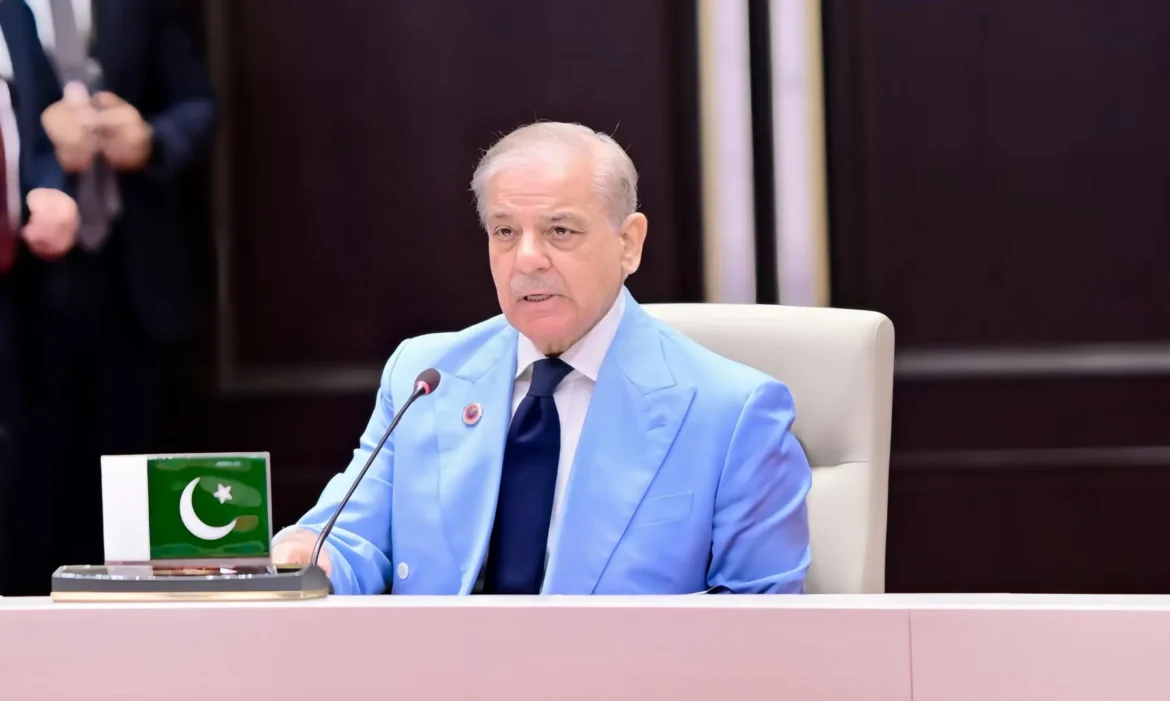
ISLAMABAD: Prime Minister Shehbaz Sharif told leaders of a major Asian security bloc on Tuesday that water “must never be weaponised,” using a summit stage to press neighbouring India on a decades-old river-sharing treaty just a day after an international tribunal ruled that India could not unilaterally suspend it.
Sharif did not name India in his remarks to the Shanghai Cooperation Organisation’s Council of Heads of State, but the target of his message was unmistakable. “Water is the lifeblood of our region,” he said. “It sustains millions of lives, nourishes our land and secures the very future of our coming generations.” The treaties governing shared rivers, he added, “are solemn, binding international commitments” and “not matters of political convenience to be cast aside at your will.”
The speech came one day after the Permanent Court of Arbitration in The Hague ruled that the 1960 Indus Waters Treaty remains fully in force, rejecting India’s position that it had the right to place the agreement “in abeyance.” India suspended the treaty last year after 26 people were killed in an attack in Indian-occupied Kashmir, an attack it blamed on Pakistan; Pakistan denied involvement, and the accusation helped trigger a brief military conflict between the two nuclear-armed neighbours in May 2025. The tribunal also ordered limited restrictions on India’s construction of a hydroelectric plant on a tributary of the Indus. India’s Ministry of External Affairs rejected the ruling outright on Monday, saying the court had no jurisdiction to issue it — a rebuff that suggests the dispute is far from resolved despite the legal victory Pakistan is now citing.
Sharif’s address marked the formal opening of a one-year term in which Pakistan will chair the nine-member organisation, whose founding members include China, Russia and four Central Asian republics, and which added India as a full member several years ago. The chairmanship rotates annually among the bloc’s states; Pakistan takes over from Kyrgyzstan and will host the group’s next full summit in Islamabad in 2027. As chair, Pakistan is proposing a governance framework for artificial intelligence within the bloc, along with new initiatives in energy, disaster response and poverty reduction — an agenda Sharif said would be guided by the theme “turning vision into action.”
The prime minister used much of his address to draw a throughline between water security and a wider case for regional stability, arguing that a bloc encompassing more than 3 billion people cannot reach its potential without durable peace. He pointed to Pakistan’s toll from decades of fighting terrorist groups — more than 90,000 lives lost and $150 billion in economic damage, he said — and renewed a warning aimed at Afghanistan’s Taliban-led government, saying peace would remain elusive “so long as terrorists continue to use Afghan territory to shed the blood of innocent Pakistanis and other nations.” He also reaffirmed Pakistan’s backing for a China-Pakistan trade corridor linking the region to the Arabian Sea, and called for building out the bloc’s development bank and rail and energy networks.
Sharif’s remarks on regional conflict carried particular weight given Pakistan’s role over the past six months as a broker in the war between the United States and Iran, a conflict that began with American and Israeli strikes on Iran in late February and has killed thousands of people. Pakistan helped negotiate a ceasefire in April and later a more detailed framework, the Islamabad Memorandum of Understanding, signed in June. Sharif called that document, still, “the most viable and enduring pathway to lasting peace in the region” — though the agreement’s record since has been rockier than that description suggests. Iran’s foreign ministry said last month that the United States had violated the memorandum within weeks of its signing, and Washington has maintained a naval blockade around the Strait of Hormuz that has continued to disrupt shipping and global energy markets.
That backdrop shaped a separate meeting on the summit’s sidelines on Tuesday between Pakistan’s foreign minister, Ishaq Dar, and his Iranian counterpart, Abbas Araghchi. According to Pakistan’s Foreign Office, Dar told Araghchi that “sincere implementation” of the June memorandum by both the United States and Iran “remains the only way forward” — language that reads less as a status update than as an appeal to revive an arrangement that has largely stalled. Dar also met Tuesday with China’s foreign minister, Wang Yi, where the two countries reaffirmed what Pakistani officials describe as an “all-weather” partnership, and separately with Belarus’s foreign minister. A day earlier, Sharif himself had met Iran’s president, Masoud Pezeshkian, on the summit’s margins.
Sharif also used part of his address to defend a trilateral defence pact Pakistan signed last month with Saudi Arabia and Turkey, formally called the Makkah Joint Defence Agreement, which commits the three countries to treat an attack on any one of them as an attack on all. He described the pact as “fundamentally defensive in nature” and said it was not aimed at any state or intended to provoke confrontation — a characterisation some regional analysts have greeted skeptically, given the pact’s origins amid the still-unresolved war next door in Iran. And in a portion of his remarks addressing the Middle East more broadly, Sharif called the suffering in Gaza and the West Bank a matter the international community can no longer ignore, saying Palestinian families “remain torn apart” and entire generations are living “under a perpetual shadow of fear, deprivation and gross injustice.”
Sharif arrived in Bishkek on Monday for a three-day visit, accompanied by Dar and three other Cabinet ministers. He is scheduled to hold formal bilateral talks Wednesday with Kyrgyzstan’s president, Sadyr Japarov, covering trade, energy and regional connectivity, before the visit concludes.
Copyright © 2021 Independent Pakistan | All rights reserved