By Staff Reporter
ISLAMABAD: A punishing overnight deluge sent floodwaters surging through Pakistan’s twin cities on Tuesday, submerging roads, breaching sealed basements and pushing a critical drainage channel to its highest level in three years, prompting authorities to shutter schools and mobilise the army alongside emergency crews.
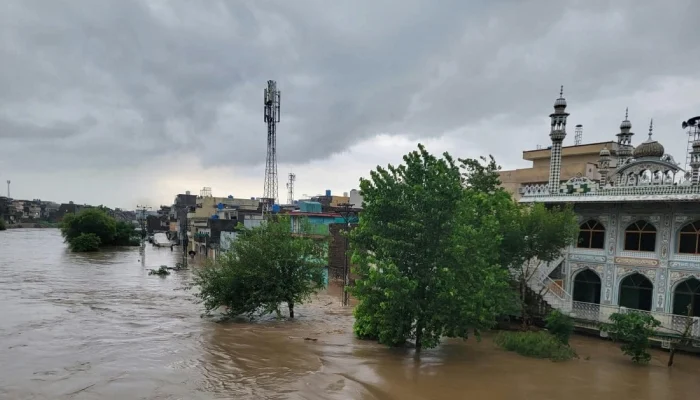
The storm, which began shortly after 3 a.m. and continued for nearly five hours, dumped as much as 201 millimeters of rain on parts of Rawalpindi — a total local officials described as the heaviest the garrison city has seen in three years. By mid-morning, Nullah Lai, the seasonal drainage channel that bisects Rawalpindi and has a history of catastrophic flooding, had swollen to 29 feet at the Kattarian crossing, according to the Pakistan Meteorological Department.
The rise triggered evacuations along the channel’s banks, where Rescue 1122 crews said they had pulled at least 60 residents from flood-threatened homes by midday, with additional operations continuing in neighbourhoods where families remained trapped.
“The biggest impact of the rain is on Nullah Lai,” said Rawalpindi Deputy Commissioner Capt. (retd.) Nadeem Nasir, who travelled to the channel as water levels climbed. He said drains feeding into Nullah Lai had begun backing up, pushing water into surrounding residential areas, and that the surge at Kattarian was near its peak, with pressure building downstream at Gawalmandi.
“We are hoping the situation will start returning to normal within an hour,” Nasir said, though he cautioned that water would not recede from low-lying neighbourhoods until levels in the drain itself began to fall.
The deputy commissioner said only two emergency calls had reached his office by midday, and characterised some flooding in low-lying areas as a routine consequence of heavy rainfall. Even so, he ordered evacuation teams into vulnerable neighbourhoods and said the Pakistan Army, Pakistan Rangers and Rescue 1122 had all been positioned to assist. The Army’s 111 Brigade, he added, remained in contact with district officials and stood ready to intervene if conditions worsened.
Government and private schools across Rawalpindi were ordered closed for the day, a decision Nasir said was driven partly by concern for children who might otherwise have had to navigate flooded roads to reach classrooms.
Flooding spreads across low-lying neighbourhoods
The Water and Sanitation Agency, known as WASA, declared a rain emergency in Nullah Lai’s catchment area and dispatched crews and heavy machinery to some of the city’s most flood-prone districts, including Liaquat Bagh, the Committee Chowk underpass, Murree Road, Dhok Khaba, Circular Road and Sadiqabad. The agency’s managing director said sirens were sounded along the channel as water flow intensified, and that WASA teams would keep monitoring both Nullah Lai and drains throughout the city.
Beyond the channel itself, floodwaters inundated a string of low-lying neighbourhoods, among them Safdarabad, Sadiqabad, Dhok Khaba, Pirwadhai, Fauji Colony, Javed Colony and Arya Mohalla. Officials warned that Rawalpindi faced the added risk of a major flood surge moving through Nullah Lai from upstream, compounded by the possibility of additional water flowing in from Islamabad.
Rainfall totals varied sharply across the city. The Meteorological Department recorded 201 millimeters at Shamsabad, the highest total in Rawalpindi, followed by 186 millimeters at New Kattarian and 157 millimeters at Golra. Other stations reported 155 millimeters near H-8/2, 104 millimeters at Saidpur, 86 millimeters at Pirwadhai, 74 millimeters at Kutchery and 72 millimeters at both Chaklala and I-12.
Islamabad grapples with overflowing drains, basement flooding
Fifteen miles away in Islamabad, the storm exposed vulnerabilities in the capital’s drainage infrastructure. The city’s E-11 sector recorded 150 millimeters of rain, according to the district administration, enough to overwhelm a local drain and send water spilling onto roads and into basements — including some that had previously been sealed after earlier flooding.
“The drain in E-11 has filled up due to the rain, with water entering the road and some basements as well,” the district administration said in a statement, adding that the deputy commissioner had gone to the site personally to oversee drainage operations. Additional dewatering pumps and sanitation crews were deployed, and officials said traffic was still being maintained on the sector’s major roads.
Islamabad Deputy Commissioner Irfan Nawaz Memon said separately that runoff in the Ghauri Town Phase 2 neighbourhood — which he described as an unauthorised housing development — had worsened after residents blocked a drainage channel with concrete slabs, contributing to flooding in the area. He directed that strict action be taken against those responsible and ordered drainage efforts intensified through additional dewatering pumps.
The surge in rainfall also pushed water levels in Rawal Dam beyond their designated threshold, Memon said, prompting officials to open the dam’s spillways at 2 p.m. He urged residents to stay away from nullahs across the city as the additional discharge moved downstream.
A protective wall collapsed in Islamabad’s D-12/2 sector amid the flooding, triggering a rescue response, though city officials said no injuries or deaths resulted from the incident.
The Islamabad Traffic Police urged motorists to build extra time into their commutes, reduce speed, maintain distance from other vehicles and use fog lights in areas with reduced visibility, warning that standing water on several roads was likely to disrupt normal traffic flow.
Footage circulating on social media captured the scope of the disruption. Journalist Hamid Mir posted video showing sections of the Islamabad Expressway submerged, with several vehicles stranded in floodwater. Former climate change minister Sherry Rehman shared additional video of cars trapped on a flooded street, submerged up to roughly half their height.
“The rain in Rawalpindi-Islamabad from last night has brought the cities to a dangerous tipping point,” Rehman wrote.
Second consecutive day of disruptive rainfall
Tuesday’s storm followed a similar, though less severe, bout of rain that struck the twin cities Monday afternoon, when intermittent downpours over roughly two hours disrupted daily life and flooded low-lying areas. The Meteorological Department had warned as early as last week that the country’s upper regions could see continued heavy rainfall through Sept. 5, cautioning that urban flooding was possible in low-lying parts of Islamabad, Rawalpindi, Mardan, Swabi, Gujranwala, Gujrat, Sialkot and Lahore during that window.
Planning Minister Ahsan Iqbal, addressing the flooding Tuesday, said the rising water levels had created urban flooding risks in low-lying areas of both cities and said all relevant relief and emergency departments — including WASA, Rescue 1122 and district administrations — had been placed on high alert and deployed to manage drainage and protect residents.
Rains compound a lethal monsoon season
Tuesday’s flooding added to what has already become one of Pakistan’s deadlier monsoon seasons in recent memory. According to National Disaster Management Authority data covering June 26 through Aug. 31, 175 people have died and roughly 500 have been injured nationwide in rain-related incidents this season. Khyber Pakhtunkhwa province recorded the highest toll, with 70 deaths, followed by Punjab with 61 and Sindh with 17.
House collapses accounted for nearly half of the season’s fatalities — 48.6 percent, according to NDMA figures — with drowning and flash flooding also cited among the leading causes of death.
Looking ahead, the Meteorological Department said it expects scattered to widespread rainfall to continue across the upper catchments of Pakistan’s major rivers, as well as upper Punjab and upper Khyber Pakhtunkhwa, through Sept. 5. Forecasters said flows in major rivers and their associated drainage channels are expected to rise further as the wet pattern persists.
Copyright © 2021 Independent Pakistan | All rights reserved