By Staff Reporter
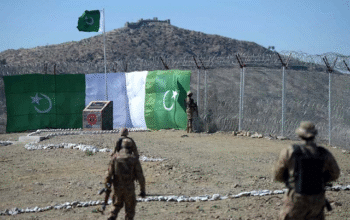
QUETTA: Five security personnel, including two officers, and one customs official were martyred overnight on Monday when militants stormed a customs facility in the country’s restive southwestern Balochistan province, part of a wave of violence that left 21 terrorists killed across two districts, the military said on Tuesday.
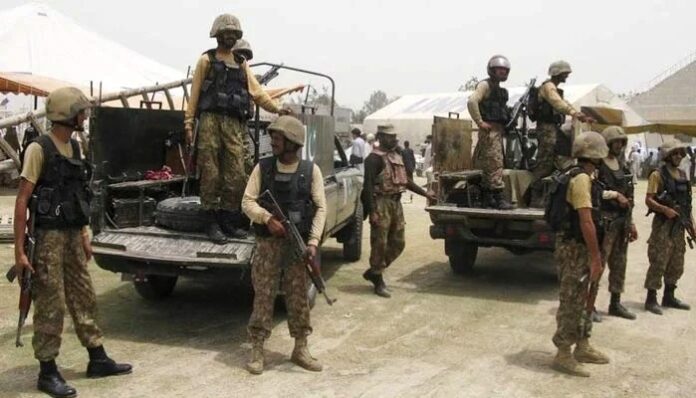
The assault on the Customs House in Ziarat Cross, in Pishin District, unfolded as a “coordinated attack” aimed at breaching the facility, according to a statement from the Inter-Services Public Relations, the media wing of Pakistan’s armed forces. Security forces beat back the assault after an intense exchange of gunfire, killing 10 attackers at the scene and pursuing others as they fled.
It was during that firefight that the six security personnel died, the military said — among them two officers and an employee of Pakistan’s Customs Department, all cut down in the line of duty.
The military blamed the assault on Fitna al-Khawarij, the government’s designation for the outlawed Tehreek-i-Taliban Pakistan, and characterized the attack as an attempt to intimidate customs officials and clear the way for criminal enterprise to continue unchecked in the area. Sweep operations were still underway on Tuesday in the surrounding countryside, the military said, aimed at rooting out any remaining fighters and securing both the local population and the national highways that run through the region.
A second, separate clash unfolded the same night some distance away, in Nokcha, in Chagai District, where militants had set up an illegal checkpoint along the N-40 Quetta-Taftan Highway, a vital commercial corridor, in an extortion scheme targeting travelers. Security forces moved in and, after their own fierce exchange of gunfire, killed 11 terrorists on the spot. Troops recovered a substantial cache of weapons, ammunition and explosives from the dead.
The military attributed that assault to a group it calls Fitna al-Hindustan — a label Pakistani officials apply to Balochistan-based militant networks they accuse of operating with Indian sponsorship, part of a broader government narrative asserting that New Delhi is fueling instability inside Pakistan’s borders.
Tuesday’s toll capped a bloody stretch even by the standards of a province that has grown accustomed to bloodshed. A day earlier, on Monday, security forces killed 12 militants after an attack on a vehicle convoy tied to the Reko Diq copper and gold mine, a massive foreign-backed mining project in Chagai that has become an increasingly frequent target for militants. That same day, in nearby Washuk district, two more suspected militants were killed in an intelligence-driven operation.
Military officials framed the overnight operations as part of a broader campaign known as Azm-i-Istehkam, or “Resolve for Stability,” a counterterrorism initiative endorsed by the Federal Apex Committee under Pakistan’s National Action Plan. In its statement, the ISPR vowed the campaign would continue “with full resolve” and said security and law enforcement agencies remained committed to eliminating foreign-sponsored terrorism from the country.
A province — and a neighboring one — under siege
The violence in Balochistan arrived alongside a similarly grim milestone hundreds of miles away, in Khyber Pakhtunkhwa province, where police said they had killed two more suspected militants in an intelligence-based raid in Lakki Marwat district.
Qudratullah Khan, a spokesman for the district police chief, said officers and personnel from the Counter-Terrorism Department moved on a mountainous hideout within the jurisdiction of the Lakki City police station after receiving what he called credible intelligence that Tehreek-i-Taliban fighters were sheltering there. A firefight broke out as the operation closed in, Khan said, and two militants were killed. One was identified as Mubashir, son of Aslam Khan, a man wanted in four separate cases in Bannu tied to murder, attempted murder, terrorism and bombings. The identity of the second man killed remained unconfirmed as of Tuesday.
The raid, conducted at night and led by the district’s deputy superintendent of police, also drew participation from the local peace committee of Village Council Bego Khel — a sign of how deeply embedded community militias have become in the province’s counterinsurgency effort.
Zulfiqar Hameed, the inspector general of police for Khyber Pakhtunkhwa, praised the operation as “successful and result-oriented” and said his officers remained determined to root out militancy in the province “with an iron hand.”
The Lakki Marwat raid followed a string of significant attacks across Khyber Pakhtunkhwa this summer, including a July 15 assault in Bannu in which militants rammed an explosives-laden vehicle into the Miryan police station and then fought security forces in a prolonged gun battle that injured six police officers and four civilians. Attackers also destroyed a nearby bridge in what police said was a deliberate effort to slow reinforcements from reaching the scene.
On August 10, a joint raid involving district police, the Elite Force, the Counter-Terrorism Department and the Pakistan Army killed one suspected militant and led to the arrest of eight others in Bannu’s Miryan area; police said the man killed had been attempting to plant a bomb when he died. Weeks earlier, on July 13, two police officers were killed and two more wounded when a remote-detonated bomb struck an armored police vehicle on routine patrol along the Wana-Jandola Road in Tank district. And on July 3, saboteurs struck twice in Bannu district in a single day — planting explosives that damaged a government girls’ school in Mama Khel, cracking walls and shattering windows, and rigging a drum of explosives beneath a bridge in the Jani Khel area, a device that was ultimately defused by a bomb squad before it could detonate.
The numbers behind the bloodshed
Statistics compiled by independent research groups paint a picture of two provinces bearing an outsized share of Pakistan’s internal violence. According to the Centre for Research and Security Studies, Khyber Pakhtunkhwa and Balochistan together accounted for nearly 96 percent of all violence-related deaths recorded nationwide during the second quarter of 2026. Khyber Pakhtunkhwa alone recorded more than 61 percent of those fatalities — 475 deaths — while Balochistan accounted for another 34 percent, or 265 deaths. Khyber Pakhtunkhwa also recorded the most violent incidents of any province, 151 in all, or 57 percent of the national total; Balochistan followed with 94 incidents, representing 35 percent.
A separate monthly tracking effort by the Pakistan Institute for Conflict and Security Studies found the toll worsening month over month in Khyber Pakhtunkhwa. Excluding the province’s merged tribal districts, deaths climbed to 154 in July from 75 in June — an increase of 105 percent — while the number of people injured rose from 60 to 98. Security personnel deaths more than tripled, from 12 to 38, and militant deaths surged 192 percent, from 37 to 108. Civilian deaths, by contrast, fell sharply, dropping 73 percent from 26 in June to seven in July, though the toll also included one member of a local peace committee.
In the province’s merged districts — the tribal areas formerly known as Fata — the overall death toll dipped slightly, to 79 in July from 85 in June, even as the complexion of the violence shifted. Security personnel deaths there nearly doubled, rising from six to 11, while militant deaths fell 24 percent, from 72 to 55. Civilian deaths climbed 86 percent, from seven to 13.
The surge in violence across both provinces traces back roughly five years, to 2021, when the Taliban seized power in neighboring Afghanistan. Pakistani officials have since repeatedly accused militant groups of exploiting sanctuary across the border to plan and launch attacks inside Pakistan — an assertion Islamabad has pressed on international forums, including at the United Nations Security Council, which has itself acknowledged the presence of such networks operating from Afghan soil.
Copyright © 2021 Independent Pakistan | All rights reserved