By Staff Reporter
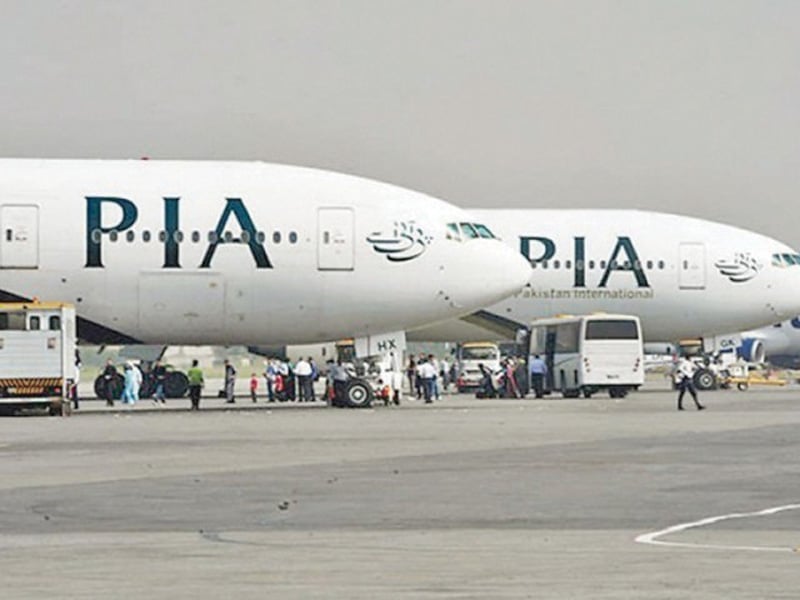
ISLAMABAD: Pakistan International Airlines Corp. will operate daily flights to London starting next month, the clearest sign yet that the state carrier’s new private owners are moving to reclaim ground lost during a five-year exile from European and British airspace.
The airline will lift weekly frequencies on the route to seven from four beginning Oct. 27, according to a statement Wednesday, adding three services that will be split across two Pakistani cities. Islamabad will account for five of the weekly flights, with the remaining two departing from Lahore, giving PIA at least one departure to the British capital every day of the week.
The expansion marks a 75% jump in capacity on what has historically been one of PIA’s most lucrative long-haul routes, underpinned by a Pakistani diaspora in Britain estimated at more than 1.6 million people. It also lands at a pivotal moment for the carrier, which completed a landmark privatization in June and is under pressure from its new owners — and from the International Monetary Fund, which pushed for the sale — to show it can turn decades of losses into a functioning business.
A PIA spokesperson said the additional capacity reflects strengthening passenger confidence and rising demand for direct connectivity between Pakistan and the UK. The airline didn’t specify which aircraft types would be deployed on the added frequencies.
The extra flights stem in part from a scheduling swap with Turkish Airlines, which returned 14 weekly landing and takeoff slots at London Heathrow for the winter 2026 season that began Oct. 25, freeing up room for PIA to expand across multiple Pakistani gateways including Karachi and Sialkot in addition to Islamabad and Lahore. Slot access at Heathrow, one of the world’s most congested airports, has long been a constraint on carriers seeking to add UK capacity, and the swap underscores how PIA’s return to compliance with European and British safety regimes is now translating into actual scheduling gains rather than just regulatory sign-off.
Grounded by Crash, Revived by Regulators
PIA’s push into London is the latest chapter in a recovery from one of the deepest crises in the airline’s history. Pakistani carriers were barred from flying to the European Union, the UK and the US in June 2020, months after a PIA Airbus A320 crashed while attempting to land in Karachi, killing nearly 100 people on board. The disaster was compounded by a parliamentary disclosure from then-Aviation Minister Ghulam Sarwar Khan, who told lawmakers that roughly a third of Pakistani pilots held licenses he characterized as suspect, prompting the European Union Aviation Safety Agency to suspend PIA’s authorization to operate in the bloc over safety concerns.
The fallout proved long-lasting. EASA didn’t lift its ban until November 2024, more than four years after it was imposed. The UK followed suit in July 2025, removing Pakistan from its Air Safety List and clearing the way for Pakistani carriers to apply for British routes. PIA secured approval to resume UK flights two months later, choosing Manchester as its first destination after a near five-year absence, before restoring direct London service in March.
That gradual reopening has since accelerated. PIA’s return to Heathrow earlier this year — using reclaimed summer slots after years away from the airport — has now been followed by the winter capacity increase, positioning London as the centerpiece of the carrier’s efforts to rebuild an international network that shrank dramatically during the ban years.
New Owners, New Pressure
The route expansion comes just over two months after PIA passed fully into private hands. A consortium led by Arif Habib Corp. took 100% ownership of the airline in June through PIA Equity Ltd., a special-purpose vehicle formed to complete the acquisition, after first winning a 75% stake in a televised public auction in December for 135 billion rupees. The consortium — which also includes Fatima Fertilizer Co., Fauji Fertilizer Co., Lake City Holdings, The City School and AKD Group Holdings — later exercised an option for the government’s remaining 25% stake, taking the total transaction value to roughly 180 billion rupees.
Of that sum, 125 billion rupees is earmarked as fresh equity injected directly into the airline to fund fleet modernization, route expansion and service improvements, with the balance paid to the government as divestment proceeds. The new owners have signaled plans to more than double PIA’s fleet from around 18 aircraft toward 38 or more, part of a broader turnaround strategy aimed at restoring profitability at a carrier that has weighed on public finances for years.
The privatization was closely watched by the IMF, which has pressed Islamabad to curb losses at state-owned enterprises as a condition of its lending program, and which officials have described as a test case for Pakistan’s broader reform credibility. Arif Habib, the consortium’s chairman, has also flagged risks to the turnaround, warning that elevated jet fuel costs — which typically account for 30% to 40% of airline operating expenses and carry additional distortions in Pakistan’s tax and pricing regime — could complicate efforts to expand capacity profitably.
Copyright © 2021 Independent Pakistan | All rights reserved