By Staff Reporter
ISLAMABAD: The Foreign Office on Wednesday welcomed a ruling from the Permanent Court of Arbitration in The Hague that ordered India to uphold the Indus Waters Treaty and halt construction on a contested hydroelectric project in occupied Kashmir, calling the decision a vindication of Islamabad’s yearlong position in one of South Asia’s most volatile disputes.
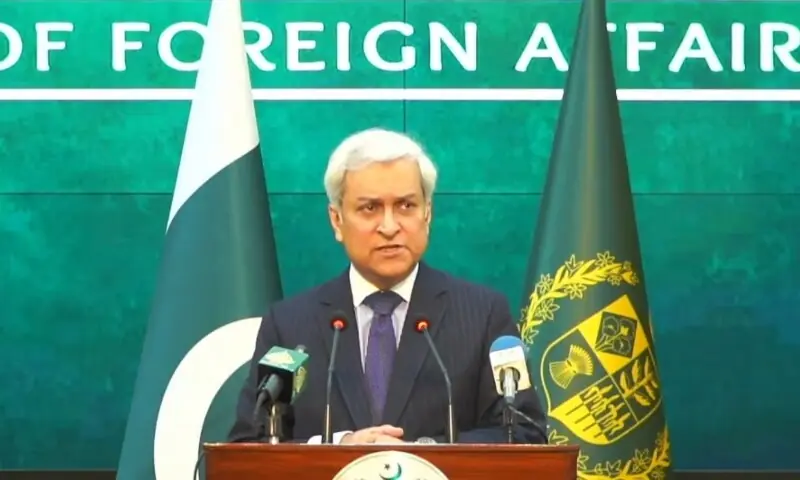
Foreign Office spokesperson Tahir Andrabi told reporters at the ministry’s weekly briefing that the court’s unanimous ruling, issued on Monday, rejected India’s attempt to place the six-decade-old water-sharing agreement in what New Delhi has called “abeyance.” The court found the treaty remains fully binding on both nations.
“The unanimous award of the Court of Arbitration constitutes an important reaffirmation of the sanctity of the IWT and the rule of international law,” Andrabi said.
The ruling represents the latest flashpoint in a dispute that has simmered since April of last year, when India moved unilaterally to suspend the treaty following an attack it blamed on Pakistan-based militants. The decision set off a chain of escalating tensions that culminated in a brief military conflict between the two nuclear-armed neighbours in May 2025.
Pakistan responded to India’s original suspension by declaring that any attempt to cut off its water supply would constitute “an act of war,” arguing the treaty contained no legal mechanism allowing either country to withdraw unilaterally. Islamabad further contended that New Delhi’s move violated the 1969 Vienna Convention on the Law of Treaties, the international framework governing how nations may enter and exit binding agreements.
The arbitration panel sided with Pakistan on the central legal question, ruling that India had no valid basis for suspending or terminating the treaty. According to Andrabi, the court determined that India’s declared abeyance did nothing to relieve it of its treaty obligations, and that the dispute-resolution mechanism built into the original 1960 agreement remains active and enforceable.
The court also issued an interim order concerning the Ratle hydroelectric project, a facility India has been developing on the Chenab River in the disputed Kashmir region. Andrabi said the ruling on Ratle reinforced a broader principle: that neither country can alter its rights or obligations under the treaty through unilateral action.
“Pakistan welcomes this clear and authoritative announcement, which validates our consistent position that differences concerning the Indus Waters Treaty must be strictly addressed within the framework of the treaty and in accordance with international law,” Andrabi said.
The Indus Waters Treaty, brokered by the World Bank in 1960, governs how the two countries share water from the Indus River system, a resource critical to agriculture and drinking water for hundreds of millions of people across the subcontinent. The treaty has long been considered one of the more durable diplomatic arrangements between India and Pakistan, surviving multiple wars since its signing. India’s move to suspend it last year marked the first serious challenge to its legal standing in more than 60 years.
Defense Pact With Saudi Arabia, Turkey Enters New Phase
Andrabi confirmed that a newly signed collective defense agreement between Pakistan, Saudi Arabia and Turkey has entered its implementation phase, telling reporters the pact was intended to deter conflict and stabilize the broader region rather than target any specific adversary.
The Makkah Joint Defense Agreement, signed Aug. 7, binds the three nations to treat an armed attack on any one member as an attack on all three — a mutual-defense clause modeled on similar arrangements elsewhere in the world. The agreement’s Strategic Political and Defense Committee held its first formal meeting in Istanbul on Aug. 31, marking the pact’s transition from signed document to active alliance.
Andrabi emphasized that Pakistan views the agreement as defensive in nature, coming as tensions remain elevated across parts of the Middle East.
“This alliance is essentially a framework for defense,” Andrabi said. “So obviously whilst it serves the interests of the three countries, it also serves the interests of the region and beyond, whereby the agreement is tailored toward maintaining and improving the peace, prosperity, regional stability and basically ending the prospects of war in the region.”
Andrabi said Pakistan intends to honor its commitments under the pact in that spirit, describing it as serving “the collective interest of the region.”
Asked whether Kuwait, Bahrain or other Gulf states might eventually join the alliance, Andrabi said Pakistan was not aware of any specific country actively seeking membership but reiterated that any future request would be evaluated jointly with Saudi Arabia and Turkey, the pact’s other founding members.
“Whenever the country wishes to join this agreement with the commitment for collective obligations and common security interests, the case will be examined in close consultations with our partners in Riyadh and Ankara,” he said.
On the question of who will lead the alliance day to day, Andrabi said Pakistan would select the pact’s secretary-general, though he did not offer a timeline or name potential candidates.
“An individual fitting this important responsibility will be selected by Pakistan,” he said. “We will inform you about it in due course.”
Andrabi closed his opening remarks by introducing Ambassador Sajjad Haider Khan as his successor in the spokesperson’s role. Andrabi is set to become Pakistan’s permanent representative to the United Nations in Geneva, according to the state-run Associated Press of Pakistan.
Copyright © 2021 Independent Pakistan | All rights reserved