By Staff Reporter
ISLAMABAD: A missile strike that Iranian officials say tore through a wedding celebration in a small coastal town, killing four people and wounding dozens more, thrust the six-month-old war between the United States and Iran into a bloodier and more volatile phase this week, as retaliatory fire from Tehran reached military installations in four separate countries.
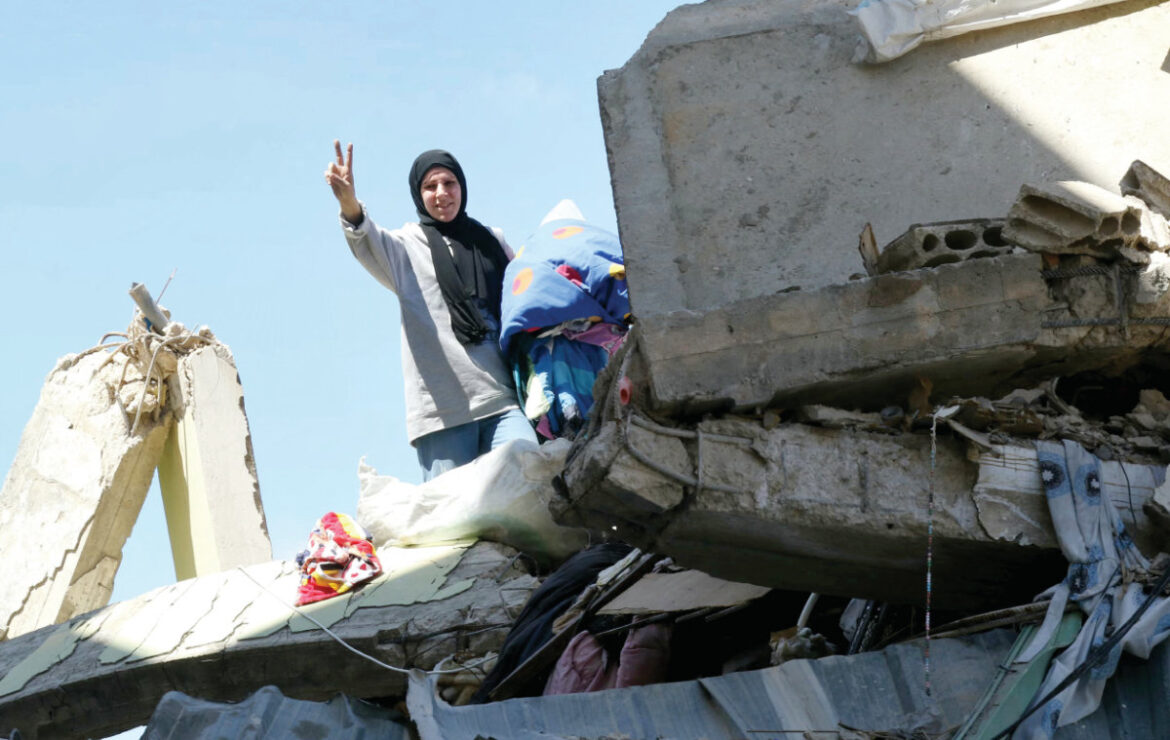
The strike landed late Tuesday in Kuhestak, a fishing town perched above the Strait of Hormuz, where a family had gathered to celebrate a daughter’s wedding. By Wednesday morning, Iranian state media were reporting that shrapnel from the missile had killed two women and two children — ages 4 and 16 — and injured at least 68 others, many of them badly enough to require hospitalization in the nearby town of Minab.
The father of the bride, identified by Iranian broadcasters as Ali Mallahi, appeared in footage aired on state television standing amid the wreckage of his home.
“Unfortunately, this is a residential building. And unfortunately, this happened during my daughter’s wedding ceremony,” he said. “It is a very saddening incident. Thank God the casualties were not higher.”
Iran’s foreign ministry spokesman Esmaeil Baqaei called the strike a war crime, and Mohammad Bagher Ghalibaf, the speaker of Iran’s parliament and one of its senior negotiators, invoked biblical language in condemning Washington, saying the attack was further proof that the United States was acting as “Satan.”
Capt. Tim Hawkins, a spokesman for U.S. Central Command, said the Pentagon was “aware of the reports, which originated from Iranian state media, and we are looking into them.” He declined to say whether CENTCOM had opened a formal investigation, and offered only a brief rebuttal to the war crime allegation: “The US military never targets civilians, unlike the IRGC.”
Independent weapons analysts, reviewing photographs of the wreckage and missile fragments circulated by Iranian media, told both the BBC and the Associated Press that the debris was consistent with a SLAM-ER, a satellite- and infrared-guided American cruise missile designed for precision strikes. Trevor Ball, an analyst with Armament Research Services, described the SLAM-ER as a weapon “developed to be very precise,” one that allows a human operator to retarget it in flight using an infrared camera feed. His colleague, N.R. Jenzen-Jones, noted that the missile is also used by Saudi Arabia and the United Arab Emirates, though neither country has reported conducting recent strikes inside Iran.
Journalists with BBC Verify, cross-referencing security camera footage and social media video, determined that a nearby telecommunications tower destroyed in the same barrage sat roughly 370 feet from the house where the wedding was underway — a level of geographic detail that, if accurate, undercuts the Pentagon’s insistence that the strike was not aimed at civilians.
Retaliation reaches four countries
Iran’s response came within hours. Early Wednesday, the Islamic Revolutionary Guard Corps and Iran’s regular military announced they had launched a barrage of ballistic missiles and drones at American installations across the Gulf — targeting bases in Bahrain, Iraq, Jordan, Kuwait and the United Arab Emirates.
The Jordanian military said it intercepted 10 of 13 incoming ballistic missiles, with the remaining three landing in unpopulated desert. Iran claimed its strikes caused casualties and damage at a Marine barracks on Jordan’s Gulf of Aqaba coast, though Reuters, citing American officials, reported no casualties resulted from the barrage. In Kuwait, firefighters extinguished a blaze at a residential complex struck by a drone; no one was hurt. Kurdish authorities in Irbil, in northern Iraq, said they intercepted 10 explosive-laden drones, and Iranian television separately reported that American installations there had been targeted — a claim Iraqi officials did not confirm, though local media reported a U.S. surveillance balloon had been shot down.
The violence rippled beyond the immediate combatants. Israel’s military said Hezbollah, the Iran-backed militia in Lebanon, fired two explosive drones at Israeli soldiers stationed in the south; no casualties were reported.
Iran, for its part, absorbed losses of its own. The Revolutionary Guard said four members of its aerospace force — the branch that oversees the country’s ballistic missile arsenal — were killed in American strikes on Kermanshah, along with three members of the paramilitary Basij militia on Lavan Island in the Gulf. Iranian state media reported seven additional deaths from separate U.S. strikes near Ahvaz and Aqajari, in the oil-rich province of Khuzestan.
Mohsen Rezaei, the newly appointed head of Iran’s Supreme National Security Council, offered a blunt warning on social media: “You will soon see that Iran’s new strategy on the battlefield, in diplomacy, and in confronting the economic blockade will shatter your foundations.”
The wave of strikes that triggered the retaliation, according to U.S. Central Command, focused on Iranian air defense sites, radar installations and maritime assets — a response, the Pentagon said, to attempted attacks by the Revolutionary Guard on American forces and commercial vessels navigating the Strait of Hormuz. President Trump, in a social media post, described the American strikes as “large and powerful.”
A waterway that will not reopen
At the center of the conflict remains the Strait of Hormuz, the narrow channel separating the Persian Gulf from the Arabian Sea through which roughly a fifth of the world’s traded oil once passed. Iran shut the strait to commercial shipping after the war’s opening salvo on Feb. 28, when the United States and Israel launched a joint strike that killed Iran’s supreme leader and a number of senior officials. Despite repeated statements from Washington that the strait has been reopened, only a trickle of vessels are making the passage, and Iran continues to strike ships it says have transited without permission.
The toll on shipping has been measured in lives as well as barrels. Saudi Arabia’s national shipping company, Bahri, said Wednesday that two Filipino sailors were killed Monday when their tanker, the SIDR, came under attack while crossing the strait. Separately, the Revolutionary Guard said two tankers caught fire after striking mines while being guided, the Guard claimed, along an “illegal route” set by the American military.
The economic consequences have been immediate and global. Brent crude, the international benchmark, has climbed to roughly $95 a barrel since fighting resumed, a jump of more than 30 percent since the war began. Sascha Bruchmann, an analyst at the International Institute for Strategic Studies’ Middle East office in Bahrain, said the standoff had appeared to be tilting modestly toward Washington before this week’s escalation, with oil prices hovering near $80 and Iranian officials increasingly candid about the toll of sanctions.
“The US is trying to reinstall some kind of confidence into the global oil markets,” Bruchmann said, “and the Iranians had to respond to that by reinserting insecurity and doubt.”
That economic pressure has been unmistakable inside Iran. The rial hit a fresh record low Wednesday, trading at 2.2 million to the dollar — a 10 percent decline from just a week earlier. Secretary of State Marco Rubio said Iran would “continue to feel the squeeze” until it abandons any pursuit of nuclear weapons and ends its support for armed groups across the Middle East. Iran has consistently maintained that its nuclear program is peaceful.
Hamidreza Azizi, a senior Iran analyst with the Crisis Group, said the current pattern of alternating strikes and pauses may not be sustainable for either side.
“At some point, one of the sides may see a need to escalate in order to break this cycle,” Azizi said. “So that could bring the two sides to a point that they have been trying to avoid until now, which is a full-scale war.”
A collapsed deal, and no clear path back
The current round of fighting followed a nearly monthlong lull that began after a June memorandum of understanding, brokered with Pakistan’s help, called for a full cessation of hostilities and the reopening of the Strait of Hormuz. That agreement gave both sides two months to negotiate a comprehensive settlement covering Iran’s nuclear program, U.S. sanctions and a lasting truce. It fell apart within weeks.
Fighting resumed in earnest over the weekend, when American forces struck Iranian rocket launchers positioned on an island in the strait, saying Iran intended to use them to lay naval mines. Iran responded by firing missiles at U.S. bases in Jordan, all of which were intercepted, and launched a drone at the United Arab Emirates.
President Trump, writing on social media late Tuesday, signaled little interest in pressing Iran back to the table.
“I couldn’t care less if they sign a worthless, to them, agreement,” Trump wrote. “I like our position now much better, with almost total control of the Hormuz Strait, and their economy totally collapsing. They are just playing out the inevitable. When are the Iranian people going to rise up and fight?”
Pakistan presses its case as mediator
Even as the fighting intensified, Pakistan continued to position itself as the conflict’s most active outside broker. Foreign Office spokesperson Tahir Andrabi told reporters in Islamabad on Wednesday that his government remained “hopeful” despite the latest escalation and would keep working toward a negotiated end to the war.
“Despite recent escalations, we remain hopeful, and we will continue to strive for dialogue and diplomacy,” Andrabi said.
Pakistan’s diplomatic involvement has been extensive. Beyond brokering the ill-fated Islamabad memorandum in June, Pakistan negotiated an earlier ceasefire between Washington and Tehran in April that halted the war’s most intense early fighting, even as sporadic clashes near the strait continued to chip away at hopes for a lasting settlement.
Andrabi said Prime Minister Shehbaz Sharif met with Iranian President Masoud Pezeshkian this week on the sidelines of the Shanghai Cooperation Organization summit, where the two discussed the deteriorating regional situation. Sharif, according to Andrabi, reaffirmed Pakistan’s commitment to de-escalation and reiterated his view that the Islamabad memorandum still represents the clearest route to lasting peace.
Deputy Prime Minister and Foreign Minister Ishaq Dar met separately with his Iranian counterpart, Abbas Araghchi, at the same summit, Andrabi said. The two countries’ leaderships had also discussed the Gulf crisis earlier in Istanbul, on the margins of a meeting tied to the Mecca defense pact.
Perhaps most notably, Field Marshal Asim Munir, Pakistan’s army chief and chief of defense forces, traveled to Tehran last week — a visit Andrabi described as centered on reopening the Strait of Hormuz, breaking the military stalemate and exploring the outlines of a negotiated settlement.
“The visit underscored Islamabad’s sincere and constructive role in bridging differences between Washington and Tehran,” Andrabi said, adding that it appeared to generate diplomatic momentum, reflected in subsequent visits to Tehran by officials from Oman and Qatar.
Asked about new American sanctions targeting countries that continue trading with Iran, Andrabi said Islamabad was still weighing the potential fallout. “The matter is being carefully evaluated and monitored in coordination with the Ministry of Commerce,” he said.
American public opinion sours further
The war’s toll is increasingly visible in American public opinion as well. A poll released Wednesday by Global Strategy Group for Navigator Research found that opposition to the U.S. military campaign has reached its highest point in six months, with 54 percent of Americans now opposed and 39 percent in support. Opposition was sharpest among independent voters, two-thirds of whom said they disapproved of the campaign.
The same survey found that Democrats now hold a narrow edge over Trump and Republicans on handling the conflict — 36 percent to 32 percent — a reversal from March, when Republicans held an eight-point advantage. Fifty-eight percent of respondents said the war had not been worth it, including 41 percent who said so strongly; just 34 percent disagreed.
The findings echo an earlier Reuters/Ipsos poll last month that found Trump’s approval rating at the lowest point of his presidency, with just 33 percent of respondents approving of his performance and 64 percent disapproving. That survey, which polled 1,166 American adults with a margin of error of 3 percentage points, found that 80 percent of respondents — including 87 percent of Democrats and 71 percent of Republicans — believed U.S. involvement in Iran would continue for an extended period. Only 16 percent thought the conflict would end within a few weeks.
Copyright © 2021 Independent Pakistan | All rights reserved