By Staff Reporter
ISLAMABAD: The weather authorities warned on Wednesday that a fresh band of monsoon rain was moving into the country’s northern regions, threatening to compound flooding that has already turned Rawalpindi streets into standing ponds this week and raised water levels in a major seasonal stream running through the capital.
The Pakistan Meteorological Department, in an advisory, said monsoon currents pushing into the country’s upper reaches would combine with a westerly weather system expected to intensify Friday and Saturday, bringing what forecasters described as rain, wind, and thundershowers — with pockets of heavy and, in some areas, very heavy rainfall — across a wide swath of territory stretching from Kashmir to the Punjab plains.
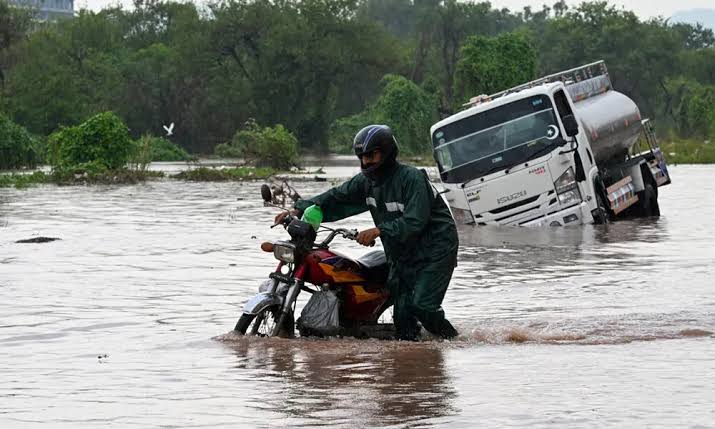
The timing and geography of the forecast set off the kind of warnings Pakistani authorities have grown accustomed to issuing each monsoon season, but with particular urgency this week given rain that has already inundated parts of the twin cities of Rawalpindi and Islamabad. On Monday, roughly two hours of heavy showers left cars and motorcycles stranded in flooded streets, and by Tuesday morning, low-lying neighborhoods were underwater again, with the Leh Nullah — the seasonal waterway that cuts through Rawalpindi and has a history of overflowing during heavy rains — running higher than normal.
Forecasters said the heaviest rain over the coming days is expected to fall across a broad northern arc. In Kashmir, the advisory named the Neelum Valley, Muzaffarabad, Rawalakot, Poonch, Hattian, Bagh, Haveli, Sudhanoti, Kotli, Bhimber, and Mirpur as likely to see rain from Thursday through Sunday. A similar pattern was forecast for Gilgit-Baltistan’s Diamer, Astore, Ghizer, Skardu, Hunza, Gilgit, Ghanche, and Shigar districts over the same stretch.
Khyber Pakhtunkhwa was expected to see some of the most intense weather, with the Meteorological Department forecasting scattered heavy — and at times very heavy — rainfall beginning Wednesday evening and continuing through Friday across Peshawar, Dir, Chitral, Swat, Kohistan, Malakand, Mardan, Nowshera, Charsadda, Swabi, Shangla, Battagram, Buner, Kohat, Hangu, Kurram, Bajaur, Mohmand, Khyber, Orakzai, Mansehra, Abbottabad, Haripur, Karak, Tank, Lakki Marwat, Dera Ismail Khan, Bannu, and the Waziristan districts.
The capital region was not spared. Islamabad, Rawalpindi, Murree, and the hill station areas known as the Galliyat were among the locations forecasters said would see thundershowers and isolated heavy-to-very-heavy rainfall from Thursday through Saturday, along with Jhelum, Chakwal, Talagang, Attock, and a string of Punjab cities including Lahore, Sialkot, Sheikhupura, Narowal, Gujrat, Gujranwala, and Kasur. A second band of rainfall was forecast slightly later, from Friday into Saturday, across Okara, Sargodha, Faisalabad, Jhang, Sahiwal, Dera Ghazi Khan, and other central Punjab districts.
Sindh and Balochistan, by contrast, were expected to remain largely dry, with the weather service forecasting hot, humid conditions across most of both provinces — though it flagged the possibility of rain and thunderstorms reaching Zhob, Bar Khan, and Musakhel in Balochistan.
The advisory’s sharpest warnings were reserved for the risk of urban flooding and landslides. The Meteorological Department said heavy rain over Friday and Saturday could flood low-lying sections of Islamabad and Rawalpindi, as well as Peshawar, Mardan, Swabi, Gujranwala, Gujrat, Sialkot, Faisalabad, and Lahore. It separately warned of flash flooding in streams and drainage channels — locally known as nullahs — across a cluster of northern districts including Dir, Chitral, Swat, Kohistan, Shangla, Battagram, Buner, and Malakand, as well as Mansehra, Abbottabad, Murree, the Galliyat, and the broader Gilgit-Baltistan and Kashmir regions.
Landslides, the department said, were a further risk in the hilly terrain of Khyber Pakhtunkhwa, Gilgit-Baltistan, Murree, the Galliyat, and Kashmir, and it urged tourists and travelers heading into those areas to exercise caution.
The weather service also called on farmers across the affected regions to adjust their crop schedules to account for the incoming rain, and asked local authorities to stay on alert and take whatever steps were necessary to head off the kind of damage and disruption heavy monsoon rains have caused in the country in recent years.
Copyright © 2021 Independent Pakistan | All rights reserved