By Staff Reporter
ISLAMABAD: The large-scale manufacturers staged a sharp rebound in July, with output climbing 9.5% from the prior month as a surge in automobile and apparel production papered over continued weakness in textiles, pharmaceuticals and steel — an uneven start to the fiscal year that underscores how narrow the country’s industrial recovery remains.
The Quantum Index of Manufacturing rose to 119.13 in July, up from 115.62 a year earlier and from 108.78 in June, the Pakistan Bureau of Statistics said Wednesday. That put year-on-year growth at 3.03%, a marked improvement from June’s 3.48% contraction, though still short of the 4.98% expansion the sector logged for the full 2025-26 fiscal year.
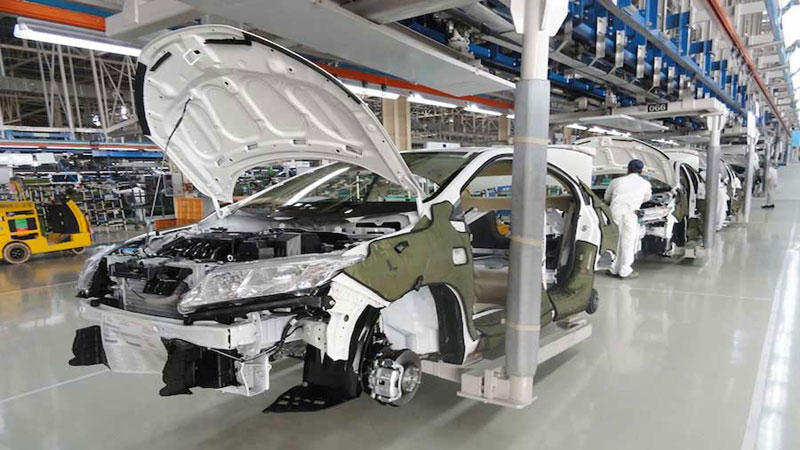
The bounce was driven overwhelmingly by two industries. Automobile production jumped 57% from a year earlier, making cars and trucks the single largest contributor to July’s growth and adding 1.91 percentage points to the headline figure. Wearing apparel output rose 22%, contributing 3.87 percentage points — the largest single contribution of any sector, reflecting the segment’s outsized weight in Pakistan’s manufacturing base and its export orientation.
Other pockets of strength included transport equipment outside of autos, which grew 40.22% year-on-year, and tobacco, up 35.82%. Both remained minor contributors to the overall index given their limited weighting — adding 0.27 and 0.55 percentage points, respectively.
The recovery’s shallowness showed up in the details. Textile production, which carries the heaviest weight of any category in Pakistan’s manufacturing index, contracted 3.09% year-on-year, subtracting 0.53 percentage points from growth. The decline was not uniform: cotton yarn output rose 2.73%, while cotton cloth slipped 0.09% — the two products together account for more than 80% of textile-sector output. Pharmaceutical production fell 20.79%, the steepest drop among major categories and a drag of 1.24 percentage points, while iron and steel output dropped 11.40%, chemicals fell, and machinery and equipment output declined 13.33%.
Food production, the index’s other heavyweight category, slid 6.39% from a year earlier, subtracting 0.84 percentage points from the headline number. The decline was concentrated in edible oils: cooking oil output tumbled 19.22% and vegetable ghee fell 11.81%, while wheat and rice milling slipped 0.99%. Tea blending was a rare bright spot within the group, up 0.52%.
Within petroleum products, which grew 1.34% on the month and added 0.11 percentage points to the index, the picture was similarly split. Petrol output rose 11.56%, kerosene surged 43.10% and LPG climbed 9.86%, but high-speed diesel production fell 7.26% and furnace oil dropped 13.28% — a divergence that points to shifting fuel demand rather than uniform strength across the energy-linked manufacturing chain.
The automobile sector’s gains were broad-based within the category: jeep and car production rose 57.19%, trucks surged 94.35% and light commercial vehicles gained 12.54%, while bus production was the outlier, falling 3.85%.
Wednesday’s data extends a recovery that began taking shape over the second half of the last fiscal year, when the manufacturing sector expanded 4.98% for the 12 months through June — a period in which automobiles were also the standout performer, with full-year output up 57.77%. But the composition of July’s rebound — concentrated in a handful of categories while textiles, pharmaceuticals and steel continue to contract — suggests the industrial base has not yet found the broader footing that would make the recovery durable.
Copyright © 2021 Independent Pakistan | All rights reserved