By Staff Reporter
ISLAMABAD: A human rights lawyer and her husband were back behind bars within hours on Thursday, after Pakistan’s Supreme Court suspended the 17-year prison sentences that had made their case a rallying point for press freedom campaigners and UN officials.
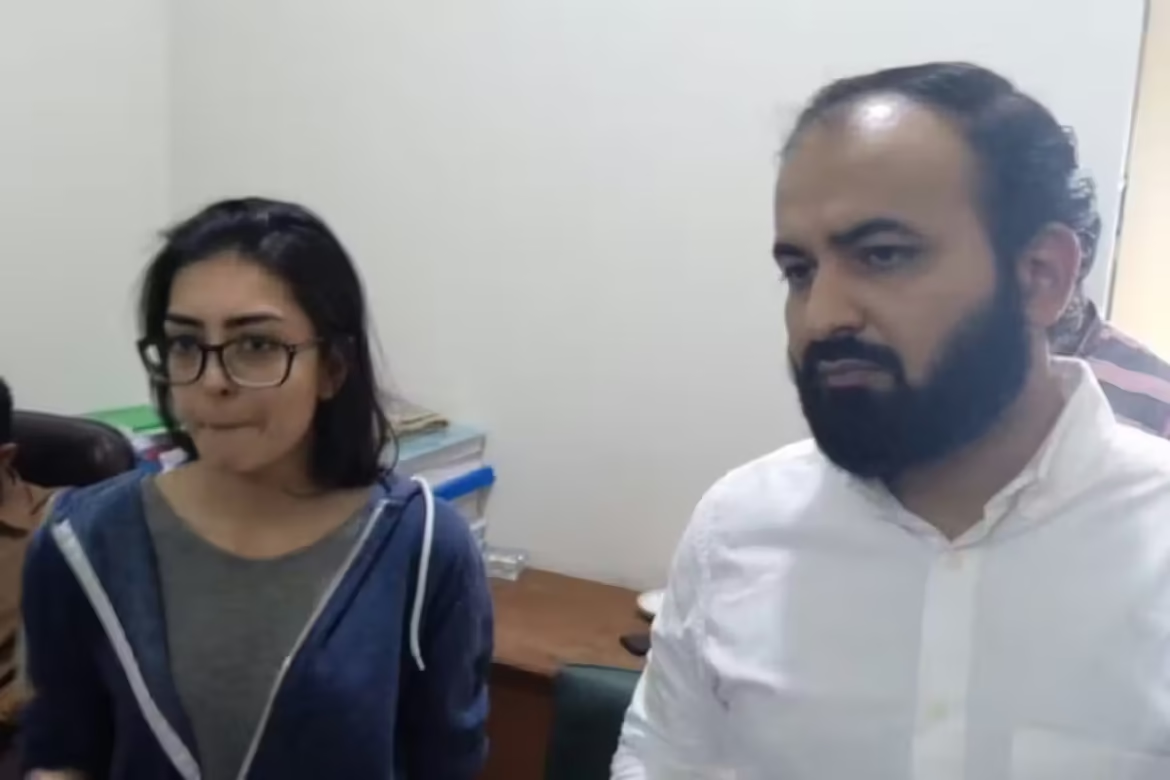
Imaan Mazari and her husband, Hadi Ali Chattha, were granted bail after the apex court suspended a trial court’s February ruling in the controversial social media posts case, pending a final decision from the Islamabad High Court. Their freedom lasted only hours. An anti-terrorism court in Islamabad rejected a police request for 30 days’ physical remand and instead ordered the pair held on judicial remand, after officers produced them in connection with a separate case registered at Kohsar police station.
ATC Judge Abual Hasnat Muhammad Zulqarnain presided over Thursday night’s hearing, which followed a chaotic sequence of events that saw the couple detained again before the paperwork securing their release from the social media case had even been finalised.
Taken from inside Adiala jail
Mazari’s mother, the former human rights minister Shireen Mazari, said the two lawyers had been removed from Adiala jail before the necessary release documentation had been completed, a move she described as illegal. “As I have been saying, it’s always been about vengeance, never about justice for Imaan and Hadi,” she wrote on X, adding that due process had never been observed in the cases against her daughter and son-in-law.
Former Sindh governor Mohammad Zubair also condemned the arrest, describing the government as a “totally fascist regime” for detaining the couple in defiance of the Supreme Court’s order.
A courtroom rebuke
The Supreme Court’s decision to suspend the sentences came after a two-judge bench headed by Justice Naeem Akhtar Afghan and Justice Ishtiaq Ibrahim took up the couple’s appeals against the Islamabad High Court’s earlier refusal to grant the same relief. Both were released against surety bonds of two hundred thousand rupees each.
Addressing the couple’s legal team, Justice Afghan made clear the court’s decision hinged in part on their professional standing. “Both are lawyers and we are keeping their honour,” he said, before urging senior counsel Faisal Siddiqui to remind his clients to observe courtroom decorum. “There is a difference between a lawyer and an ordinary person,” the judge added.
In its written order, the court converted the couple’s petitions into formal appeals and suspended the operation of the February ruling, describing both as practising advocates. A more detailed verdict is expected at a later date.
The hearing exposed the court’s mounting frustration with delays at the Islamabad High Court, which had been instructed as far back as May to rule on the couple’s sentence-suspension applications within a fortnight. That deadline came and went, prompting the National Cyber Crime Investigation Agency to challenge the Supreme Court’s order rather than comply with it.
Siddiqui told the bench that scheduling had repeatedly stalled at the high court, with requests for an early hearing rejected by its registrar’s office. “What transpired at the high court came as a surprise to us,” he said. Justice Ibrahim’s reply was dry: “These days are an era of surprises.”
At one stage, Siddiqui invoked the late chief justice Asif Saeed Khosa’s dictum that a hearing should only be adjourned upon the death of a judge or a lawyer, prompting the bench to wave forward the government’s additional attorney general, Rana Asadullah Khan, with the remark that he had “certainly worn us out.” Khan told the court that no adverse ruling had yet been issued by the high court and that seven opportunities had already been given at trial. Justice Afghan was unmoved, observing that the high court routinely cited Supreme Court directives for swift resolution without acting on them. When pressed on whether proceedings would definitely go ahead at the next hearing, Khan said he could not offer assurances on behalf of a sitting high court judge.
Convictions that drew international criticism
Mazari, a rights activist and lawyer, and Chattha, an advocate, were sentenced to a combined 17 years in January 2026 on multiple charges linked to social media posts that prosecutors alleged amounted to an anti-state narrative under Pakistan’s cybercrime laws. The couple had filed applications for suspension of their sentences the same month.
That case stemmed from a complaint lodged by an investigating officer with the National Cyber Crime Investigation Agency, who accused Mazari of spreading material sympathetic to banned militant groups, and her husband of amplifying her posts. The original police report alleged the couple had blamed security forces for enforced disappearances in Khyber Pakhtunkhwa and Balochistan, and suggested the military had failed to contain proscribed organisations, including the Baloch Liberation Army and Tehreek-i-Taliban Pakistan.
Following their conviction, the couple lodged appeals with the Islamabad High Court in February. Although the high court issued notices to respondents, it declined to suspend the sentences — a decision that set in motion the drawn-out appeals process culminating in Thursday’s Supreme Court intervention, and, within hours, the couple’s return to custody.
The case has drawn sustained criticism from rights bodies, opposition politicians and journalists since the couple’s initial arrest, with critics arguing their right to a fair hearing has been repeatedly undermined.
Copyright © 2021 Independent Pakistan | All rights reserved