By Staff Reporter
KARACHI: Pakistan will defend Saudi Arabia “to any extent,” a senior military spokesman said on Thursday — the toughest yet in a run of statements from Islamabad that have hardened by the day as the kingdom faces its heaviest barrage of Houthi drone and missile strikes in the current hostilities.
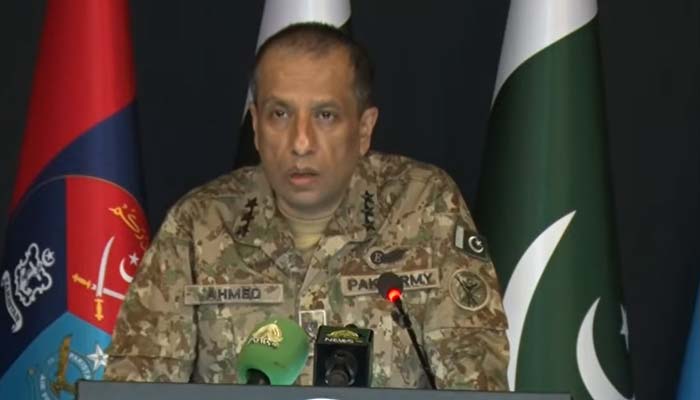
Lieutenant General Ahmed Sharif Chaudhry, spokesman for the Pakistani military, told Arab News that the pledge was not merely diplomatic. “Pakistan fully stands with the Kingdom of Saudi Arabia, both diplomatically and physically,” he said. “I would like to underscore here the word physically … We will go to any extent.” The guarantee, he added, covered Makkah and Madinah, Islam’s two holiest sites, as well as Saudi territory more broadly: “There should be no doubt on that.”
The strikes prompting that language have been immediate and, for the first time in this round of hostilities, lethal. Falling debris from a drone intercepted over Taif on Thursday killed a Yemeni resident and injured two others — a Saudi woman and a Pakistani national, the latter in critical condition — Saudi civil defence said, part of a barrage that has now wounded more than 80 people across the kingdom. The Saudi-led coalition fighting the Houthis in Yemen said this week it had intercepted a separate drone before it could breach the restricted airspace around holy Makkah, a red line Riyadh has said would endanger sites sacred to every Muslim; the Houthis denied targeting the city. Drones launched from within Iraq also struck three pumping stations on Saudi Arabia’s East-West Pipeline, forcing the kingdom to suspend a route that carries crude to its Red Sea terminals and bypasses the Strait of Hormuz entirely — underscoring how directly the crisis now threatens Riyadh’s energy exports, not merely its cities.
A fortnight of contradictions
What makes General Chaudhry’s language notable is not just its firmness but how much Pakistan’s public position has moved in the space of ten days. On 9 September, hours after Houthi drones struck Saudi oil installations and injured 73 people, defence minister Khawaja Asif told a local television channel there was “no ambiguity”: any spillover of the Yemen conflict into Saudi Arabia would make the trilateral Makkah Joint Defence Agreement operational, and Pakistan would honour it. Within a day, officials were briefing reporters that no military response was under active discussion. By the following week, the pact was being described instead as a purely “defensive alliance” with no plans for expansion. By Thursday, Pakistani officials were telling local media the bilateral defence arrangement with Riyadh was “operational,” while declining to say what that meant in practice — a discretion General Chaudhry maintained in his own interview, before his language pushed the public stance further still.
Some of that ambiguity is structural rather than evasive. The Makkah agreement, signed on 7 August by Pakistan, Saudi Arabia and Turkey, was likened by officials at the time to Nato’s Article 5, treating an attack on one signatory as an attack on all three — though its full text has never been published, and analysts have cautioned against taking the Nato comparison too literally given how untested the pact remains. It builds on a bilateral Strategic Mutual Defence Agreement Pakistan and Saudi Arabia signed in September last year, which similarly treats aggression against either country as aggression against both, but does not mandate automatic military intervention. Islamabad has itself acknowledged as much, saying last month that “the operationalisation of the agreement remains at an early stage.”
Pressed on whether Riyadh had asked for more than words — additional troops, air-defence systems, or direct Pakistani involvement against the Houthis — General Chaudhry did not say whether any new request had been made. He was equally guarded on whether Pakistan’s nuclear arsenal fell within the scope of its assurances to Saudi Arabia, a question on which Islamabad has previously sent conflicting signals. Minister Asif said after last year’s bilateral pact was signed that Pakistan’s nuclear capability could, in principle, be made available to the kingdom if needed; he later told Reuters that nuclear weapons were “not on the radar” of the agreement.
Troops already on the ground
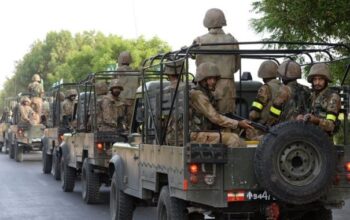
What is not in doubt is the scale of Pakistan’s existing presence in Saudi Arabia. Local media reported in May that Islamabad had deployed roughly 8,000 troops to the kingdom, together with a squadron of JF-17 fighter jets, drones and an HQ-9 air-defence system. General Chaudhry framed the relationship as running deeper than any single deployment. “Our commitment to Saudi security is unconditional,” he said. “It stems from an emotive, deep-rooted, historical and unbreakable bond between the people of Pakistan and the people of the Kingdom of Saudi Arabia, and between the political and military leadership of both countries.”
Riyadh’s search for backing has not been limited to Pakistan, nor has it gone smoothly. Saudi Arabia has approached several allies, including Britain, France and Egypt, for support as repeated Houthi attacks put pressure on the kingdom’s missile-defence supplies, the Associated Press reported this week. No country had publicly committed additional military assistance in response to the latest Saudi request. Most strikingly, Crown Prince Mohammed bin Salman telephoned President Donald Trump twice last week urging direct US strikes on the Houthis as the group advanced on the Red Sea port of Mokha; Trump declined both times, offering intelligence-sharing and targeting data instead while stopping short of committing American forces to the fight. It is against that backdrop of a great-power ally holding back that Pakistan’s pledge to go “to any extent” carries particular weight.
Alongside its military assurances, Islamabad is also trying to contain the wider regional confrontation diplomatically, positioning itself as a mediator between Washington and Tehran and saying it has passed on a Saudi warning urging Iran to rein in the Houthis. Field Marshal Syed Asim Munir, Pakistan’s army chief, spoke by telephone on Wednesday with Iran’s foreign minister, Abbas Araghchi, then visiting Beijing; Iranian state media said the two discussed regional developments without specifying whether the Houthi attacks were raised. “The politico-military leadership of Pakistan remains in continuous communication with the esteemed leadership of the Kingdom of Saudi Arabia on all these matters,” General Chaudhry said, adding that Pakistani officials were consulting regional governments in pursuit of “a negotiated and peaceful outcome.”
That diplomacy carries a mixed recent record. Pakistan helped broker the Islamabad Memorandum of Understanding in June, under which Washington and Tehran agreed a framework for ending hostilities and addressing disputes over Iran’s nuclear programme — talks that have since stalled amid renewed escalation and disagreement over implementation. General Chaudhry called the document “a consensus document which we think provides the only real pathway forward for getting out of this complex military situation,” though he offered no timetable for reviving it, citing continued mistrust and what he called “spoilers” and “detractors.” “So that effort keeps on going,” he said.
Copyright © 2021 Independent Pakistan | All rights reserved