By Staff Reporter
MULTAN: Maryam Nawaz, the chief minister of Punjab province, has launched a robust defence of her use of a provincial government aircraft to attend her daughter’s graduation ceremony in London, telling critics she “does not owe” them an explanation while simultaneously producing what she described as a receipt for the trip on her mobile phone.
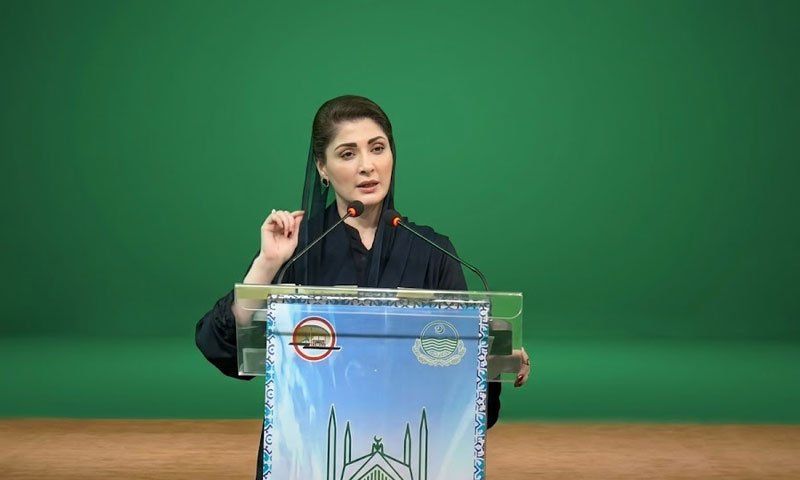
Speaking at a ceremony in Multan on Thursday, Nawaz rejected accusations that she had misused public resources, arguing that the jet in question did not belong to her personally but to the office of chief minister, and that all four of Pakistan’s provincial leaders had access to similar aircraft.
“It is not Maryam Nawaz’s plane; it is the chief minister’s plane,” she told the gathering. “Maryam Nawaz is not going to take it to Raiwind.” She was referring to the ancestral seat of the Sharif family, to which she belongs; her father, Nawaz Sharif, and her uncle, Shehbaz Sharif, have both served as Pakistan’s prime minister.
The controversy erupted after it emerged that Nawaz had travelled to London aboard the provincial jet to attend a family occasion — her daughter’s graduation — prompting opposition politicians to question why an aircraft funded by taxpayers had been deployed for what they characterised as a private engagement. Punjab’s information minister, Azma Bokhari, had already sought to head off the criticism, insisting that the costs of the trip had been met privately.
Nawaz went considerably further on Thursday, placing the total bill for the graduation trip at 27.5 million rupees — roughly £77,000 — and insisting she had personally covered every expense. She held up her phone to the audience, displaying what she said was proof of payment.
Her central argument, repeated throughout a lengthy and often combative address, was that no journey undertaken by a sitting chief minister could properly be described as personal. “A chief minister or prime minister is never on leave, and none of their visits is personal,” she said. “I am working while I am on the plane. I work wherever I am.”
She described the demands of the office in granular terms, telling the crowd she rose early, worked late into the night, and had on occasion fallen asleep still holding her phone or tablet. The nature of the role, she argued, meant she could not risk being uncontactable, citing the length of the London route as a particular concern. “If I lose contact with my government on an eight-hour flight and if there is an issue, who is going to handle it?” she asked.
Nawaz also pointed to a stroke of bad fortune that, she suggested, vindicated her decision to fly on the government aircraft rather than a commercial airline. She recalled that on the day she was due to return to Pakistan, widespread disruption to UK air traffic control had forced the cancellation of numerous commercial flights, leaving passengers stranded for five to six days. Had she been reliant on a scheduled service, she said, the delay would have cost Punjab far more than her own time. “That is not just five to six days for Maryam Nawaz but five to six projects for the people of Punjab,” she said.
The chief minister, who has now spent two and a half years in office, used the episode to draw a wider contrast between her government’s record and that of rival provinces, framing the criticism as evidence that Punjab’s progress under her leadership had rattled her opponents. She listed a string of infrastructure and welfare initiatives, including 300 billion rupees committed to the Apni Chhat Apna Ghar housing scheme, 200 billion rupees for a green bus network, and what she described as the world’s largest cancer hospital, then turned to challenge her critics directly. “What have you done?” she asked.
She placed the value of the aircraft at 9 billion rupees and argued that the “most precious resource” for any chief minister was time, telling the audience that if she needed to travel between cities such as Sargodha and Rawalpindi at short notice, she had no practical alternative. She also referenced her presence on rescue boats during the catastrophic floods that struck Punjab in 2025 as evidence of the aircraft’s operational necessity, alongside trips to Brazil, Japan, China and Turkey, which she said were undertaken to showcase her government’s progress to international audiences.
At one point, plainly irritated by the scale of the online criticism, Nawaz suggested — apparently in jest — that she might travel by motorcycle rickshaw or metro bus instead. “Today, as I was coming here, I thought since there has been so much criticism, perhaps I should go by Qingqi or motorcycle, or if there is a metro bus I can take till here from Lahore,” she said, drawing a reaction from the crowd.
She was dismissive of the online commentators driving much of the criticism, telling the audience she felt no obligation to justify herself to “vloggers and YouTubers”, though she added that she would nonetheless set out her case “in the court of the public”. She closed that section of her remarks with a pointed message to her detractors: “Kids, keep at it; may God give you more success in your business. I don’t owe you an answer; I am answerable only to the people.”
Nawaz further insisted that the criticism levelled at her personally was, in reality, aimed at Punjab’s development more broadly, telling the audience that the province had become an uncomfortable “mirror” held up to the performance of other provincial governments. She said she had spent two and a half years hoping to hear rival administrations claim they were outperforming Punjab, and made clear she had heard no such claims. She added that when her term in office eventually ends, she would not be taking the aircraft with her — before immediately undercutting the remark by adding that she hoped to fly on it again regardless.
The chief minister used part of her address to turn her attention to Sohail Afridi, the chief minister of Khyber Pakhtunkhwa, over his recent visit to Lahore, though she did not name him directly. She claimed the visit had drawn such a poor turnout that local officials had struggled to gather even a few hundred people to welcome him, and suggested he had gone largely unrecognised. She went on to reference his claim to have been forcibly detained and later released by the roadside in Lahore, characterising it as a failed attempt to generate publicity. The Punjab government has denied Afridi’s allegation that he was abducted by the authorities.
Copyright © 2021 Independent Pakistan | All rights reserved