By Staff Reporter
ISLAMABAD: The Supreme Court of Pakistan on Thursday suspended the 17-year prison sentences imposed on the prominent human rights lawyer Imaan Zainab Mazari-Hazir and her husband over social media posts critical of the country’s powerful military, ordering the couple released on bail after nearly eight months in custody.
A two-judge bench headed by Justice Naeem Akhtar Afghan, sitting with Justice Ishtiaq Ibrahim, granted bail against surety bonds of Rs200,000 each and directed that the pair be freed pending the outcome of their appeals before the Islamabad High Court.
In a written order, the court converted the couple’s petitions into appeals and suspended the operation of the conviction handed down on 24 January. Noting that both were practising advocates, the bench ordered their release on personal bonds to be furnished with the Supreme Court’s additional registrar (judicial). A detailed judgment is to follow.
“Both are lawyers and we are keeping their honour,” Justice Afghan observed during the hearing, though he asked their senior counsel, Faisal Siddiqi, to remind his clients to observe the decorum of the court. “There is a difference between a lawyer and an ordinary person,” the judge added.
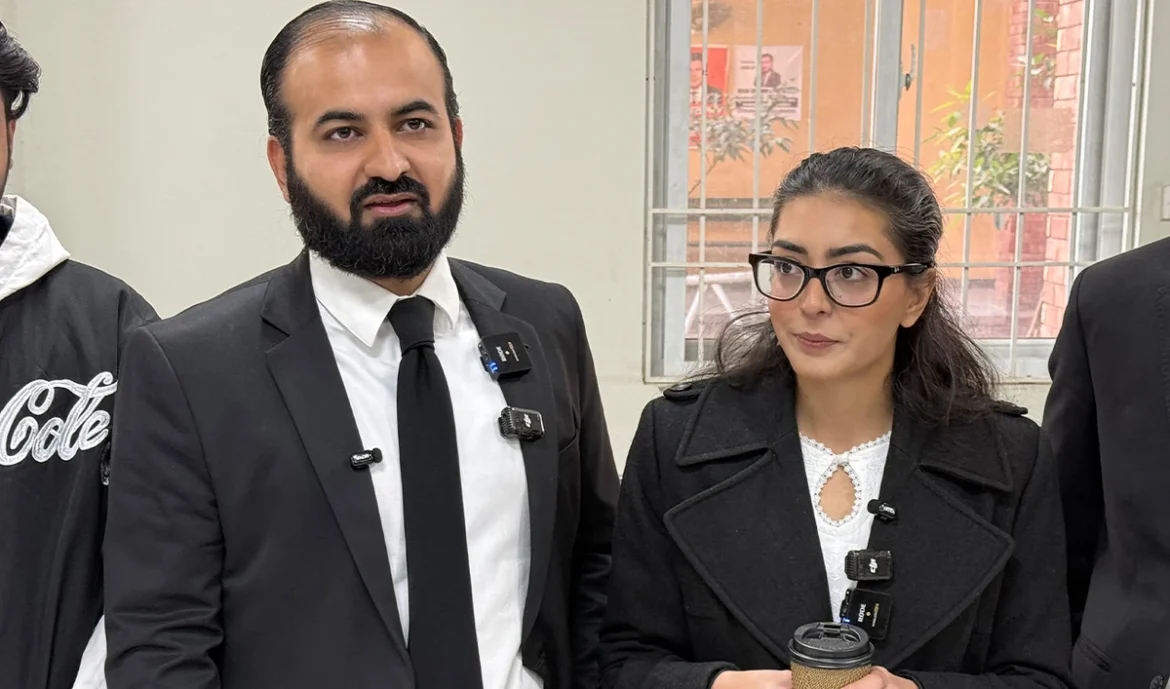
Speaking to reporters outside the court, Siddiqi said: “Today they have suspended the judgment of the trial court. And they have ordered both Imaan and Hadi to be released on personal bond.” He thanked the lawyers and civil society figures who had campaigned on the couple’s behalf since their sentencing.
Mazari-Hazir’s mother, the former human rights minister Shireen Mazari, was also outside the courtroom. “We had hoped for justice from the Supreme Court and today, we got justice,” she said.
A conviction that caused an outcry
Mazari-Hazir, one of Pakistan’s best-known human rights lawyers and a persistent critic of the armed forces, was convicted alongside her husband Hadi Ali Chattha by Additional District and Sessions Judge Muhammad Afzal Majoka in Islamabad on 24 January.
The judge found the prosecution had proved its case under three provisions of the Prevention of Electronic Crimes Act (Peca): section 10, covering cyber terrorism, which carried 10 years; section 9, glorification of an offence, which carried five years’ rigorous imprisonment; and section 26-A, the dissemination of false and fake information, which carried two years. The terms amounted to 17 years in all. Each defendant was also fined a total of Rs36m, or roughly $129,000.
The couple deny the allegations.
The case originated in a complaint lodged on 12 August 2025 by an assistant director at the National Cyber Crime Investigation Agency (NCCIA) in Islamabad, filed before the Federal Investigation Agency’s cybercrime reporting centre. It accused Mazari-Hazir of disseminating and “propagating narratives that align with hostile terrorist groups and proscribed organisations”. Chattha was implicated for resharing some of her posts.
The first information report alleged that the two had held the security forces responsible for enforced disappearances in Khyber Pakhtunkhwa and Balochistan, and had portrayed the armed forces as ineffective against banned groups including the Baloch Liberation Army and the Tehreek-i-Taliban Pakistan. Prosecutors said the posts on X incited ethnic division and cast the military as complicit in terrorism.
Judge Majoka indicted the couple on 30 October last year and issued arrest warrants on 5 November, reissuing them in January after repeated failures to appear.
The verdict, delivered a day after the couple had already been jailed in a separate case, drew immediate condemnation from the Pakistani bar and from United Nations experts, who joined lawyers and rights groups in accusing the authorities of using the cybercrime statute to punish Mazari-Hazir for her criticism of the military establishment.
Eight months of delay
Thursday’s order followed a protracted and increasingly fraught procedural battle that the Supreme Court made plain it had lost patience with.
The couple filed separate appeals in the Islamabad High Court on 7 February. When the high court took up those appeals on 19 February, it issued notices to respondents but declined to suspend the sentences. On 30 April, the pair moved the Supreme Court against that refusal, seeking an early hearing in June; notices were issued on 6 July.
On 12 May, the Supreme Court directed the high court to decide the suspension applications as expeditiously as possible, and preferably within a fortnight. That deadline expired on 26 May. Rather than comply, the NCCIA on 1 June challenged the Supreme Court’s own order and sought its withdrawal. The high court declared the pleas admissible only on 25 July, prompting a further application to the Supreme Court for an early hearing.
The apex court had itself repeatedly adjourned the matter on the grounds that the high court had tied the suspension applications to the main appeal.
Siddiqi told the bench on Thursday that his clients’ request for an early hearing had been turned down by the high court registrar’s office, and read out order sheets from a succession of high court hearings. “What transpired at the high court came as a surprise to us,” he said.
“These days are an era of surprises,” Justice Ibrahim replied.
There was a flash of levity when the bench asked the additional attorney general, Rana Asadullah Khan, to take his seat while counsel for the appellants was heard. “Let him sit, though he has certainly worn us out,” Siddiqi remarked, invoking the former chief justice Asif Saeed Khosa’s dictum that a case should be adjourned only on the death of a judge or a lawyer.
Khan argued that the high court had issued no adverse ruling and that seven opportunities had been afforded in the trial court, and maintained that the proper forum for suspension of a sentence under section 426 of the Code of Criminal Procedure was the high court.
Justice Afghan responded that the high court routinely cited Supreme Court directions for the early disposal of the case without acting on them. Asked whether he could give any assurance that proceedings would actually take place at the next high court hearing, the law officer said he could not speak for a high court judge.
In their applications, the couple argued that it was settled Supreme Court policy to prioritise criminal matters, particularly those concerning bail or suspension of sentence, and pointed to section 7 of the Supreme Court (Practice and Procedure) Act 2023, which requires any application pleading urgency to be fixed for hearing within 14 days. Mazari-Hazir, the application said, was a young woman lawyer who had been held for a prolonged period on a conviction that was the “result of a sham trial”.
The couple have been in custody since 23 January, when they were arrested over a protest outside the Islamabad High Court and the alleged manhandling of the president of the high court’s bar association. That arrest was itself condemned by rights organisations, politicians and journalists, who insisted on the couple’s entitlement to a fair trial. The Peca conviction came a day later.
Thursday’s order applies to the sentences in the social media case and holds until the Islamabad High Court delivers its final decision on the pending appeals.
Copyright © 2021 Independent Pakistan | All rights reserved