By Staff Reporter
PESHAWAR: A suicide bomber rammed a car packed with explosives into a mosque inside a police compound in north-west Pakistan during Friday prayers, killing at least 21 people, before gunmen tried to storm the complex and fought security forces for hours.
Fifteen of the dead were police officers. The other six were civilians. More than 100 people were wounded, according to health officials in Kohat, a district in Khyber Pakhtunkhwa province close to the Afghan border.
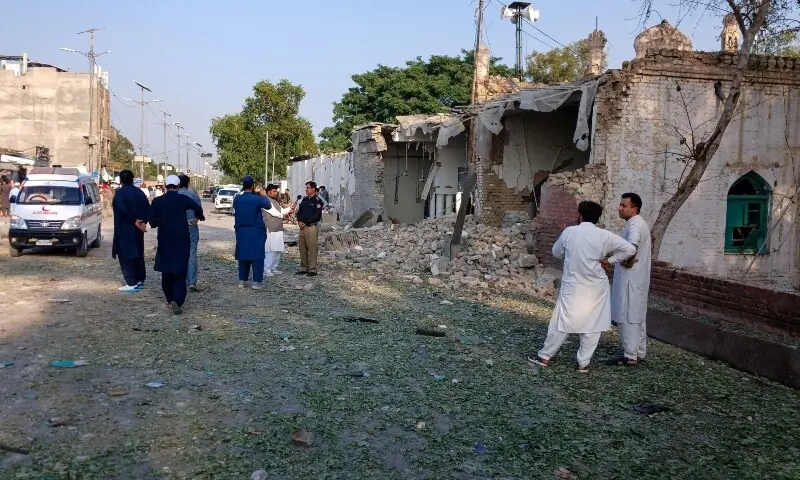
The blast tore away part of the mosque’s outer section and brought down a section of the boundary wall of the Old Police Lines, a complex that houses counterterrorism and Special Branch offices. Footage from the scene showed residents digging through rubble with their hands as ambulances queued on a road leading to the compound. Witnesses said the explosion could be heard from some distance away. Eyewitnesses reported hearing at least 10 further explosions afterwards.
Zulfiqar Hameed, the provincial police chief, said the vehicle hit the gate and exploded, and that firing followed. Accounts differed on precisely how the bomb was delivered. Some officials described a car smashing into the outer wall; others said it struck the gate or the mosque itself. Hameed said the cause of the first blast was still under investigation.
At least seven armed militants then entered the compound and moved towards the Counter Terrorism Department and Special Branch buildings, a police statement said. A second suicide bomber blew himself up near the Special Branch building as officers and counterterrorism personnel returned fire.
Officials gave shifting accounts of how many attackers died. Police first said six had been killed, including a suicide bomber and a sniper, with one cornered inside the compound. By mid-afternoon they said the clearance operation was in its “final stages”. Later, according to Reuters, police confirmed all seven attackers were dead. The additional inspector general of the counterterrorism department said he had entered the compound himself to lead officers.
“The operation will continue until the complete elimination of Fitna-ul-Khawarij,” Hameed said earlier, using the state’s term for the banned Tehreek-e-Taliban Pakistan (TTP), the Pakistani Taliban.
Dr Nasir Hussain, the district health officer, said 103 people were wounded: 73 police officers and 30 civilians. Dr Tahir Shah, the medical superintendent of the main hospital, said 90 of the injured were taken to the District Headquarters Hospital and 13 to Liaquat Memorial Hospital. By the evening, 34 remained in treatment and four in a critical condition had been sent to Peshawar. The hospital declared an emergency as casualties arrived, and the Kohat-Hangu road was shut to traffic.
Among the dead was Dr Israel Khan Orakzai, a senior specialist at a Kohat hospital, and Akbar Shinwari, a senior traffic police officer. Bilal Faizi, a senior rescue official, told the Associated Press that most of the wounded were worshippers.
Funeral prayers for the 15 police officers were held in Kohat in the evening. Their bodies were then taken in Rescue 1122 ambulances to their home districts of Kohat, Karak, Lakki Marwat, Bannu and Mardan.
Who was behind it?
Accounts on responsibility diverged. Local media reported that Ittehadul Mujahideen, a militant alliance linked to the Taliban commander Hafiz Gul Bahadur, claimed the attack. Reuters reported that the TTP publicly denied involvement. Police did not name a group.
The denial follows a familiar pattern. After the January 2023 suicide bombing at a mosque in Peshawar’s Police Lines, which killed more than 100 people, most of them police officers, a TTP-linked faction claimed responsibility and the TTP itself then distanced itself from the attack, saying it was not its policy to target mosques. The government and other observers have maintained the group likely knew of and approved that attack.
A surge along the border
The bombing came a day after a roadside bomb killed six soldiers in neighbouring Hangu district. On Thursday, troops killed 10 suspected militants in raids in Hangu and North Waziristan, the military said. In February this year, a bombing at a Shia mosque in Islamabad killed at least 31 people and wounded more than 170.
Kohat lies on the main route towards North Waziristan, Bannu and Dera Ismail Khan, areas that have all seen heavy attacks in recent months. Observers counted 15 terrorism-related incidents in the district in 2025 and 21 so far this year.
The TTP is separate from, but allied with, the Taliban that returned to power in Afghanistan in 2021. Pakistan accuses Kabul of sheltering TTP fighters and allowing them to plan cross-border attacks. The Taliban government denies this and says militancy is Pakistan’s domestic problem. The dispute has grown into open confrontation, with intermittent cross-border strikes.
Michael Semple, a former EU representative in Afghanistan who has negotiated with the Taliban, told Al Jazeera that an attack of this sophistication required planning, logistics and training. “Essentially, this seems to fit into the pattern of the Afghan Taliban providing sanctuary to both al-Qaeda and different factions of the TTP to do the kind of training for this kind of attack,” he said.
Reaction
Asif Ali Zardari, the president, said the complete elimination of “foreign-backed” terrorists was essential for national security. Shehbaz Sharif, the prime minister, asked for a report on the cause of the blast and told officials to speed up rescue work. The interior ministry said the attackers’ “cowardly actions” could not weaken the “nation’s firm resolve”.
Sohail Afridi, the chief minister of Khyber Pakhtunkhwa, called the targeting of civilians “extremely regrettable and unacceptable” and ordered a detailed report. In a video message he said the province had sacrificed more than 80,000 lives and was Pakistan’s “frontline province” in the fight against terrorism. He also criticised those he said had labelled its people terrorists, an apparent reference to remarks by the chief minister of another province, whom he did not name in the material available.
Jane Marriott, the UK high commissioner, said she was “appalled by the horrific attack” and that “nobody should face violence in a place of worship”. Embassies of China and Russia condemned the attack, as did the governments of Saudi Arabia, Qatar, Kuwait, Jordan, Poland and Australia.
Copyright © 2021 Independent Pakistan | All rights reserved