By Staff Reporter
ISLAMABAD: The government has vowed to stop supporters of the jailed former prime minister Imran Khan from marching on Islamabad “in every possible way”, warning that security forces have been given clear rules of engagement and will not stay silent if they come under fire.
Interior minister Mohsin Naqvi said on Friday that anyone who defied a fresh ruling from the Islamabad High Court (IHC) would first face contempt of court proceedings, and that the organisers of any march would be held responsible if lives were lost.
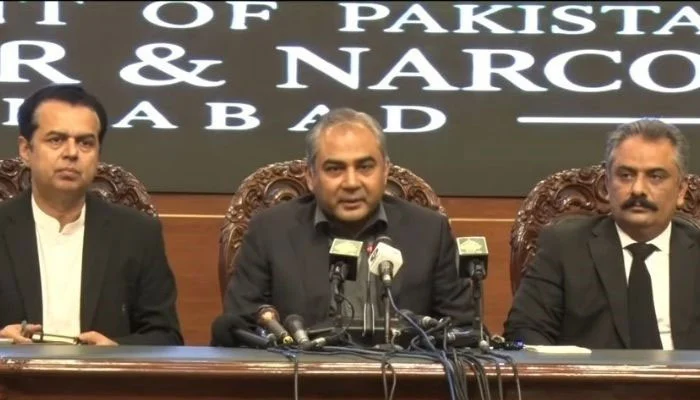
His remarks, made at a press conference in the capital, came ahead of a protest called for 27 September by Khan’s Pakistan Tehreek-e-Insaf (PTI) party, which is demanding the release of its founder and says it is mobilising in defence of the supremacy of the constitution.
The warning followed a day of intense security activity. Officials decided on Friday to seal all five routes leading to Islamabad’s Red Zone, the high-security district housing parliament, the Supreme Court and government offices, with two layers of shipping containers, according to Pakistani media reports. Islamabad police have cancelled all leave for personnel until 10 October.
“This time, we are communicating very clear rules of engagement to our law enforcement agencies,” Naqvi said. “They will not remain silent if a bullet is fired at them.”
He said weapons had been used and losses suffered during protests in the past. Naqvi did not name the episodes, but the government and PTI have long traded accusations over a November 2024 march to the capital that turned deadly. At least four paramilitary soldiers were among those killed, while PTI also reported deaths among its own supporters – claims that remain a source of bitter dispute.
“There is complete clarity,” the minister said. “The organisers of this march will be held accountable if even a single life is lost.”
Naqvi said the government would act on the court’s ruling before resorting to other measures. “If someone comes out after the court’s decision, we will first initiate contempt of court proceedings,” he said. “Otherwise, we will not allow anyone to come out.” He said the provinces had been informed, and that officials from all provinces and federal law enforcement agencies had attended a meeting on the law and order situation earlier in the day.
Asked about the right to protest, he drew a distinction between political activity and what he described as armed mobs. “Political activity is one thing, while arriving in the form of armed mobs is quite another,” he said, pointing to discussion on social media about groups from a particular tribe travelling to the capital.
“You should certainly protest, but do so in your own area and city,” he said, adding that plans to lock down the capital or “charge into another province” would never be permitted. He said he was personally against the use of shipping containers, but that law enforcement agencies required them to be installed when necessary.
The minister also said there were “sensible” voices within the opposition who he hoped would reconsider. “There is only loss in it, no sort of gain at all,” he said. He said Prime Minister Shehbaz Sharif had repeatedly invited the opposition from the floor of parliament to hold talks on all issues. “If you want to resolve matters through violent mobs, we are ready for it,” Naqvi said.
He also urged PTI to poll its own members, claiming that many might not know why they were travelling to Islamabad.
The court ruling
Naqvi’s comments came shortly after the Islamabad High Court issued a 37-page detailed judgment on a petition brought by a local trader, Waqas Ahmed, against the planned march.
The bench, headed by Chief Justice Sarfraz Dogar and including Justices Azam Khan and Muhammad Asif, ruled that no political party, leader, provincial government or public office holder had any lawful right to occupy roads, highways, interchanges, toll plazas or buildings within or leading to the capital, or to obstruct citizens’ movement or their access to medical facilities and educational institutions.
The court said any activity that infringed citizens’ fundamental rights amounted to a violation of the constitution, and that public office holders responsible would be deemed to have breached their oath. It held that the right to peaceful assembly could not be exercised in a way that infringed the fundamental rights of others.
The bench also directed provincial governments not to use public funds, officials, vehicles or other state machinery to facilitate political marches, and ordered that no government employee be compelled to take part in a rally. Chief secretaries were told to begin departmental proceedings against officials who failed to comply.
The judgment recorded that armed individuals had moved towards Islamabad alongside provincial police during earlier marches, and said aggression by a provincial government against the federation in the form of a march or rally would be unconstitutional and unlawful. It also pointed to what it said was a history of PTI disregarding court orders and assurances given by its leadership, including before the Supreme Court.
The bench had announced its short order on 14 September, when the Khyber Pakhtunkhwa (KP) police chief assured the court that any illegal advance from the province would be stopped.
Kohat attack
Naqvi also turned on the government of Khyber Pakhtunkhwa, which PTI runs, after a suicide attack on a police compound in Kohat earlier on Friday.
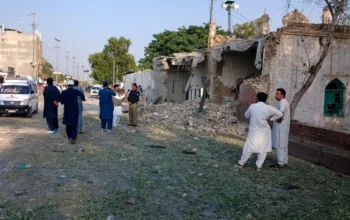
At least 21 people, including 15 police officials, were killed when an explosives-laden vehicle detonated near a mosque in Kohat Police Lines during Friday prayers, according to officials cited by Pakistani media. More than 80 people were injured. Earlier tolls were lower and figures shifted throughout the day.
Attackers then stormed the compound and targeted police facilities, senior police and district health officials said. Police said six attackers, including a suicide bomber, were killed. Reports said the attack was claimed by a group led by the militant commander Hafiz Gul Bahadur.
“We have to focus on this, rather than making strategies for mobilising masses, arranging transport and collecting money,” Naqvi said. “After such incidents, it doesn’t suit you to call for long marches and, on the other hand, lift the dead bodies of martyrs.”
He said the KP chief minister and his cabinet should pursue the fight against terrorism with the same energy they were devoting to the march. The chief minister, Sohail Afridi, has been rallying support for the protest in Sindh and Punjab.
Opposition response
The PTI has said repeatedly that its march will be peaceful. Afridi has described the protest as a last resort after democratic avenues for securing Khan’s release were exhausted, and has said Mr Khan is being held in solitary confinement.
Khan, who served as prime minister from 2018 until he was ousted in a parliamentary no-confidence vote in 2022, has been imprisoned since August 2023 and faces a series of criminal cases. He denies wrongdoing, and his party says the cases are politically motivated.
On Friday, the opposition alliance Tehreek Tahaffuz-e-Aain Pakistan (TTAP), chaired by opposition leader Mahmood Khan Achakzai, met and said the 27 September march would be a “peaceful, constitutional and democratic struggle”. It said it would coordinate a political, media and public outreach strategy, step up contacts with other parties and convene an all-parties conference.
“All democratic political forces should unite on a single platform to steer the country out of the crisis,” the alliance said in a statement. It added that an unrepresentative government had no authority to divide the provinces or turn them into mere administrative units.
The government faces pressure from more than one direction. The Islamist Jamaat-e-Islami party, which has held sit-ins across the country for weeks against a petroleum levy and rising fuel prices, has announced its own march on Islamabad from 20 September, and farmers have separately called a protest.
Last week, the administrations of Islamabad and neighbouring Rawalpindi began preparing for the PTI protest, including requests to detain activists, arrange containers, bring in additional personnel and procure anti-riot equipment.
Naqvi said the government had finalised its preparations and that all law enforcement agencies were ready. “We are ready this time and will not allow the disorder that some people have spread in the past,” he said.
Copyright © 2021 Independent Pakistan | All rights reserved