By Staff Reporter
ISLAMABAD: Pakistan began formal negotiations with the International Monetary Fund on Tuesday over about $1.2 billion in bailout financing. It did so with a key state-asset reform still missing and a war-driven revenue shortfall to explain.
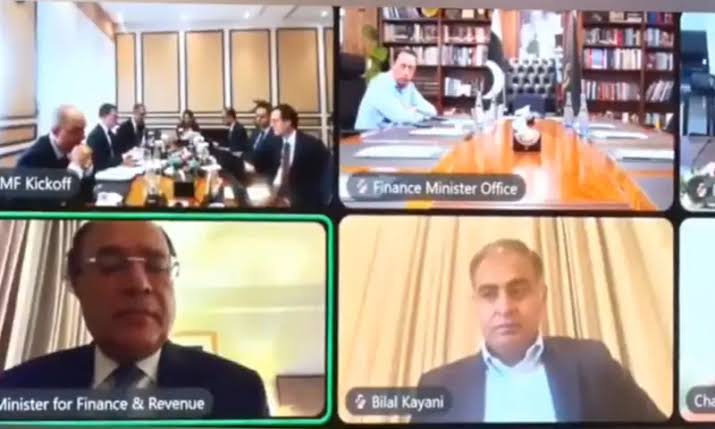
Finance Minister Muhammad Aurangzeb held a kick-off meeting with the IMF staff mission, led by Iva Petrova, the finance ministry said. The team is in Islamabad for the fourth review of Pakistan’s $7 billion Extended Fund Facility and the third review of a $1.4 billion Resilience and Sustainability Facility. Aurangzeb joined by video link. He briefed the mission on the latest macroeconomic indicators, improvements in the country’s credit rating and the investment climate, against a difficult outlook shaped by the prolonged conflict involving Iran. Minister of State Bilal Azhar Kayani, Federal Board of Revenue Chairman Rashid Mahmood Langrial and senior finance ministry officials also took part.
A successful conclusion would make Pakistan eligible for about $1 billion under the EFF and $200 million under the climate facility. The money would arrive by the end of October or early November, once the IMF’s executive board signs off. Islamabad may need waivers from the board for slippages on structural benchmarks. Any staff-level agreement would first have to clear the board.
The biggest gap is the sovereign wealth fund law. Authorities missed an end-March 2026 benchmark to amend the Sovereign Wealth Fund Act and put governance mechanisms and safeguards around seven state-owned enterprises, which together hold about $8 billion in assets. The companies are OGDCL, Pakistan Petroleum, Mari Petroleum, National Bank of Pakistan, Govt Holdings, Pakistan Development Fund and the Neelum-Jhelum hydropower project. Most are listed blue-chip companies, yet they remain outside normal reporting requirements. The amendments are still awaiting parliamentary approval, and the issue is on the table with the visiting team.
The government moved on a related front on Monday, two days before a Sept. 30 deadline, by notifying the Public Procurement Rules 2026. The rules make the E-Pak Acquisition and Disposal System, the state’s digital procurement platform, mandatory for federal agencies. They also require dedicated procurement cells and add third-party validation, evaluation and pre-shipment inspection for large purchases to curb conflicts of interest. Enforcement tools include blacklisting, cross-debarment and independent grievance committees with an appeal route to the Public Procurement Regulatory Authority. The rules also shorten response times and standstill periods and add faster methods such as shopping and negotiated tendering. They encourage participation by small businesses and marginalized groups.
The rules keep a carve-out that the IMF had questioned. Under Rule 32, agencies may contract directly with state-owned enterprises for works and services that are time-sensitive, scattered, remotely located or in the public interest, or where there is urgency, provided the contracts aren’t sublet. Bidding is limited to domestic firms. Contracts started before the new rules took effect continue under the 2004 framework.
Revenue is another pressure point. The government told the mission on Monday that the Gulf war and disruption in the Strait of Hormuz had cost it revenue in the first quarter and slowed economic activity. The Federal Board of Revenue told the team it would still meet its 3.053 trillion-rupee target for July to September, despite missing its August goal by 28 billion rupees, according to a report by 24NewsHD TV. The tax authority also said about 4.7 million income tax returns had been filed, up from 3.2 million a year earlier. Separately, roughly 10,000 federal employees must digitally declare their assets by Oct. 30 under a mandatory disclosure regime, officials told the mission.
Local media reports citing unidentified officials say the IMF’s concerns remain over slow progress on governance reforms at state-owned enterprises, continued market interventions and gaps in budget transparency. The fund is said to be focused on 853 billion rupees in statistical discrepancies in last fiscal year’s accounts, and detailed meetings on the issue are expected. Pakistan did beat the IMF’s primary budget surplus condition, which excludes interest payments. It missed by 370 billion rupees a requirement that the federal and four provincial governments together spend 3.47 trillion rupees on health and education. That could prove one of the harder points in the talks.
The mission arrived on Sept. 23 and spent its first days in Karachi with State Bank of Pakistan officials. It has since met the finance ministry, the revenue board, the Establishment Division, and the finance secretaries of Khyber Pakhtunkhwa and Punjab. It also began Article IV consultations, a broader assessment of the economy that would produce a report to serve as the basis for future engagement. Local reports say the mission will stay until the first week of October.
The talks come after a rocky stretch in the program. Pakistan and the IMF agreed on the $7 billion, 37-month EFF in July 2024, and the board approved it that September. It was Pakistan’s 25th IMF program since 1958 and its sixth EFF. The board cleared the first review in May 2025, releasing $1 billion and approving the climate facility. It approved a second review in December, releasing another $1 billion plus $200 million under the climate facility. A Petrova-led mission failed to reach a deal on the third review in March. The board approved it in May, releasing about $1.1 billion under the EFF and about $220 million under the RSF. That brought total disbursements under the two arrangements to roughly $4.8 billion.
Pakistan is also dealing with the fallout from the conflict that followed U.S. and Israeli strikes on Iran in February. Disrupted Gulf oil supplies have raised the import bill and domestic fuel prices. Prime Minister Shehbaz Sharif announced earlier this month a relief scheme of 100 rupees per liter off petrol for motorcycles, three-wheeled rickshaws and cars with engines up to 800cc. Last week, he met IMF Managing Director Kristalina Georgieva on the sidelines of the UN General Assembly in New York. He said the IMF hadn’t raised serious concerns about the targeted subsidy. Georgieva later said continued implementation of the reforms had helped preserve stability, restore confidence and regain market access.
Copyright © 2021 Independent Pakistan | All rights reserved