By Staff Reporter
ISLAMABAD: Pakistan, Saudi Arabia and Turkey have agreed to rapidly deploy military forces and capabilities in the kingdom, putting the collective defence commitments of their Mecca pact into practice after an emergency meeting in Riyadh on Monday.
The alliance’s Strategic Political and Defence Committee met to address what Pakistan’s Foreign Office called the security developments and threats facing Saudi Arabia. Its statement named no specific threat, but the meeting came as Saudi forces fight Yemen’s Houthi rebels and the kingdom’s cities and oil installations come under missile and drone attack.
The committee resolved to “move immediately to the practical implementation of the collective defence commitments”, the statement said. Deployments will follow arrangements already approved and each country’s national legislation.
The three countries condemned “in the strongest terms” the attempted targeting of Mecca and Medina, and continuing attacks on cities and on civilian and economic facilities. Pakistan and Turkey praised the vigilance and professionalism of the Saudi armed forces. The statement also described the security of each member as an “integral part” of the collective security of all three.
Khawaja Asif, Pakistan’s defence minister, was in the delegation. He told Geo News that Saudi Arabia had made gains and recovered some areas in Yemen. Asked about an operational role for Pakistan and Turkey, he said both had a “presence in theatre” but that only Saudi troops were involved in combat.
“Whatever assistance they require is being provided,” he said. “But right now, the Turkish and Pakistani armies are playing a supportive role.” He said Pakistan was involved in reconnaissance.
Mr Asif said the meeting mainly formalised the alliance’s operational structure. The committee named Lt Gen (retd) Nauman Mahmood of Pakistan as the alliance’s first secretary general, on a three-year term.
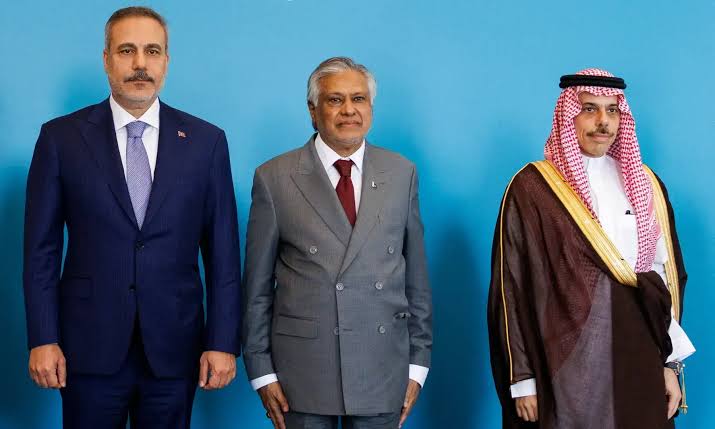
Pakistan’s delegation also included Deputy Prime Minister and Foreign Minister Ishaq Dar and Field Marshal Asim Munir, the chief of defence forces. Turkey’s foreign minister, Hakan Fidan, said the talks covered military assistance for Saudi Arabia alongside diplomatic efforts over Yemen.
The pact was signed in Mecca on 7 August by Crown Prince Mohammed bin Salman, Turkey’s president, Recep Tayyip Erdogan, and Pakistan’s prime minister, Shehbaz Sharif. It commits the three to treat an attack on one as an attack on all. Until now it has had little visible military effect. On 10 September, Pakistan said it was not considering an immediate military response to the Houthi attacks, which prompted questions about the pact’s practical value.
The three countries’ military chiefs met in Riyadh on 25 September. A week earlier, the head of Pakistan’s military press wing had said Islamabad would go to “any extent” to defend Saudi Arabia and that its commitment was “unconditional”.
The pressure on Riyadh has grown. A wave of Houthi attacks on 8 September wounded 73 people and set fire to oil facilities and utilities in the south.
The Yemeni government, backed by Saudi Arabia, launched a major campaign on Sunday to recapture territory held by the Houthis, who had seized Yemen’s Red Sea coast and the Bab al-Mandeb strait in a rapid offensive. The Houthis said Saudi Arabia had carried out 106 air and missile strikes in 24 hours, and claimed missile and drone attacks on Aramco sites in Riyadh and Khurais; there was no word from Riyadh on those claims. An AFP journalist saw flames and smoke at an Aramco facility near the capital on Saturday.
Iran, which backs the Houthis, has sought some distance. President Masoud Pezeshkian said the group was responsible for its own decisions.
Copyright © 2021 Independent Pakistan | All rights reserved