By Staff Reporter
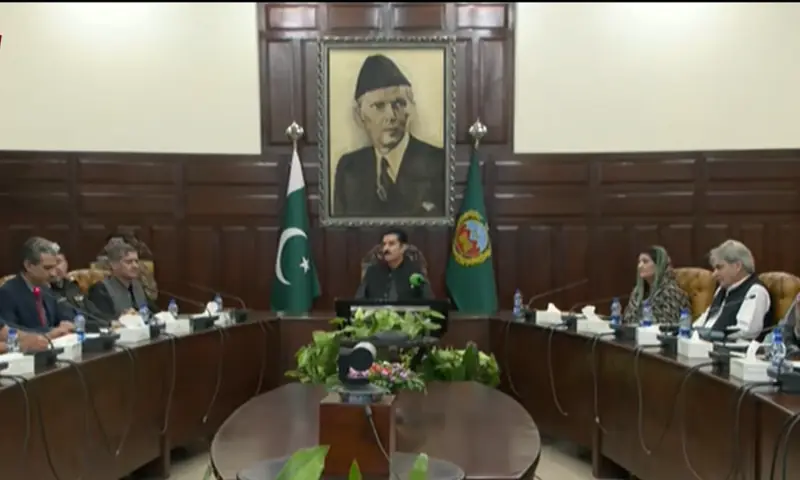
PESHAWAR: The governor of Khyber Pakhtunkhwa has vowed “zero tolerance” on corruption and promised to dismantle the networks that sustain terrorism, as he convened the first meeting of a federally appointed advisory council on the day Islamabad imposed emergency and governor’s rule on the opposition-run province.
Faisal Karim Kundi, a member of the Pakistan Peoples Party, which sits in the ruling coalition, told the 11-member body that it faced “many challenges” and must show a clear difference from the work of its predecessors.
President Asif Ali Zardari signed the proclamation on the advice of Prime Minister Shehbaz Sharif under Articles 232 and 234 of the Constitution, following recommendations from the federal cabinet. Law Minister Azam Nazeer Tarar said the arrangement would initially last six months. Under the federal order, the governor will perform the functions of the provincial government on behalf of the federal government, assisted by the council.
The presidency said the decision rested on law-and-order reports from security institutions and on the collapse of negotiations between a government delegation and the provincial leadership. The Centre has also alleged shortcomings in the provincial government’s counterterrorism efforts.
At the outset of Sunday’s meeting, each member introduced themselves and their portfolio. Kundi said they would be briefed on their assignments and given a few days to familiarise themselves.
“We have to fast-track things. There will be zero tolerance on corruption. Things should be done in a timely manner,” he said.
Law and order, he said, would be the first order of business, and there should be no hesitation in learning from the other provinces. He described the present situation as an “opportunity” to build the province’s soft image. “If we have peace, we will get tourists and investors. My support is with you. I am available for you 24/7,” he said.
Kundi then read a message to the people of the province, saying that “extraordinary circumstances” had required “necessary measures” under the Constitution. He said he would refrain from allegations and political rhetoric. “I have one message: peace, protection and stability have to be brought back to KP,” he said.
He said Pakhtuns were not a cause of terrorism but its “biggest victims”, and that the state was determined to rid the province of militancy so that children could go to school, businesses could operate and people could travel without fear.
Police officers, military personnel, Levies personnel, government employees, religious scholars, teachers, traders and ordinary citizens had all died, he said. “Mothers have lost their sons, children their parents, and families their loved ones. The time has come for the people to receive their right to peace after these sacrifices.”
The governor set out three priorities. The first, he said, was protecting the peace and the people, with the capacity of the police and the Counter Terrorism Department to be raised through better resources, training, technology, intelligence support and modern weapons. The state, he said, must stand behind officers confronting militants and ensure neither they nor their families were left unsupported.
The second was to strengthen the “writ of the state” in conflict-affected districts, whose residents have endured terrorism, displacement and prolonged deprivation. He promised those areas their due share of development, education, healthcare, employment, roads, electricity, water and administrative services. “The state’s duty is to give greater attention to areas where deprivation is greater,” he said.
The third was public service delivery. “Mere statements are not the real test of a government, rather the service it provides to the people,” he said, adding that the council would concentrate on healthcare, education and employment. Addressing young people, he said the state’s responsibility was to give them “not guns, but pens, books, skills, employment and hope”.
Kundi said the fight could not be won by targeting gunmen alone. Facilitators, financiers, extremism, illegal weapons, drugs and unlawful movement would all have to be addressed, he said, with the National Action Plan remaining central. “Those facilitating and financing … must be eliminated,” he said.
He insisted the measures were not directed at any party, nation, language or region. “The law will take action against anyone who commits terrorism, and it will also reach those who facilitate it,” he said.
Council and district secretariat
The council comprises Tariq Mahmood Pasha, Dr Aamir Abdullah, retired Lieutenant General Nigar Johar, Samar Bilour, Dr Sarfaraz Ali, Aamir Javed, Dr M Irshad, Kefayatullah, Tayyab Qureshi, Usman Saifullah Khan and Asif Rafiq. The federal government has also appointed Sanaullah Advocate as the province’s Advocate General.
A separate federal order, issued in a Gazette notification, creates an Area Development Secretariat in 12 designated districts: Dera Ismail Khan, Tank, Lakki Marwat, Bannu, Bajaur, Mohmand, Khyber, Kurram, Orakzai, North Waziristan, Upper South Waziristan and Lower South Waziristan.
The secretariat will be headed by the province’s additional chief secretary (Designated Districts), who will act as administrator and exercise all “administrative, managerial, and law enforcement powers” of the provincial government in those districts. Provincial officers and personnel from other agencies deployed there will fall under the secretariat’s administrative and operational control.
The administrator may set up organisational structures for governance, security and development, direct the civil administration, police and military authorities, and “issue orders for the allocation and transfer of funds”. His orders will carry the same legal status as those of the provincial government.
The order says Chapter III of Part IV of the Constitution and Article 175(3), along with the provincial Rules of Business 1985, will not apply in the designated districts. A supervisory Area Representative and Development Council of prominent local figures will oversee the secretariat. The prime minister may order further postings and transfers on the administrator’s recommendation. “This Order shall come into force at once,” the notification said.
The emergency follows a fortnight of confrontation. A PTI march on Islamabad led by Afridi began in Lakki Marwat on 4 October after talks between the government and opposition broke down over counterterrorism cooperation in the province and access to the jailed party founder, Imran Khan, including a visit from his personal doctor. Mr Afridi had called on supporters to gather in Swabi district by 14 October before heading for the capital.
Copyright © 2021 Independent Pakistan | All rights reserved