By Staff Reporter
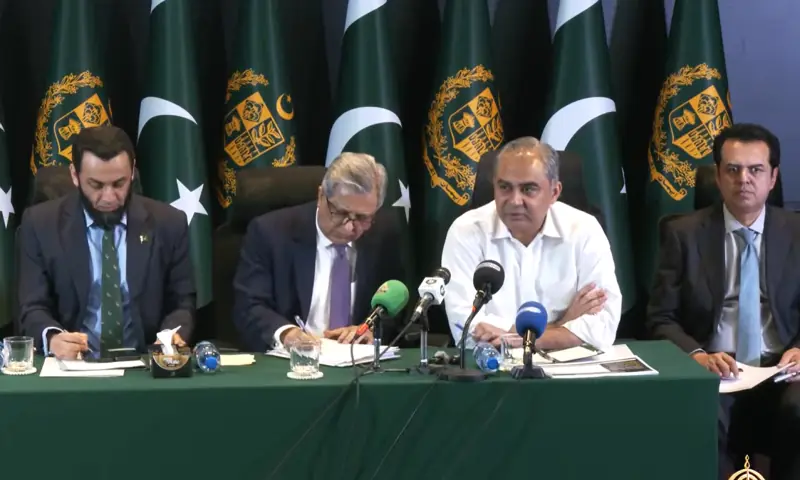
ISLAMABAD: Information Minister Attaullah Tarar has accused the government of the jailed former prime minister Imran Khan’s party in Khyber Pakhtunkhwa of a “nexus” with militant groups, in a press conference called to justify the federal takeover of the province.
Tarar spoke on Sunday, shortly after the federal government imposed an emergency in the north-western province. He was joined by Interior Minister Mohsin Naqvi, Law Minister Azam Nazeer Tarar and Tallal Chaudhry, the minister of state for interior. The ministers cited the provincial government’s failure to fight terrorism. Khyber Pakhtunkhwa was the only province where Khan’s Pakistan Tehreek-e-Insaf (PTI) was in power.
Tarar said every cabinet member who attended Sunday’s meeting believed the PTI government was “hand in glove with terrorists” and had an “unholy alliance” with them. “Terrorists have a clear say in how each district will be run,” he alleged, citing reports from the Intelligence Bureau and law enforcement agencies. He did not produce the reports.
He claimed that while other political parties had come under attack in the region, the PTI enjoyed “secure access and passage” because of its alleged alliance with militant groups. “What is the reason that even police stations of some districts have been sublet to the Taliban?” he asked, adding that the case was one of “empowering” the militants as well as inaction and incompetence.
The minister alleged that a “power-sharing formula” had been taking shape between militants and the provincial government, beginning in the southern districts and spreading across the province. He said the alliance had allowed several districts to be “outsourced” to militants, enabling attacks on civilians and infrastructure. “I say this publicly that these [Taliban] are foreign-funded people who want to bring our country to destruction,” he said, calling a provincial government’s facilitation of such elements a “constitutional breakdown”.
He also pointed to a recent bill on police assignments, alleging that the provincial government wanted to “hire individuals from terrorist groups in the police”. He said “irrefutable proof and evidence” was available. The PTI has not been reported as responding to these specific claims.
“Today was not an easy day”
Naqvi gave an account of the weeks before the decision. He said the Centre had tried for more than a month to bring the provincial government on board, with himself in contact in the background. “Our only goal was to onboard them so that we could fight together against terrorism,” he said.
He said he had been in touch with PTI leaders until 11.45pm on Saturday and had been communicating with them all day about the draft’s fourth paragraph. “They did not respond all day,” he said. “I told them that we can still avoid the situation.”
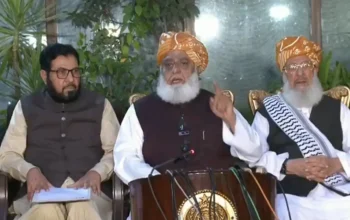
The interior minister said the Centre had repeatedly told the PTI it had “no issue” with the party’s long march. “Our issue was entirely terrorism-related, and we want to take you on board on it,” he said, insisting the matter was “not linked to politics even one per cent”. He said the veteran politician Maulana Fazlur Rehman had also tried to reduce tensions, without success.
Naqvi said the situation was “really bad” in 12 districts. “In some districts, you cannot even leave your house in the evening,” he said. He said the Centre had proposed strengthening the provincial police in five districts and handing security to them within six months, then repeating the process in another five. The provincial side cited a lack of funds, he said, though the Centre had offered more. “This was a four-month-old conversation but still no work has happened on it,” he said.
On the talks of 3 October, which broke down, he said the situation would have been different had an agreement been reached then, and that the emergency would not have happened “even if last night they had said yes”. He said the draft had been revised four times before the government’s negotiators found that the opposition had presented a new one. “Although the previous day the chief minister had authorised them to agree on their behalf, the next day it all changed,” he said. He said the PTI’s Asad Qaiser had told the talks “with clarity” that no step back on terrorism was possible. He added: “Ask them who their masterminds are. Who were sabotaging them?”
Naqvi claimed the PTI team had agreed to an emergency in 12 districts but were “scared of being seen meeting with us”. He also alleged: “Their connections with the Taliban are no secret. I would not say anything further.” He noted that the party had held rallies in districts described as dangerous without anyone being harmed.
“We only had two options: either we would see the martyrdoms daily, or we end them,” he said. “So this difficult decision we have made has a background.”
Warning to marchers
Naqvi urged groups gathered in parts of the province, an apparent reference to PTI supporters on the party’s long march, to disperse because they no longer had “provincial protection”. “Whoever is caught, complete legal action will be taken and that person themselves will be responsible for it,” he said.
Asked about reported arrests of provincial ministers, he said people would be held under preventive detention where needed to maintain order, while those “wanted will be arrested”. On a question about Balochistan, he said counterterrorism operations there in recent months had made a “difference”.
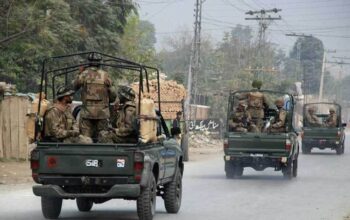
The law minister said an Area Development Secretariat, overseen by the governor, had been created to run 12 districts directly. He described them as districts “that were nearly in a war situation”. He noted that Parliament now exercises the legislative powers of the provincial assembly, which is non-functional. He also said troops had been ordered to help the governor maintain law and order under Article 245 of the Constitution.
The order covers Dera Ismail Khan, Tank, Lakki Marwat, Bannu, Bajaur, Mohmand, Khyber, Kurram, Orakzai, North Waziristan, and Upper and Lower South Waziristan. The secretariat will be headed by an administrator, the additional chief secretary of those districts, who will hold the executive, administrative and law enforcement powers of the provincial government. He can issue binding orders to civil, police and military authorities and reallocate funds, and his orders will carry the same legal force as the provincial government’s. A council of local notables will oversee the secretariat.
The order disapplies the Constitution’s chapter on provincial governments and Article 175(3), which provides for the separation of the judiciary from the executive, in the designated districts. The provincial Rules of Business 1985 will not apply there either.
The Centre has also formed an 11-member advisory council under Article 232 to assist the governor across the rest of the province. Former prisons chief Kifayatullah Khan will oversee home affairs, and Tariq Mahmood Pasha, a former head of the Federal Board of Revenue, will advise on finance. The others are Samar Haroon Bilour (information), retired Lt Gen Nigar Johar (health), Amir Javed (law), Osman Saifullah Khan (energy and power), Asif Rafiq Afridi (communication and works) and Maulana Tayyab Qureshi (religious affairs). Advocate Sanaullah is the new advocate general.
Tarar said all the advisers held doctorates or had extensive public service experience, naming Dr Muhammad Irshad (industries and commerce), Dr Sarfraz Ali Shah (mines and minerals) and Dr Syed Amir Abdullah (education).
Copyright © 2021 Independent Pakistan | All rights reserved