By Staff Reporter
ISLAMABAD: Maulana Fazlur Rehman, a key political mediator, has accused the government of going back on its commitments after it imposed an emergency and governor’s rule in Khyber Pakhtunkhwa, ending Imran Khan’s party’s control of the province.
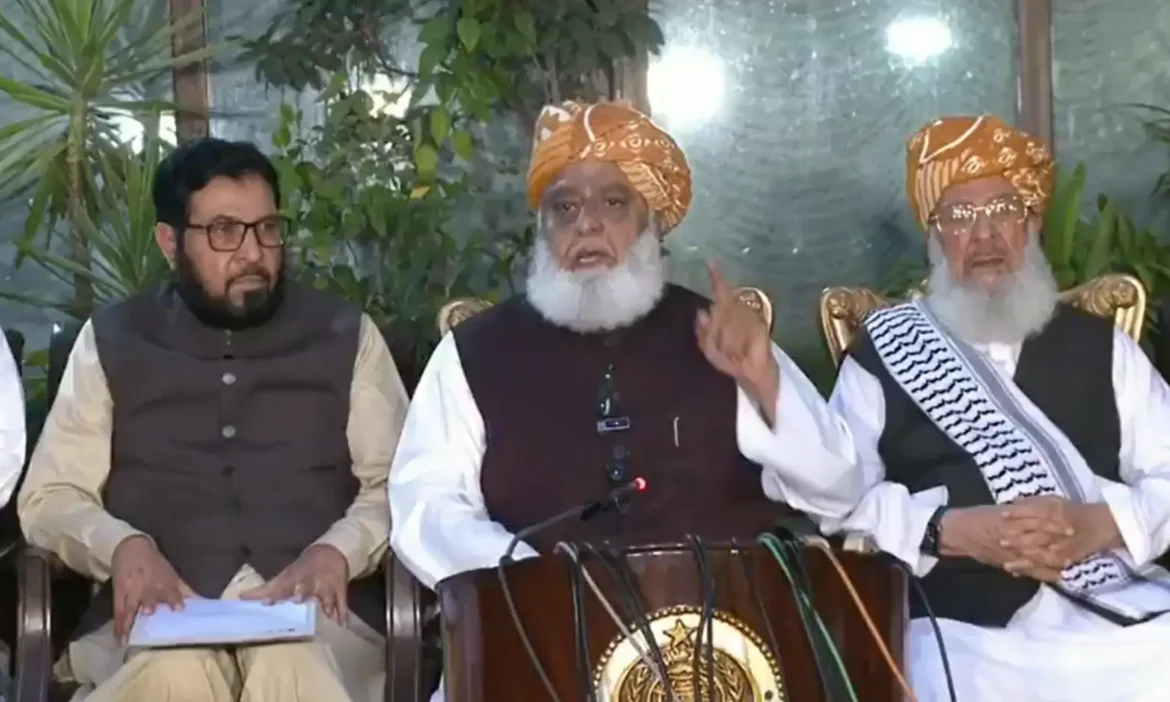
Rehman, who leads the Jamiat Ulema-i-Islam-Fazl (JUI-F), had been cast until Sunday as the one figure who could defuse the confrontation between Islamabad and the Pakistan Tehreek-e-Insaf (PTI). He told a press conference at his Islamabad residence, held after an emergency meeting of his party’s Central Core Committee, that he had been brought into the process by both sides and then overruled by one of them.
The measures were approved by President Asif Ali Zardari on the recommendation of Prime Minister Shehbaz Sharif’s federal cabinet, under Articles 232 and 234 of the Constitution, and they pass executive authority in the province to the governor, Faisal Karim Kundi. The Prime Minister’s Office accused the PTI-led provincial leadership of “deliberate indifference in the war against terrorism”, while the President’s Office said Mr Zardari had studied security intelligence reports and noted the failure of negotiations with government delegations.
Rehman said he returned from Umrah on 7 October, after which opposition leaders approached him and asked him to help end the impasse. Federal ministers visited him the next day and also sought his intervention.
The two sides had been on a collision course since the PTI announced a long march on Islamabad to demand the release of Khan, its jailed founder. Bilateral talks collapsed on 3 October and the march began the following day, led through the province by the chief minister, Sohail Afridi. The march stayed inside Khyber Pakhtunkhwa. In the meantime, several federal ministers began speaking openly about an emergency and governor’s rule, linking them to the province’s security situation and the PTI’s alleged failure to cooperate on counterterrorism.
Rehman said the march had held back from entering Islamabad at his request, and that the government’s plan to impose an emergency was deferred after a government delegation approached him.
He was then invited to meet Sharif at the Prime Minister House. “Although I felt the government had already made up its mind, my colleagues advised me to meet the prime minister,” he said.
The two sides, he said, were deadlocked over who should move first. The government insisted the march be called off before anything else. The PTI wanted its leaders allowed to meet Khan in jail, and a court order for his transfer to a private hospital implemented. “I asked both sides to authorise me to act as a mediator and make decisions to move the process forward,” Rehman said.
He then held a conference call with Afridi, the PTI chairman, Barrister Gohar Ali Khan, and the party leader Asad Qaiser, among others. Asked whether the PTI would end its march if its demands were accepted, Afridi replied that it would, Rehman said.
Rehman took that message back to the prime minister and asked for an assurance that the PTI would be allowed to meet Khan, and that Khan would receive the medical treatment he needed. He said he planned to travel to Peshawar to speak to Afridi and other stakeholders. He also wanted two representatives each from the PTI and the PML-N to join talks under his supervision.
Then, he said, the deputy prime minister and foreign minister, Ishaq Dar, telephoned him during Sunday’s cabinet meeting to say the government wanted to impose an emergency in the province because of the security situation.
Rehman said he challenged the reasoning, noting that the security situation in Balochistan was worse than in Khyber Pakhtunkhwa and the government had imposed no governor’s rule there. “I asked Dar why I was asked to mediate if the cabinet was going to make the decision on its own,” he said.
Asked whether politicians were to blame for the failure of the talks, he said the question should go to the prime minister. “Ask Shehbaz Sharif how much authority he had during the negotiations,” he said. He added that the government had put obstacles in the way of the negotiations.
Rehman called the move an “attack on democracy and the rights of the people” and said he rejected it “word for word”. He said his party would challenge it through every democratic and constitutional forum available, including parliament and the courts. “We are not prepared to bow, even for a moment, before such unconstitutional measures,” he said.
Rehman also criticised the Pakistan Peoples Party, saying its role in the matter had undermined the Constitution and democracy. Citing military operations since the tenure of the former military ruler Pervez Musharraf, he said the approach had failed repeatedly.
Pressed on the PTI government’s record, he said that if it had failed, the situation in Balochistan was worse. Asked whether the opposition would resign from the assemblies, he said the question would be considered if and when the situation arose.
Crackdown on the ground
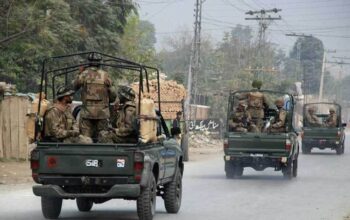
The hours after the announcement brought a more forceful federal presence in the province. Mobile and data services were throttled or cut in selected urban areas, police were heavily deployed, and shipping-container barricades went up along key routes, particularly around Peshawar. A new chief secretary was installed, and a senior officer was transferred to the province to oversee operations under federal direction.
A couple of hours after the announcement, the provincial information minister, Shafi Jan, who was travelling with the march, said Afridi had been taken into custody. The PTI also said its provincial president, Junaid Akbar, had been arrested. Authorities have not confirmed either claim.
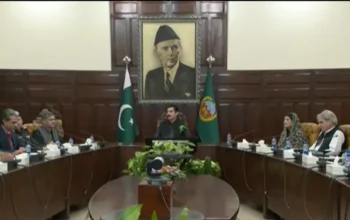
Governor Kundi chaired the first meeting of an 11-member advisory council in Peshawar on Sunday evening and said the state was committed to bringing peace and stability to the province. The day before, he had ruled out further talks with the PTI. The interior minister, Mohsin Naqvi, told reporters on Saturday there was little room left to avoid an emergency.
The PTI has described the move as politically motivated and intended to weaken the party. Opposition to it has not come only from Khan’s supporters: JUI-F, the Awami National Party and Jamaat-e-Islami have all spoken against extraordinary measures. The ANP leader, Aimal Wali Khan, who blamed the PTI government for the province’s worsening situation, said Khyber Pakhtunkhwa could not be made a testing ground for further political experiments.
Local media reported that the president and prime minister had agreed to hold separate sessions of the National Assembly and Senate on 13 October. The sessions are expected to be the first parliamentary test of the decision.
The confrontation has deepened a long-running dispute between the PML-N-led federal government and the PTI administration in Peshawar over counterterrorism operations and talks with the Afghan Taliban. Islamabad accuses the provincial government of failing to counter militants, while the PTI says it has been shut out of key security decisions and opposes military offensives in the region.
Copyright © 2021 Independent Pakistan | All rights reserved