By Staff Reporter
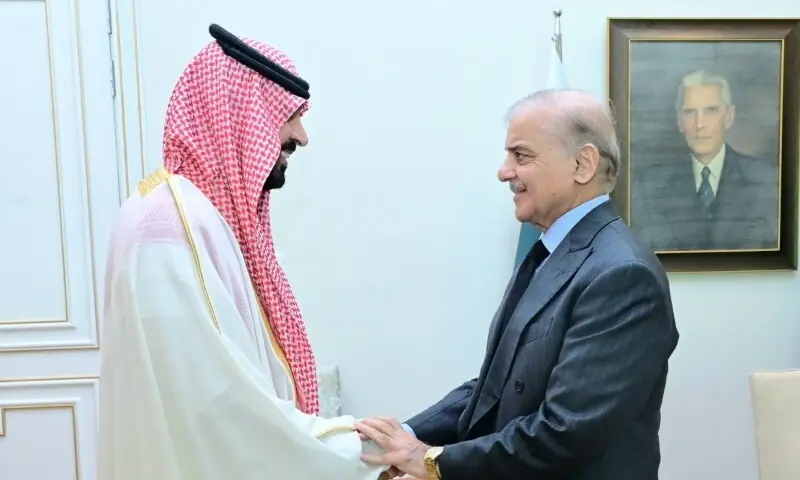
ISLAMABAD: Prime Minister Shehbaz Sharif has vowed that Pakistan will stand “shoulder to shoulder” with Saudi Arabia against escalating Houthi attacks that have killed and wounded Pakistani nationals in the kingdom.
Sharif made the pledge in Islamabad on Friday during a meeting with Saudi Arabia’s newly appointed ambassador, Dr Rajeh Tami Albugamy, who took up his post on Thursday, according to a statement from the Prime Minister’s Office (PMO). He said Pakistan would support the kingdom in safeguarding its “sovereignty, security and territorial integrity”.
The prime minister “strongly condemned” the recent surge in Houthi attacks, which the PMO said had caused deaths and injuries, including among Pakistani nationals.
He told the envoy that relations between the two countries had made significant progress in recent years and that they had always stood by each other. He described the Strategic Mutual Defence Agreement and the Makkah Joint Defence Alliance as “historic milestones” that reflected a shared commitment to regional peace and security. Sharif also thanked the Saudi leadership for its longstanding economic and financial support to Pakistan and promised Islamabad’s full cooperation in deepening ties.
The meeting came less than a week after the deadliest attack on Saudi soil in more than a decade. A missile strike on Riyadh’s King Khalid International Airport last Saturday killed at least 12 people and wounded more than 300. A second strike the following day killed a Pakistani resident and wounded 11 others, Saudi Arabia’s civil aviation authority said. Sharif said after the first attack that six Pakistani nationals were among the injured. Operations at the airport were suspended, with no clear date for resumption.
The violence has continued this week. On Tuesday, Saudi Arabia struck Houthi-controlled areas of Yemen, targeting fuel and energy facilities it said were supporting missile and drone attacks. The Yemeni group had threatened a “harsh and painful” response against Saudi airports, refineries and oil installations.
Hours later, Saudi authorities warned of possible hostile aerial threats in the Eastern Province and Riyadh. Witnesses reported loud explosions near Saudi Aramco’s headquarters in Dhahran. The energy ministry said a limited fire broke out in an administrative building and that no one was hurt. Two regional officials told the Associated Press that the strike damaged the top three floors, including offices of the company’s chief executive and other senior figures.
Saudi Arabia’s civil defence agency said debris from two intercepted Houthi missiles wounded four people in the capital – two women, a man and a child – and damaged 15 homes.
On Wednesday, the Houthis said they had targeted Aramco facilities and Riyadh’s airport with a ballistic missile, after the Saudi-led coalition reported intercepting a missile fired towards the capital. On Thursday, the coalition said the Houthis had attacked Riyadh’s airport 20 times this month, and that it had shot down a cruise missile over the Medina region, a claim the Houthis denied. Government military sources in Yemen said four people were killed when Houthi missiles struck the presidential palace in Aden.
The Houthis have repeatedly attacked Saudi airports, oil facilities and tankers since a truce in their long-running war with Yemen’s coalition government unravelled in July.
The attacks have started to disrupt life in the kingdom. The European Union has postponed a summit with Gulf states due to be held in Riyadh on 24 October. The Six Kings Slam tennis exhibition has been moved to 27 December, and the Asian Tour’s Saudi International golf event has been postponed. Organisers of Riyadh’s Future Investment Initiative forum, due to run from 26 to 29 October, are offering remote attendance and alternative travel routes.
A senior Saudi foreign ministry official said on Thursday that Iran continues to arm, train and support the Houthis, and that Tehran was encouraging the latest escalation. A senior Houthi official told the Associated Press that regional and international powers had approached the group about a ceasefire. The fighting is unfolding against the backdrop of the US-Israeli war with Iran, now in its seventh month.
Dr Albugamy also met Deputy Prime Minister and Foreign Minister Ishaq Dar, who underscored the “longstanding fraternal and strategic ties” between Islamabad and Riyadh, according to the Foreign Office. Mr Dar reaffirmed the two countries’ “shared commitment to further strengthen bilateral cooperation for mutual progress and prosperity”. The ambassador conveyed greetings from the Saudi leadership, and Mr Dar sent his best wishes to King Salman bin Abdulaziz Al Saud, Crown Prince Mohammed bin Salman and other Saudi leaders.
Pakistan’s public backing for the kingdom has firmed up in recent weeks. On 18 September, Inter-Services Public Relations Director General Lt Gen Ahmed Sharif Chaudhry said Pakistan would go to “any extent” to defend the Gulf state. He described its commitment to the kingdom’s security as “unconditional”.
On 5 October, at an emergency meeting of the Makkah pact in Riyadh, Pakistan, Saudi Arabia and Turkey agreed to the rapid deployment of military forces and capabilities. Defence Minister Khawaja Asif, a member of Pakistan’s delegation, said Pakistan and Turkey had “presence in theatre”, but that only Saudi troops were involved in combat operations.
Asif has also said Pakistan will stand by Saudi Arabia “practically and diplomatically” against the Houthis if the situation escalates, and that it will meet all its obligations under the alliance in line with the agreement between the three countries.
Pakistan has also stressed that the alliance is intended for collective deterrence and is defensive in nature.
Copyright © 2021 Independent Pakistan | All rights reserved