By Staff Reporter
ISLAMABAD: Pakistan will chair the boards of governors of the International Monetary Fund and the World Bank Group next year, its first turn in the post since 1953, the government said on Friday.
Ahad Khan Cheema, the economic affairs minister and Pakistan’s governor to the World Bank, was formally announced as incoming chair at the plenary session of the 2026 annual meetings in Bangkok, the ministry said in a statement on Friday. The gathering, which runs through Oct. 18, has drawn more than 15,000 participants from 191 countries, including central bank governors, policy makers and business leaders.
The ministry called the appointment a “historic milestone.” It said the role would give Pakistan “an opportunity to contribute to global economic and development discussions and facilitate constructive dialogue among member countries.”
The last time Pakistan held the chair was at the eighth annual meeting of the IMF and World Bank governors in Washington in September 1953, which was presided over by Mohamad Ali, the country’s governor at the time.
After the plenary, Cheema was briefed by the World Bank Group’s Corporate Secretariat on the duties of the chairmanship, the ministry said. He also met Aradhana Kumar-Capoor, the bank’s vice president and corporate secretary, to discuss institutional support and coordination during Pakistan’s term.
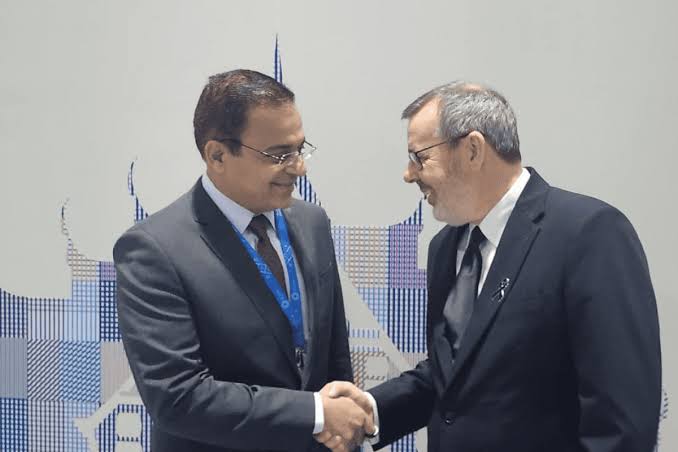
Cheema also met Carlos Carvallo Spalding, governor of Paraguay’s central bank and the outgoing chair, congratulating him on completing his tenure and commending his stewardship, according to the statement. The two discussed the responsibilities of the office and priorities for the coming year.
Cheema told the meetings that Pakistan is committed to “strengthening the voice of developing countries,” promoting effective and predictable development financing, improving coordination among multilateral development institutions and mobilizing private capital for sustainable and inclusive growth. He reaffirmed Pakistan’s resolve to work closely with the World Bank Group, the IMF and member nations toward a more responsive multilateral development and financial system, the ministry said.
Finance Minister Muhammad Aurangzeb, who is leading Pakistan’s delegation in Bangkok, met World Bank Group President Ajay Banga at a dinner hosted by the Thai prime minister on the sidelines of the meetings, state-run Pakistan TV reported. The broadcaster described the encounter as an informal interaction. Aurangzeb is also holding talks with international financial institutions, finance ministers, policy makers and investors.
On Oct. 12, Pakistan took over the chairmanship of the Governing Council of the Borrowers’ Platform, with Aurangzeb accepting the role in Bangkok. He said the platform would focus on knowledge-sharing and technical cooperation rather than act as a collective bargaining forum or a crisis-management mechanism, and he named debt-management practices, reform experiences and innovative development financing instruments as priorities for the 2026-27 work plan.
The appointments come as Pakistan stays in the IMF’s debt in a $7 billion Extended Fund Facility and a $1.4 billion Resilience and Sustainability Facility. IMF staff reached a staff-level agreement with Pakistani authorities last Thursday on the fourth review of the extended arrangement and the third review of the sustainability facility, clearing the way for about $1.2 billion in disbursements. That would comprise about $1 billion under the EFF and about $210 million under the RSF, taking total disbursements under the two programs to roughly $5.7 billion, subject to approval by the IMF’s Executive Board.
The IMF said Pakistan had navigated the impact of the Middle East conflict, with growth estimated at 3.6% for the fiscal year that ended in June after expanding 4% in the first three quarters. Headline inflation peaked in May and eased to about 10.3% in September, while sovereign rating upgrades and renewed access to international markets pointed to stronger policy credibility, the fund said. The IMF team, led by Iva Petrova, held talks from Sept. 23 to Oct. 7, and the money is expected to arrive within four to five weeks of approval.
Pakistan has turned to the IMF more than 20 times since 1958.
Copyright © 2021 Independent Pakistan | All rights reserved