By Staff Reporter
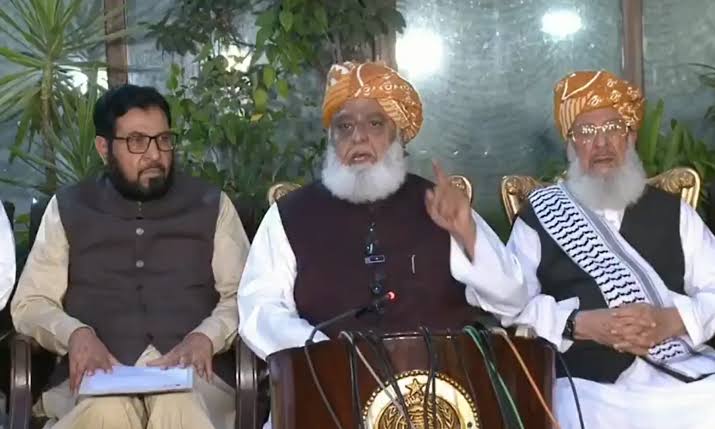
ISLAMABAD/LAHORE: The head of one of Pakistan’s largest religious parties has called for a closed-door session of parliament on terrorism, after a string of ministers and the military’s spokesman attacked him over his criticism of emergency rule in Khyber Pakhtunkhwa.
Maulana Fazlur Rehman, who leads the Jamiat Ulema-e-Islam-Fazl (JUI-F), told a press conference in Lahore on Saturday that the country needed a unanimous national policy against militancy and that the public should be taken into confidence.
“Why are we not achieving success in the campaigns and challenges we face? The more medicine we administer, the more the disease grows,” he said. “The only platform to take the nation into confidence is parliament.”
He said he had repeatedly asked for an in-camera session to examine why the state had failed to achieve the success it wanted against militants, and urged the government to accept his offer. If ordinary people were expected to join the fight and “stand in trenches”, he said, they had to be told what was happening.
Rehman said his criticism was aimed at policies, not institutions, and described the allegations made against him by federal ministers as character assassination. He said about 250 religious scholars and party workers had been killed in terrorist violence over the years. “How can a party whose members have laid their lives be accused of supporting terrorists?” he asked.
“We are not making fun of the sacrifices; we are criticising policies with the intention of bringing about improvements,” he said.
Rehman also challenged the way power is exercised in Pakistan. “If Parliament is supreme, why are decisions taken in Rawalpindi while Parliament is simply told to follow them?” he said, referring to the city that hosts army headquarters. “The issue is that this government is powerless. Decisions are taken somewhere else, and it implements them obediently,” he alleged.
The JUI-F chief questioned why Khyber Pakhtunkhwa (KP) had been placed under governor’s rule and an emergency when Balochistan faced the same level of terrorist violence, “if not more”. He also asked why the government had negotiated with the Pakistan Tehreek-e-Insaf (PTI), the party of the jailed former prime minister Imran Khan, if it considered the party to be backing terrorists.
Recalling his family’s record, he said his father had resigned when the government of Zulfikar Ali Bhutto imposed an emergency in Balochistan in the 1970s. He said he was a loyal citizen of Pakistan but opposed coercive measures, and noted that he had himself been jailed for six months.
The federal government imposed governor’s rule and an emergency in KP on 11 October, citing the PTI-led provincial government’s “deliberate disengagement” from the fight against terrorism. A joint sitting of parliament endorsed the measures on Thursday despite protests from opposition benches. Interior Minister Mohsin Naqvi told that sitting the Centre had been left with “no option”.
The move followed weeks of tension after the PTI announced a march on Islamabad to demand Khan’s release. Talks between a government-PPP delegation and the opposition, including a second round on 3 October that lasted hours, produced no breakthrough. Rehman had been cast as a possible mediator, and both sides met him separately.
On the day the measures were imposed, he said his party might protest on its own or alongside the PTI. He told reporters in Islamabad that both options remained open and the party would decide after consultations.
Prime Minister Shehbaz Sharif said the government had been “compelled” to act over security concerns and had made a “last attempt” to avoid it. He said he had held repeated meetings with Sohail Afridi, the KP chief minister, and his predecessor Ali Amin Gandapur. The government, he said, had instead faced “threats and long marches every other day”.
His elder brother Nawaz Sharif, the PML-N president, went further. Speaking to journalists at his London residence, he said the intervention should have come much earlier. “Which country allows a chief minister to use official resources to attack the federal capital?” he asked.
Government response
Naqvi said on Friday, without naming anyone, that the “head of a party” was “extremely upset over being denied a role in the new setup in KP and not getting the governorship”. He alleged the politician had remained “dependent on the establishment for decades”. Maryam Nawaz, the Punjab chief minister, also criticised Rehman in a post on X, saying a senior politician should not be supporting those who facilitate terrorism.
Talal Chaudhry, the minister of state for interior, said on Saturday: “I am upset. We did not expect Maulana sahib […] to consider this as spoils of war and seek his share in the absence of a PTI government in the province.” He insisted the KP arrangement was “an administrative setup” with a “one-point agenda: combating terrorism”, and said Rehman’s party had lost to the PTI in KP and to the Pashtunkhwa Milli Awami Party in Balochistan.
He criticised Rehman for raising the 1971 separation of East Pakistan, saying: “You bring up 1971 after losing the 2024 elections.” He also alleged “a relationship or a mutual interest arrangement” between the Tehreek-e-Taliban Pakistan (TTP) and the PTI, and displayed a TTP press release condemning the dismissal of the provincial government. He called for implementation of a second National Action Plan and for parties to name and condemn the TTP and the Balochistan Liberation Army. The Centre accuses the PTI of backing terrorism.
Defence Minister Khawaja Asif accused Rehman of constantly “targeting” the security forces. He said the government had engaged the whole PTI and opposition leadership before imposing the measures, “but it was fruitless”. Parliament could roll back the emergency, he said, only if improvement in the province was guaranteed.
The military’s media wing also weighed in. Lieutenant General Ahmed Sharif Chaudhry, director general of Inter-Services Public Relations, said insulting remarks about the armed forces and the martyrs of Kargil promoted India’s narrative. “It is beyond comprehension that anyone would do such a thing,” he said. He also questioned whether anyone would lay down their life merely for a salary.
Minerals dispute
KP Governor Faisal Karim Kundi, who now runs the province, rejected Rehman’s opposition to governor’s rule. He said the province’s mineral wealth should be developed with foreign and Pakistani investors. “Minerals are meant to be extracted. We will extract them and sell them as well,” he said. He also said the previous provincial government had taken its decisions from Kabul and Kandahar rather than Islamabad, an allegation he made without offering evidence in the remarks reported. Mr Kundi also questioned whether land in Dera Ismail Khan held by Mr Rehman, which he described as belonging to martyrs, was “halal”. He added: “The government in Khyber Pakhtunkhwa has been formed without him and will continue to function.”
Asif denied that the military was seeking mining contracts in KP. He said the PTI government had issued thousands of licences to party leaders and to individuals based in the United States.
The JUI-F’s deputy secretary general, Maulana Muhammad Amjad Khan, said the interior minister should apologise. He pointed to a statement by Rana Sanaullah, an adviser to the prime minister, that Rehman had not asked for a governorship. Sanaullah has said the government had wanted Rehman in its alliance after the 2024 elections and that he declined.
Rehman had told a rally in Multan on Thursday that his party had reservations about the 2018 merger of the tribal areas into KP. He alleged governor’s rule had not been imposed in Balochistan because that province’s chief minister “praises you”.
Copyright © 2021 Independent Pakistan | All rights reserved