By Staff Reporter
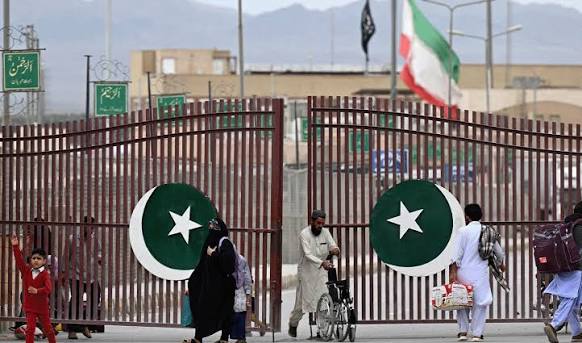
ISLAMABAD: Pakistan has suspended trade with Iran through the Taftan and Gabd-Rimdan border crossings, stranding hundreds of trucks and threatening supplies of liquefied petroleum gas to the South Asian nation.
The Ministry of Commerce issued a memorandum on Friday withdrawing an earlier order dated Oct. 3, with immediate effect. The memo didn’t specify a reason for halting trade through the two crossings.
Officials in Balochistan, the southwestern province where both crossings are located, pointed to security. “Trade through the Iran border has been temporarily suspended due to security reasons,” Chagai Deputy Commissioner Bakhtiar Ismail said in a post on X, adding that the closure was a measure to improve border management and support counterterrorism efforts. The border will reopen “as soon as effective measures are in place,” he said.
Shahid Rind, an adviser to the Balochistan chief minister, said the closure was meant to address security concerns, prevent smuggling and make the border system more effective. In a statement on X, he dismissed “rumours being spread on social media” and said talks between senior officials of both countries on administrative issues were making progress. The border is “likely to reopen soon,” Rind said, adding that a coordinated system was being set up to improve border affairs and curb smuggling.
Iran described the shutdown differently. Foreign Ministry spokesman Esmail Baghaei said cross-border movement and exchanges had been suspended temporarily because of technical issues and the need for precautionary measures. Authorities in both countries are in close contact and working to restore normal operations as soon as possible, state-run IRNA reported him as saying.
Iran-based Wana news agency reported that passenger traffic through the Rimdan-Gabd crossing remains operational. It quoted Syed Hossein Hosseini, director general of the Iranian Transit Office, as saying commercial operations there had been halted.
The Quetta Chamber of Commerce and Industry has advised members trading with Iran to stop placing new import and export orders until further notice. Sources said Pakistani and Iranian authorities have made initial contact since the closure.
Traders said the suspension came without warning. Ayoub Miryani, a former president of the Quetta chamber, said more than 2,000 containers were stranded at Gabd-Rimdan, and that the closure would cost traders “billions of rupees.” Hajji Liaquat Essazai, an LPG trader in Taftan, said hundreds of trucks were stuck and nobody knew how long the closure would last.
A customs clearing agent at Gabd-Rimdan, who asked not to be named, said about 65 containers he had cleared were stuck at the border, and that more trucks carrying fresh produce from Sindh and Punjab were on their way. Pakistani traders had already paid their Iranian counterparts, he said.
The energy implications may be the most acute. Gabd-Rimdan had become a main route for Pakistan’s energy needs, with more than 4,000 metric tons of LPG reportedly imported through it every day. Trade and energy sector sources warned the closure could worsen LPG shortages in Karachi and elsewhere, and push up prices in the open market. Pakistan imported LPG worth $687 million from Iran in 2024.
Rice exports through the crossing had also surged in recent months, bringing in millions of dollars in foreign exchange. Traders and the chamber warned of losses to the national exchequer, lost livelihoods and an energy crisis.
The Taftan route was already disrupted by unrest in Balochistan. Trade through the Panjgur and Mand-Radig crossings has been virtually non-existent, Gwadar Chamber of Commerce and Industry President Jiand Hoot has said, citing poor roads and recurring arson and vehicle burnings.
Gabd-Rimdan has stopped before. Trade through the crossing came to a complete halt in June, when the Gwadar chamber blamed Pakistani customs procedures.
Since March, Islamabad and Tehran have eased customs procedures, formalised Taftan as a customs station and notified new transit routes, as the war that began with US and Israeli strikes on Iran on Feb. 28 strained regional economies. An Iranian delegation led by Trade and Industry Minister Mohammad Atabak visited Islamabad in early August for the 10th session of the Pak-Iran Joint Trade Committee. After meeting Prime Minister Shehbaz Sharif, both sides agreed to expand trade by keeping crossings open around the clock, improving logistics and harmonising customs rules.
The closure also follows a spate of violence in Balochistan. At least 20 police constables were kidnapped in Mastung district on Friday, a senior provincial official told Arab News. They were returning from a recruitment center in Kalat district when armed men stopped their passenger van. A day earlier, armed men abducted Asad Ullah Kakar, commissioner of the Rakhshan Division, as he traveled from Quetta through Kharan district. No group has claimed responsibility for either incident.
Balochistan, which borders Iran and Afghanistan, has seen a prolonged separatist insurgency, with groups including the Baloch Liberation Army frequently attacking security forces and government installations. Separatists accuse Islamabad of exploiting the province’s resources without benefiting residents, a charge the federal government rejects. Pakistan has also accused India of backing the militants, which New Delhi denies.
Neither government has given a date for reopening the crossings.
Copyright © 2021 Independent Pakistan | All rights reserved