By Staff Reporter
KARACHI: Emergency rule in Khyber Pakhtunkhwa could end if the opposition agrees to a joint plan to fight terrorism, Pakistan Peoples Party chairman Bilawal Bhutto-Zardari has said.
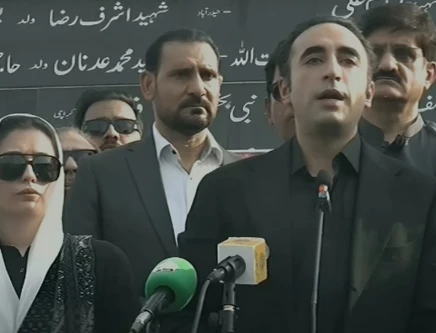
Speaking to reporters in Karachi on Sunday, after visiting the Karsaz Monument on the 19th anniversary of the bombing that targeted his mother, Benazir Bhutto, he said the offer was open to the PTI-led opposition. It came a week after the federal government imposed governor’s rule and an emergency in the northwestern province.
“If they really want to fight terrorists, and if they want that emergency and governor’s rule in KP to end, they should engage with the federal government and politicians and discuss a united policy regarding the fight against terrorism,” Bhutto-Zardari said.
He was scathing about the province’s PTI chief minister, Sohail Afridi. “If the Khyber Pakhtunkhwa chief minister is a coward, if he is not ready to defend his homeland, if he is not ready to fight those terrorists, then the PPP is ready to fight them,” he said. “That is why we supported the government’s decision to impose governor’s rule in KP.”
Bhutto-Zardari claimed that Khyber Pakhtunkhwa, the province with the highest number of terrorist incidents, was led by a chief minister who had pledged not to confront the militants. The PTI has rejected the federal government’s case against its administration.
President Asif Ali Zardari’s proclamations of emergency and governor’s rule were ratified by a joint sitting of parliament on Thursday for two months, amid uproar from opposition benches. The PTI has called the measures an assault on the province’s democratic mandate and autonomy. Afridi and some of his cabinet members were taken into preventive custody after the proclamations, according to a minister of state for interior. AFP, citing police officials, reported that more than 270 PTI members had been arrested since the province came under governor’s rule.
The federal government has cited the provincial government’s “deliberate disengagement” from the fight against terrorism. The move also followed a mobilisation drive and protest march by the PTI, which governed Khyber Pakhtunkhwa and sits in opposition at the centre, to demand the release of its jailed founder, Imran Khan.
Bhutto-Zardari’s party is not in the federal government and does not hold a majority in parliament, as he acknowledged on Sunday. He said the PPP had nominated Faisal Karim Kundi as governor, but that “constitutionally, he is now a representative of the federal government”. He said he would “keep talking to him and keep advising him”.
Asked about a possible deal with the opposition, he rejected the idea that compromise was a weakness. “You say ‘compromise’ like it’s a bad word,” he said. “Compromise and politics go hand in hand.” He said Benazir Bhutto had always sought compromises, and credited the PPP’s own concessions with ending Gen Pervez Musharraf’s rule and securing the 18th Amendment. He said they had also helped secure the passage of the 1973 Constitution.
He defended the use of emergency powers by pointing to his party’s record. During the 2008-2013 PPP government, he said, emergency rule was imposed in Balochistan over terrorism, and governor’s rule was imposed there against the PPP’s own provincial government. “If the PPP thought only of itself, how would it have removed its own government?” he said.
Bhutto-Zardari said the country had reached a point where “terrorist attacks are taking place from Khyber to Khuzdar”. He blamed decisions taken after the Taliban returned to power in Kabul in 2021. The government of the time, he said, invited militants in Afghanistan to settle in Swat, Malakand and the former tribal areas, and freed jailed terrorists. He was apparently referring to plans under then prime minister Imran Khan to resettle members of the Tehreek-i-Taliban Pakistan. “Today, Pakistan is suffering the losses from these wrong decisions,” he said.
He said Pakistan faced a “historic economic crisis” that appeared likely to worsen, and that tackling it required fighting terrorism as well. He said the PPP was pressing for a new National Action Plan and for a fresh consensus on counterterrorism. He also said the government had agreed to form an electoral reforms committee in the National Assembly, and he invited the opposition to take part. “If they say that democracy is weak in this country, they should help us to strengthen it,” he said.
He said Maulana Fazlur Rehman, the chief of the Jamiat Ulema-i-Islam (F), had every right to criticise government policy. He added that Mr Fazl’s party had also suffered terrorist attacks and urged him to condemn the militants as well. He urged all politicians not to politicise terrorism or turn measures against it into a source of controversy.
On the question of new provinces, Bhutto-Zardari said Interior Minister Mohsin Naqvi knew “clearly” the position of the PPP and President Zardari, and that no new province could be created without the president’s signature. Naqvi’s July remarks calling for new provinces had set off a heated national debate, and the PPP, which governs Sindh, strongly opposes any division of that province. Last month the Sindh Assembly, with the opposition boycotting, passed a resolution rejecting all such attempts. Mr Bhutto-Zardari said new provinces could be created only where the provincial assembly agreed, and pointed to Gilgit-Baltistan, whose legislative assembly had unanimously passed a resolution on the region’s constitutional rights.
The Karsaz attack on 18 October 2007 hit Benazir Bhutto’s homecoming procession in Karachi after years in exile. Bhutto-Zardari called it the largest terrorist attack in the country’s history. He said that after the first blast, party workers formed a human shield around her vehicle and were killed when the second explosion struck.
Bhutto-Zardari’s conditional offer contrasts with signals from elsewhere in government. Rana Sanaullah, an adviser to Prime Minister Shehbaz Sharif, said on a television programme that the emergency could stay in place for at least a year and might run until 2029. The opposition alliance, Tehreek Tahaffuz Aiyeen-e-Pakistan, called off talks with the government on Thursday, calling the measures unconstitutional. Sharif, for his part, invited the opposition to resume dialogue during the joint sitting.
The measures also face a legal challenge. The Peshawar High Court has fixed Tuesday for a preliminary hearing of a petition by PTI chairman Barrister Gohar Ali Khan seeking to have the emergency and governor’s rule declared unconstitutional.
Copyright © 2021 Independent Pakistan | All rights reserved