By Staff Reporter
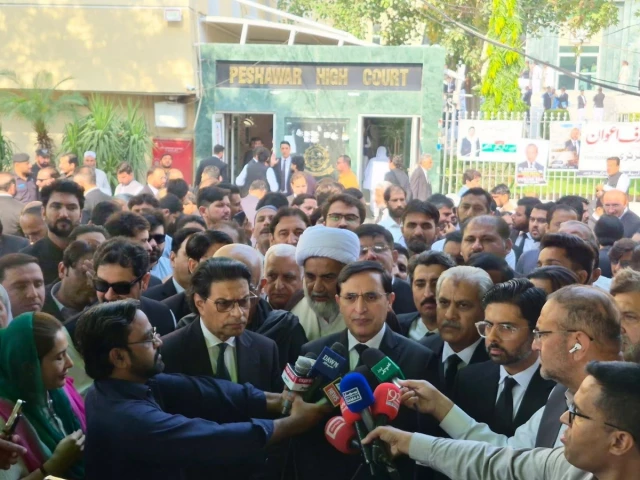
PESHAWAR: The federal government must answer a constitutional challenge to the emergency and governor’s rule it imposed on Khyber Pakhtunkhwa, after the Peshawar High Court issued notices on Tuesday over a takeover that removed an opposition-run provincial government.
A two-member bench of Justices Ijaz Anwar and Muhammad Faheem Wali heard several petitions against the measures, imposed on 11 October, and adjourned proceedings until 10 November after preliminary arguments. Notices went to the federal and provincial governments, Attorney General Mansoor Usman Awan and the provincial advocate general. When lawyers asked for interim relief, the judges said they would examine the request and issue an order.
The lead petition was filed by Barrister Gohar Ali Khan, chairman of Imran Khan’s Pakistan Tehreek-e-Insaf (PTI), which governed the province until the intervention. Petitions were also lodged by PTI leader Shandana Gulzar, the Khyber Pakhtunkhwa Bar Council and the Tehreek-i-Tahafuz-i-Ayin-i-Pakistan opposition alliance. A further plea came from Mohsin Dawar and Bushra Gohar, president and provincial head of the National Democratic Movement.
The federal government has said the measures are needed to restore order. The presidential proclamation cited an extraordinary surge in terrorist incidents and serious security threats, and officials have pointed to the provincial government’s lack of support for counterterrorism operations. The province is now run by Governor Faisal Karim Kundi, assisted by an 11-member technocratic advisory council appointed by Islamabad.
Barrister Sameer Khosa, who appeared for Gohar, told the court the action was unlawful because the provincial assembly had never approved it. The proviso to Article 232(1) of the Constitution, he said, uses the word “shall”, making the condition mandatory.
“No approval was obtained from the provincial assembly,” he said. The National Assembly and Senate endorsed the action afterwards, and Khosa said that endorsement was being challenged in a separate application. He also argued that conditions in the province did not amount to a loss of control by the elected government.
The hearing returned repeatedly to the whereabouts of Sohail Afridi, the chief minister, and Babar Saleem Swati, the assembly speaker. Khosa told the judges both men were “missing”. Afridi has not been seen publicly since the measures took effect. Federal ministers said a day later that he and some cabinet colleagues were in preventative custody.
Asked by the bench whether the petition sought the leaders’ production in court or their recovery, Khosa replied: “Yes, we have made that request in this application.”
In a separate petition on Afridi, the court gave the authorities two days to explain his detention. The petitioner’s counsel said he was reportedly being held at a state guest house at one of two possible locations. In the petitions on Swati and PTI provincial president Junaid Akbar, officials were given 10 days to respond.
Khosa cited the Supreme Court’s judgment in the case of former chief minister Pir Sabir Shah, which he said established that a chief minister and cabinet continue to function when an emergency is imposed. “In the current case, the chief minister, the cabinet and the advocate general have been stopped from working and rendered inactive,” he said. “Our plea is that the assembly be restored and the chief minister and speaker be released.”
PTI secretary general Salman Akram Raja, also appearing for Gohar, said the measures had been imposed without “fulfilling legal requirements” and should be revoked. Governor’s rule, he argued, could be justified only if the provincial government was unable to function.
Advocate Muazzam Butt, for Gulzar, said an apex committee under the National Action Plan, which includes federal and provincial representatives, the governor and security officials, was responsible for assessing security in the province. Terrorism, he argued, could not be laid at the door of the provincial government. He also asked where the governor’s report was, given that the president had reportedly said the rule was imposed on the strength of one, and said the authorities should explain what it contained.
Advocate Babar Khan Yousafzai, for the Bar Council, adopted Gohar’s arguments. One petitioner, Advocate Qaiser Shah, backed the emergency but opposed governor’s rule.
Gohar also addressed the bench, saying the PTI-led government had always supported the centre against terrorism. He claimed that 12 PTI members of the National Assembly and 14 members of the provincial assembly had been “picked up”, and that raids on party members’ homes were continuing. He told the court that on 11 October deputy commissioners, district police officers and staff at the advocate general’s office had been replaced.
Speaking to reporters afterwards, Gohar said party symbols had been removed and demolished, and that the PTI had called the measures unconstitutional “from day one”. “There are no two opinions about it; terrorism is unacceptable in this country,” he said, adding that the party rejected allegations that it facilitated militancy. He said the party had asked for a larger bench and an early decision.
Raja described the emergency as “an attack” on provincial autonomy and democracy. “Sohail Afridi is still the chief minister of the province and the cabinet is present,” he said.
Mehmood Khan Achakzai, the leader of the opposition in the National Assembly, said disputes should be settled in court. “We want decisions to be made in the courts. If that does not happen, issues will come out onto the streets,” he said. He cited recent cost-of-living protests in France, saying police there had not fired a single bullet, and called for peaceful protest against the government. He added that the final phase of the movement had begun.
Gohar’s petition, filed on 14 October under Article 199 of the Constitution, asks the court to declare the proclamation “unconstitutional, ultra vires, coram non judice, tainted with malice in law and fact, devoid of objective material, and of no legal effect”. It also challenges the deployment of troops, the creation of the advisory council, and the detention and removal of Afridi and his cabinet, who held executive powers under Article 130. Respondents include the federation, the province, Governor Kundi and the assembly speaker. Mr Afridi is named as a pro forma respondent.
Gohar has since sought to amend the petition to challenge resolutions passed by the National Assembly and Senate on 14 October and a joint sitting of Parliament on 15 October. The application argues that retrospective parliamentary approval cannot cure a failure to meet the constitutional requirements at the outset, and that no resolution was passed by the provincial assembly.
Copyright © 2021 Independent Pakistan | All rights reserved