By Staff Reporter
ISLAMABAD: Pakistan’s incomes could triple by 2050 if the government pushes ahead with deeper economic overhauls, the World Bank said, arguing that the stability won through fiscal tightening and IMF-backed discipline won’t by itself deliver the faster growth the country needs.
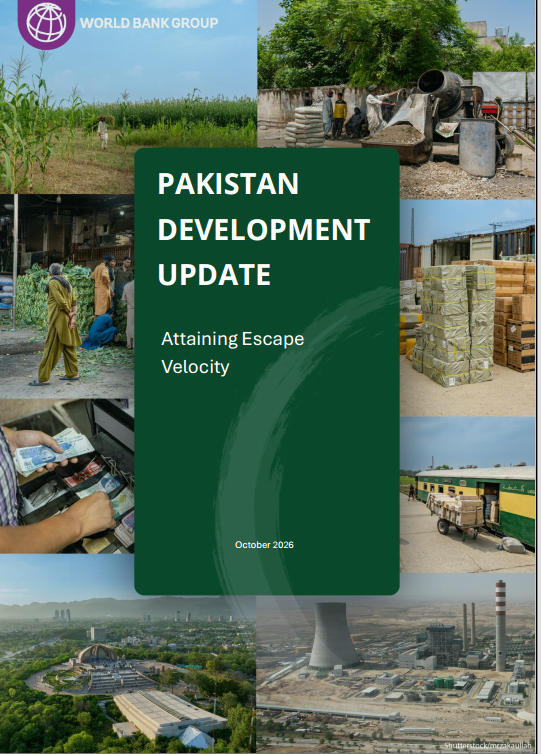
The lender’s Pakistan Development Update, released Thursday in Islamabad, credits policymakers with steadying an economy that was in the grip of a balance-of-payments crisis as recently as 2022. Real GDP growth quickened to 3.7% in the fiscal year that ended in June, from 3.2% a year earlier, even as the war in the Middle East that began Feb. 28 drove up energy costs. Services, led by wholesale and retail trade, did most of the work. Agriculture grew 2.9% and industry 3.5%.
“Pakistan has made real progress in restoring stability, and markets have taken notice,” said Bolormaa Amgaabazar, the bank’s country director for Pakistan. “But real per capita growth – the rate at which the income of the average Pakistani increases – remains stuck at around 1.6 percent. Reforms to drive faster growth are now urgently needed.”
The fiscal numbers are the strongest part of the record. The primary surplus widened to 2.9% of GDP in fiscal 2026, and the consolidated deficit narrowed to 2.6% from 5.4%. Interest payments fell to 5.5% of GDP from 7.8%, and public debt including guarantees declined to 72.9% of output from 76.3%. The bank described the cumulative adjustment since fiscal 2022 as one of the largest in Pakistan’s recent history. It cautioned, though, that some of the gain rests on factors that may not last, including the sharp drop in borrowing costs and large profit transfers from the central bank. The bank projects the primary surplus will shrink to 2.0% of GDP this fiscal year and the deficit will widen to 3.5%, with national elections due in early 2029.
Investors have noticed as S&P Global Ratings lifted Pakistan to B from B- in July, and Moody’s raised it to B3 from Caa1 in August. Pakistan sold $750 million of three-year Eurobonds in April, its first international bond sale in four years. It followed on Sept. 2 with $3 billion in two tranches: $1.75 billion of 5.5-year notes at a 7.5% coupon and $1.25 billion of 10-year paper at 7.9%.
Beneath the headline gains, the report points to an economy that remains dependent on money sent home by workers abroad. Remittances climbed 8.6% to a record $41.6 billion, which held the current-account deficit to 0.1% of GDP. Without them, the shortfall would have been about 9%. Goods exports fell 4.7% to $30.8 billion as rice lost market share to India and textile shipments stagnated. Net foreign direct investment dropped by almost half to $1.3 billion.
The bank also took aim at currency management. The rupee has stayed in a narrow PKR278-285 band against the dollar since 2024, and with inflation running above that of trading partners, the real effective exchange rate rose 10% between end-June 2025 and July. The lender said a fully market-determined rate would better buffer shocks and protect competitiveness, and noted that earlier episodes of holding the rupee steady preceded each of Pakistan’s recent external crises.
The human cost of years of weak growth is still visible. Poverty rose to 29% in 2024-25 from 22% in 2018-19, according to the report. About 3.6 million people reach working age each year, and unemployment hit 7% in 2024. Labor productivity grew just 0.4% a year between 2014 and 2024, and most of the 17.7 million net jobs created since 2018 are in low-paying, low-productivity sectors. Credit isn’t reaching the people who could change that: government paper accounts for 79.4% of bank assets, near a record, while business lending is less than a fifth of banks’ exposure.
The bank’s central argument is that closing half the gap in policy and institutional quality with the average upper-middle-income country would lift Pakistan’s trend growth to 6.9% if done over five years, or 6.2% over seven. The baseline is about 4.5%. On those paths, per-capita income growth would rise to 5.2% or 4.5% a year from 2.9%. If sustained, that would put Pakistan above India’s current per-capita level by roughly 2035 or 2036 and level with Egypt and Vietnam today by 2045 to 2048. The bank stressed that the estimates, drawn from cross-country regressions across 50 economies, are associations rather than forecasts. It pointed out that India and Vietnam have averaged growth of 6.3% to 6.9% since 2011, against 3.8% for Pakistan.
“With macro stabilization achieved but fiscal resources and foreign exchange still tightly constrained, structural reform to encourage private investment is the necessary next step towards higher living standards,” said Sebastian Essl, the report’s lead author. Getting there, he said, “requires a plan, coordination, and committed reform implementation.”
The prescription is long and included a freely functioning interbank currency market, full operation of the Export-Import Bank, and cutting the trade-weighted average tariff to below 6% from 10.6%. On the state’s footprint, it calls for concessioning of key airports, private participation in energy-sector state companies and public share offerings in selected enterprises. Revenue measures include harmonizing the general sales tax nationwide, enforcing the revised agricultural income tax and cutting tax exemptions. It also urges a new National Finance Commission Award, pension reform and private investment in power transmission and distribution.
Some of that is under way, the bank noted. Timely power tariff adjustments helped cut energy subsidies to 0.8% of GDP from 1.1%, tariff cuts under the National Tariff Policy are continuing, and Pakistan International Airlines has been privatized.
The baseline outlook, which assumes limited reform, is for growth of 3.8% in fiscal 2027, rising to 4.5% by 2031. Inflation is seen averaging 8.2% this fiscal year. The bank listed a prolonged Middle East conflict as the biggest near-term threat, followed by external financing needs averaging about 5% of GDP and a strong El Niño that could shave 0.2 percentage point off growth if crop output stalls. A simultaneous revenue shortfall and spending overrun of 1% of GDP each would push the primary balance into deficit by fiscal 2028.
Recent data suggest the inflation risk is already playing out. Consumer prices rose 10.26% in September from a year earlier, easing from 11.15% in August, and the Bureau of Statistics put the first-quarter average at 10.20%. That is well above the bank’s full-year forecast. The International Monetary Fund, in its World Economic Outlook on Oct. 13, raised its fiscal 2027 inflation projection for Pakistan to 9.9% from 8.4% and kept growth at 3.5%, below the 3.8% the World Bank forecast, with the current-account deficit seen widening to about 1% of GDP.
The State Bank of Pakistan held its policy rate at 11.5% on Sept. 14 and is scheduled to meet again Oct. 26. Its own foreign-exchange reserves stood at $21.47 billion in the week ended Oct. 9, helped by the September bond sale. Finance Minister Muhammad Aurangzeb, speaking on the sidelines of the World Bank-IMF meetings in Bangkok last week, reaffirmed his commitment to completing the IMF program, which runs to September 2027.
The report also looks at artificial intelligence. It estimates that 18% of Pakistani workers hold jobs with high AI exposure but strong potential to be helped by the technology, against 8% in roles more open to replacement. Wholesale and retail trade is the sector most likely to feel the effect.
Copyright © 2021 Independent Pakistan | All rights reserved