By Staff Reporter
LAHORE: Lahore’s district administration has formally approved three days of Basant on 12-14 March next year, setting out which kites and string may be made and sold, who may sell them and which parts of the city will be closed to kite-flying.
The notification, issued by the deputy commissioner on Friday, says kite-flying using permitted material, as defined in the Punjab Regulation of Kite Flying Rules, 2025, “shall be allowed from March 12-14, 2027”. The permission applies across the city except in designated prohibited zones.
The Punjab cabinet approved the March dates earlier this week, after the deputy commissioner, Captain (retd) Muhammad Ali Ijaz, sent a proposal to the Home Department seeking a change. It was the second alteration to the schedule. Chief Minister Maryam Nawaz announced the same March dates in August, but at the end of September she approved a 10-day festival from 29 January to 7 February, with a pause on 5 February for Kashmir Day. The March dates now stand.
The notification sets out a timetable for the supply chain. Manufacturing of permitted kite-flying material is allowed from 5 September 2026 to 14 March 2027, provided the maker holds a valid digital registration. Purchase, transport and storage are permitted from 1 February. Sales to the public may begin on 10 February and must go through registered sellers.
No one may make, trade, store or sell the material without registering with the deputy commissioner through the government’s eBiz application. Registered manufacturers, traders and sellers must display their certificates “conspicuously” at approved premises and keep full stock, sales and movement records, to be produced on demand for any authorised officer.
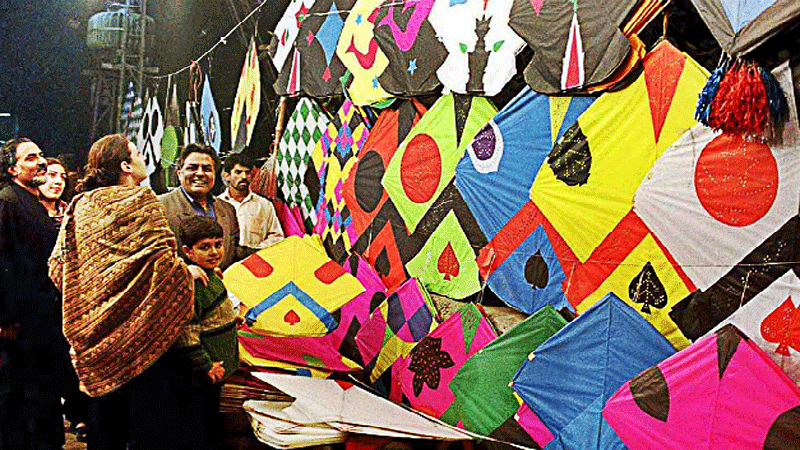
The notification also sets out what the kites and string must look like. A patang, the standard kite, must not exceed four-and-a-half githi, a unit based on the span of a hand, or measure more than 35 inches across and 30 inches high. A gudda, the larger kind, is capped at 40 inches in width and 34 inches in length. String, known as dor, may be wound only in the traditional pinna form. It must be cotton, with no more than nine threads and a count of no fewer than 28, and coated with maanjha made with glass powder of at least 350 mesh.
The coating may contain only laundry starch, 350-mesh glass powder and rice flour. The notification forbids any other chemical, adhesive, hardener, abrasive, metallic substance or strengthening agent, and names rema tip top and amri powder among the banned additives. It also prohibits the manufacture, trade, transport, storage, sale, possession and use of charkhi, sharp maanjha, metallic wire, nylon dandi, and any thread coated with sharp maanjha or another injurious material.
Motorcyclists must fit safety rods, as laid out in Chapter III of the Punjab Kite Flying Regulations 2025 and in guidelines issued by the provincial home secretary. Registered kite-flying associations must stay in close contact with the deputy commissioner and his officers. All government departments and agencies are directed to help the district administration and police enforce the terms.
Kite-flying is barred in areas under the airport’s approach path: Nadirabad, Gulshan Ali Colony, Nishat Colony, Bhatta Chowk and blocks R, S, P and Q of DHA Lahore. It is also barred under the take-off path in Al-Faisal Town, Jorraypul, Canal Bank Road beside Tajpura, and Tajpura itself.
Kite-flying remains banned elsewhere in Punjab. Basant had been prohibited in 2007 after a rising number of deaths and serious injuries, many caused by sharp string to motorcyclists and pillion riders, along with celebratory gunfire. The ban was lifted this year after the provincial assembly passed the Punjab Regulation of Kite Flying Bill, 2025 on 24 December. It authorised deputy commissioners to grant conditional permission on specified days and at designated places. The festival was held in Lahore alone from 6 to 8 February.
The 2026 festival left a heavy toll. Official Home Department records put it at 17 deaths and 160 injuries, though local media reported deaths at 21. The Home Department told the Lahore High Court that most of the deaths were caused by electrocution and falls, and it did not provide figures on injuries from string, which the court had requested. A separate petition in the same court seeks criminal proceedings against government officers over the deaths and injuries, alleging that institutions failed to stop the making, transport and sale of dangerous string.
A report before the court said police registered 1,926 cases and made 2,030 arrests in Lahore between 1 January and 8 February, and seized 105,718 kites and 2,953 rolls of string. The government estimated that the festival brought in Rs3bn to Rs4bn in revenue, with kite and string sales accounting for Rs2bn to Rs2.5bn.
Copyright © 2021 Independent Pakistan | All rights reserved