By Staff Reporter
PESHAWAR: Khyber Pakhtunkhwa’s governor-led administration plans to set up faceless anti-terrorism courts, in which judges, prosecutors and witnesses would be shielded from identification, and to spend about Rs70bn a year on the province’s police and Counter-Terrorism Department (CTD).
Officials set out the plan at a televised briefing at Governor House in Peshawar on Sunday. Of the total, Rs59.8bn is earmarked for the police and Rs10.3bn for the CTD. Adviser for Home and Tribal Affairs Kifayatullah Khan and Home Secretary Amjad Ali Khan presented it, with Governor Kundi alongside. Immediate measures are due within 100 days and a second set within 180 days, while longer-term projects will begin in that period but take more time to finish, the governor said.
Home Secretary Khan said terrorism trials were being undermined because those who could testify were frightened to do so.
“Witnesses in terrorism cases are afraid to come forward due to their identity. So we have recently sent the amendment for these faceless courts. Through this measure, witnesses, prosecutors, and judges will have their protection ensured,” he said. He added that the courts would also allow cases against militants to be concluded more quickly.
The briefing, as reported, did not set out how the courts would work in practice. Faceless trials are already contentious in Pakistan. Punjab’s assembly passed a law on 31 August that lets an unnamed official designate terrorism cases as “special security cases”, after which the identities of the judge, prosecutor and witnesses cannot be disclosed. Opposition politicians, lawyers and the Human Rights Commission of Pakistan criticised it, arguing it threatens the right to a fair trial. Balochistan passed a comparable law in September 2025, while Khyber Pakhtunkhwa had not amended its legislation along either track.
A province under emergency rule
Sunday’s announcements are the first detailed security programme from the administration that took over the province last month. President Asif Ali Zardari signed a proclamation on 11 October, on the advice of Prime Minister Shehbaz Sharif, imposing an emergency and governor’s rule, and the elected provincial government led by Imran Khan’s Pakistan Tehreek-e-Insaf (PTI) ceased to hold office. The proclamation said that government had failed to show the ownership, will and intent needed to deal with terrorism. The PTI rejects that charge, and a former provincial finance minister from the party has said it has owned the fight against terrorism.
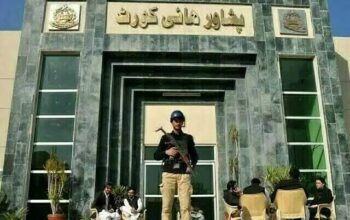
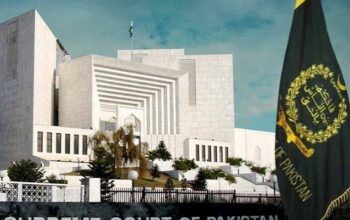
Parliament later approved both measures at a joint sitting for two months, after which governor’s rule lapses unless it is renewed. Judicial scrutiny of the measures has effectively stalled. The Federal Constitutional Court stripped the Peshawar High Court of jurisdiction over Khyber Pakhtunkhwa cases filed on or after 12 October, including those on the emergency and governor’s rule. On Saturday the high court removed the petitions from its cause list, among them pleas from PTI chairman Gohar Ali Khan, opposition leader Mahmood Khan Achakzai and the provincial bar council, and told petitioners to approach the appropriate forum.
The violence behind the decision has not eased. The Pakistan Institute for Conflict and Security Studies counted 1,232 attacks nationwide in the first nine months of 2026, against 1,066 in the whole of 2025, with most in Khyber Pakhtunkhwa and Balochistan. The casualty figures were stark. Between 2024 and September 2026, 1,003 members of the armed forces, 627 police officers and 808 civilians were killed. So far this year the toll stands at 255 soldiers, 302 police and 304 civilians. Security forces had killed 3,788 militants over the past three years.
Shortfalls laid bare
Khan described a police force that he said had been left under-resourced for years. It is short of 10,537 personnel, while the CTD has 638 vacant field operator posts. Police face a 36 per cent shortage of operational vehicles, and only 12 per cent of the force has access to anti-drone systems, he said, adding that militants were increasingly using drones.
In the former tribal districts merged with Khyber Pakhtunkhwa in 2018, officers still work from temporary arrangements and buildings nearly eight years on. Only 3.2 percent of the budget had been allocated to security there, he said. Some 15,186 former Khassadar personnel were absorbed into the police after the merger, but many have not received adequate training.
Of Rs6.4bn approved for restoring counter-terrorism infrastructure in 22 districts, only Rs1bn has been released, according to the presentation. The CTD, set up in 2014, has just 12 purpose-built facilities across the province’s 37 districts.
Of the police allocation, Rs33.4bn is for infrastructure and Rs26.4bn for procurement. The CTD’s Rs10.3bn splits into Rs5.4bn for infrastructure and Rs4.9bn for procurement.
The presentation set out the following targets for the police:
- Raise surveillance coverage from 15 per cent to 60 percent.
- Lift night-fighting capacity from 18 per cent to 50 percent.
- Raise anti-drone capability from one per cent to 50 percent.
- Increase availability of armoured police vehicles from 19 percent to 45 percent.
- Increase jamming equipment from 40 per cent to 50 percent.
- Cut the manpower shortfall from 15 per cent to 5 percent.
For the CTD, the aims include raising vehicle armouring from 16 percent to 70 percent, jammer availability from three percent to 50 percent, and counter-drone and fighting capability from 52 percent to 60 percent. It also aims to close a 79 percent shortfall in protective equipment and to build facilities in 34 districts.
Anti-drone systems are to be installed in Dera Ismail Khan, Lakki Marwat and Bannu. District Nerve Centres will bring intelligence and operational data together in about ten districts, and the Safe City project will be extended. Satellite-based communications are planned for areas with no reliable connection, and artificial intelligence tools will monitor social media to counter what officials call the narrative of “Fitna al-Khawarij”, Islamabad’s term for the Pakistani Taliban. Training in drone technology, sniping and explosives disposal is to be arranged with the Pakistan Army.
Khan said kinetic operations would be stepped up, with more intelligence-based raids, arrests of suspected facilitators and re-verification of people on the Fourth Schedule, the watchlist maintained under anti-terrorism law. He also announced action against smuggling, narcotics, extortion and vehicles that have not paid customs duty.
“Our war”
Kundi said the biggest failing of past counter-terrorism policy was a lack of political ownership.
“There was a time when the response was that this was not our war,” he said. “But when a family loses a martyr, what do you think they would say? Did their loved one sacrifice their life for this soil, for this country, or for some particular agenda?”
Of the police, he asked: “Until we strengthen and facilitate [the police], how will they fight using just one Kalashnikov and a few bullets?” He said no police line had been built in the merged districts since the merger, and that the chief secretary and additional chief secretary had been told to prepare a package to upgrade stations, posts and lines there.
“This is absolutely our war,” he said.
The governor repeated the federal government’s hard line on Afghanistan. “Our decisions and policies will come from Islamabad, not Jalalabad, Kandahar or Kabul,” he said. He alleged that the Afghan Taliban government allowed its territory to be used by India and Israel against Pakistan, and said some drones that had crossed the border were intercepted. He also criticised the previous provincial government for failing to respond to remarks by Afghan officials about taking control of Peshawar.
“There can be no dialogue with those who do not recognise the state, the Constitution and the law,” he said. “Those who take up arms against the state will be answered in the same language.”
Kundi also said that some former militants repatriated from Afghanistan or released from prison had returned to arms, and that public confidence would decide the outcome of the campaign. He recalled the Swat operation, which displaced residents who were later resettled. Police outreach will include meetings with elders, jirgas and religious scholars, while district dispute resolution councils are to be extended to tehsil level. Sports and employment schemes are planned for young people.
“You can build roads, flyovers and a beautiful city, but what is the use if people are not safe?” he said. “We have reached a point where there is no turning back.”
Who gets the money
Asked by journalists about timelines, legal approvals and whether Islamabad would release the funds, Kundi said Prime Minister Sharif had agreed to support the province’s request for Rs160bn, and that coordination with the federal government had improved. Khan said the provincial and federal governments were on the same page.
Questioned about money promised to the former tribal areas at the time of the merger, the governor said the pledge had been Rs100bn a year for ten years, not Rs1,000bn. He accepted that the federal government might not have paid in full, but said the previous provincial government had failed to pursue it.
He said 70 percent of the proposed funding would go to the merged districts and the 12 districts facing security problems, and would be spent on planned projects rather than street paving or drainage. “These will be proper projects that restore people’s confidence,” he said. This year’s provincial budget set aside Rs45bn for development in those areas, he added, with a further Rs30bn expected from Islamabad under the security package.
Copyright © 2021 Independent Pakistan | All rights reserved