By Staff Reporter
PESHAWAR: All gold mining has been suspended and every lease cancelled in Pakistan’s Khyber Pakhtunkhwa province, its governor announced on Saturday, accusing illegal miners of bankrolling the Pakistani Taliban days after 10 police officers were killed in an ambush in Kohat.
Faisal Karim Kundi, who has run the province under emergency and governor’s rule since last month, told a press conference in Peshawar that leaseholders had a week to remove heavy machinery from the affected areas. After that, he said, it would be seized.
“After one week, the machinery, if not removed, will be seized,” Kundi said. He added that fines would no longer be limited to the Rs25,000 or Rs30,000 imposed by magistrates but could reach Rs2m under the law. “We are also investigating why fines were not being imposed in accordance with the law.”
The announcement follows an attack on Wednesday on police returning from an operation against illegal gold mining in the Darbukach area of Gumbat tehsil, Kohat district. Police said 18 militants were killed in the ensuing gunbattle, and five police vehicles were reportedly set on fire. The dead included Gambat’s deputy superintendent of police, Haider Zaman, and a sub-inspector, Mukhtiar. The Tehreek-e-Taliban Pakistan (TTP) claimed responsibility. A day earlier, the Kohat deputy commissioner had imposed a 60-day ban on parking excavators in designated gold-mining blocks and adjoining areas.
Kundi said the officers were targeted by “Fitna al-Khawarij”, the term the state uses for the banned TTP, while returning from a successful operation.
“Fitna al-Khawarij and illegal miners had a nexus,” he said. “The miners used to pay extortion money to the terrorists and, in return, received protection from them.” He said that arrangement was responsible for the officers’ deaths.
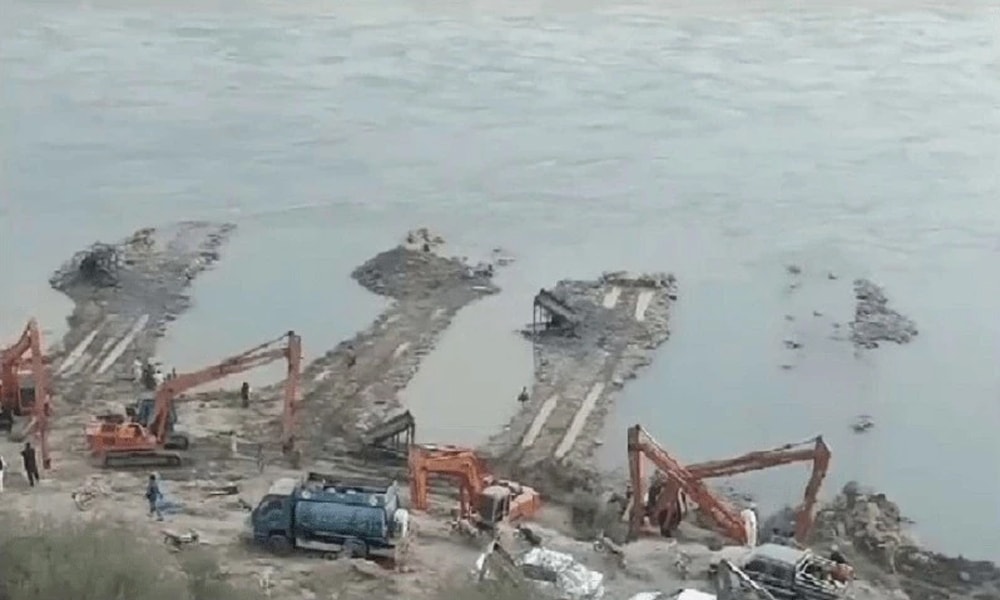
The governor said illegal mining in Kohat was concentrated in two blocks, C and D, and was worth Rs4.92bn a month. About 8,350 trucks, 3,660 excavators, 1,730 tractor trolleys with dynamos, 1,600 dumpers and 200 heavy loaders were in use, along with between 49,000 and 51,000 labourers. Local media reported about 90kg of gold was being extracted from the two blocks every month.
“Eighty percent of the profits were being sent to Afghanistan and used for terrorist activities against Pakistan,” he said.
Kundi also made allegations about the previous provincial government, which was led by Imran Khan’s Pakistan Tehreek-e-Insaf (PTI). He said a “Youth Committee” was formed in February this year under the chairmanship of a Taliban figure, Naimatullah, known as Commander. Its purpose, he said, was to collect weekly extortion payments of Rs800,000 from locals and Rs110,000 from non-locals. He said the money went to militants fighting Pakistan’s security forces and police.
The governor read out a list of 12 politicians he said were involved in illegal mining or gave it political cover. They included Aftab Alam, Sheheryar Afridi, an MNA, and Senator Khurram Zeeshan, all of the PTI. Also named were Amjad Afridi, a former PPP lawmaker; Seth Saifullah, a former district mayor from Jamiat Ulema-i-Islam-Fazl (JUI-F); and Hammad Azam, a former JUI-F candidate. The list further included Naveed, the brother of Sohail Afridi, the PTI chief minister before governor’s rule; Naseem Afridi; Azhar Bukhari; Nazir Afridi; and two former town nazims, Sajid Iqbal of Gambat and Ehsan of Lachi. He also shared a list of local residents he said were involved.
Kundi said there would be no political victimisation, but that anyone found guilty, “whether a politician, bureaucrat or police officer”, would face the consequences regardless of influence.
“If there is no system of reward and punishment, neither this province nor this country will move forward,” he said. “This country can no longer run under the doctrine of necessity.”
He announced a task force named after Zaman to produce a “comprehensive and lasting” strategy for gold mining within three weeks. According to the governor, its members will include representatives of law enforcement agencies and the mines and minerals, finance and district administration departments. It will cover legal mining procedures, security for workers and environmental protection.
A judicial commission headed by a retired Peshawar High Court judge will be formed by next week to investigate the Kohat attack, he said. He also urged the KP Advisory Council, the 11-member technocratic body appointed to assist him, to investigate all those involved in illegal mining and how so many licences had been granted.
The federal government imposed emergency and governor’s rule on 11 October, after the president approved a cabinet recommendation. It cited the provincial government’s “deliberate disengagement from the fight against terrorism” and a worsening security situation.
Kundi framed the mining measures as part of a wider defence of the province’s resources, but said the province remained open to joint ventures, as discussed at a recent two-day minerals conference. “For the past 13 years, the resources of our province have been looted,” he said, alleging that those who objected to investment were themselves responsible. “We are not selling your resources. Above all, the interests of the people of the province will be protected.”
JUI-F chief Maulana Fazlur Rehman has alleged that governor’s rule was linked to the federal government’s wish to take control of the province’s resources.
Gold mining has been politically contentious in the province for some time. Provincial authorities have repeatedly imposed and extended bans on placer gold mining along the Indus and Kabul rivers in Swabi, Nowshera, Kohat and Karak. Last month, ARY local media reported that the National Accountability Bureau had raised concerns over auctions and contract awards during the PTI government, including four placer gold blocks sold for about Rs4.93bn.
“We are fighting a war against terrorism and we have burnt our boats,” Kundi said. “Accepting defeat is not a choice for us.”
Copyright © 2021 Independent Pakistan | All rights reserved