By Staff Reporter
ISLAMABAD: Pakistan has called for an immediate end to military provocations in the Gulf at a UN Security Council meeting where the US and Iran blamed each other for attacks on shipping and threats to maritime security.
The Gulf Cooperation Council (GCC) also set out its grievances on Friday. Its secretary-general said member states had been hit by more than 7,000 Iranian missiles and drones since 28 February.
The debate showed how little common ground remains between the parties, even as fears grow that the confrontation could disrupt trade, energy supplies and food shipments and widen into a regional war.
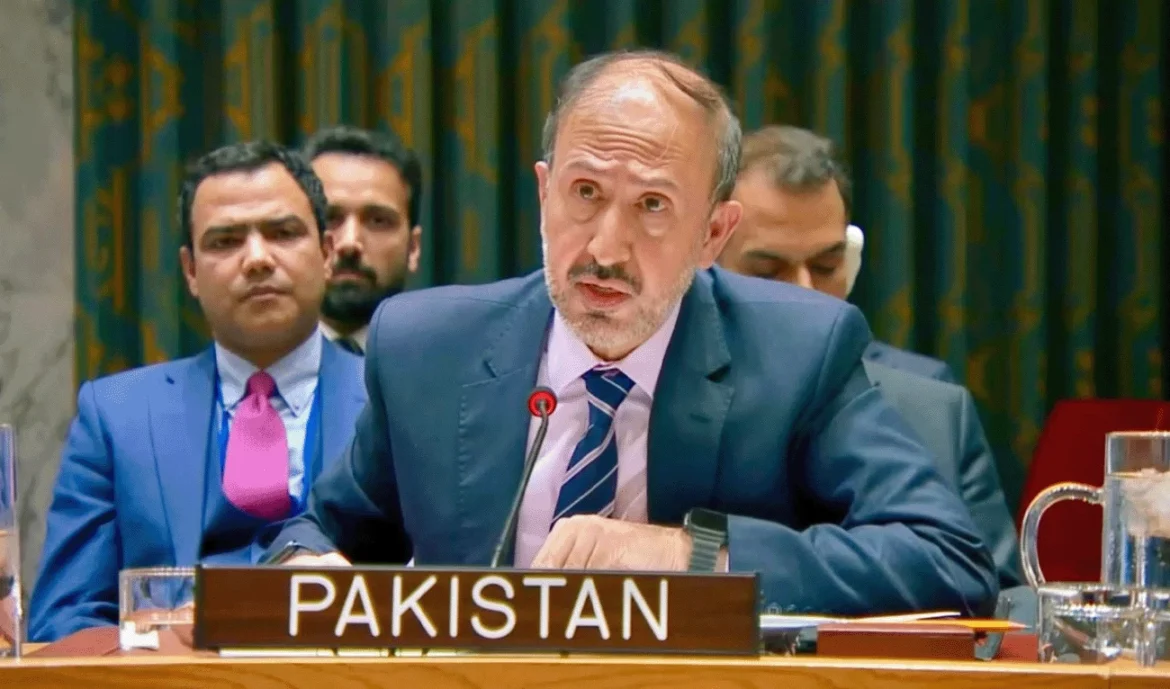
Syed Haider Shah, Pakistan’s permanent representative to the UN, condemned attacks on Gulf countries and demanded respect for their sovereignty and territorial integrity. He also called for the protection of civilians and commercial shipping and the restoration of normal maritime traffic.
He singled out the Iran-backed Houthi militia, which has stepped up attacks on Saudi aviation and energy facilities since last month. “Pakistan condemns, in the strongest terms, the Houthi militia’s attacks and threats against the Kingdom of Saudi Arabia, including its civilian infrastructure and vessels engaged in lawful trade with the Kingdom,” Shah said.
He reaffirmed Pakistan’s support for the kingdom’s sovereignty, security and territorial integrity. Pakistan signed a mutual defence agreement with Saudi Arabia in 2025.
Shah described maritime security as a “shared international interest” and pointed to the strategic weight of the Strait of Hormuz and the Bab el-Mandab Strait. Hormuz, he said, carries about a third of globally traded crude oil and a significant share of the fertiliser trade. Instability at the two chokepoints, he added, had sent energy prices soaring and heightened fears of food insecurity, with vulnerable economies hit hardest.
“These actions endanger seafarers, undermine navigational freedoms and jeopardize regional stability,” he said. “The attacks and threats must end.”
He said lasting peace required tackling the underlying causes of regional conflicts through a framework built on common security, peaceful coexistence and mutual prosperity. He urged all sides to end attacks, keep communication channels open and back diplomatic initiatives, including the UN secretary-general’s good offices.
Iran: ‘aggressor and victim reversed’
Iran’s ambassador, Gholamhossein Darzi, accused Western members of the Council of ignoring the origins of the crisis and trying to reverse the roles of aggressor and victim.
He named what he called unprovoked wars launched by the US and Israel on 13 June 2025 and 28 February 2026 as the root cause of the insecurity. He said the attacks violated international law and had targeted Iran’s supreme leader, government officials, nuclear scientists and civilian infrastructure. He put the Iranian death toll at 5,000, including 254 children, and described the strikes as war crimes and crimes against humanity.
“The insecurity surrounding the Strait of Hormuz is a direct consequence of these acts,” Darzi said.
He insisted Iran remained committed to peace in the Persian Gulf, but argued that the presence of foreign military forces was itself a major source of instability and a threat to maritime safety.
He rejected Security Council Resolution 2817, calling it politically motivated. He accused it of ignoring the origins of the crisis, denying Iran’s right to self-defence and failing to identify those responsible for the aggression. The Council adopted the resolution on 11 March by 13 votes to none, with Russia and China abstaining. It condemned Iranian attacks on Gulf states and Jordan.
Tehran had not closed the door to diplomacy, Mr Darzi said. But Washington, he argued, must end its military actions, provide credible guarantees against their repetition and lift what he called unlawful coercive measures.
The US ambassador, Jennifer Locetta, gave the opposite account. “The regime attacks its neighbors, fires on commercial ships, arms terrorist proxies, and defies this Council at every turn,” Locetta said.
She said Iranian missiles, drones and what she called unlawful mines in the Strait of Hormuz, together with attacks in the Bab el-Mandab Strait, threatened global energy and food security.
She cited Resolution 2817, which demands that Iran stop attacks on shipping and neighbouring states and has drawn 136 co-sponsors, as evidence that Tehran was defying the international community. “Iran ignores this Council,” she said. “It ignores the overwhelming opinion of the international community.”
Locetta also accused the Houthis, with Iranian backing, of attacking Saudi airports and energy installations and of imposing an illegal, self-declared embargo on maritime traffic through the Bab el-Mandab. She said this breached Security Council resolutions, including Resolution 2216 (2015), and urged members to hold Iran accountable.
The Houthis have said their strikes on Saudi Arabia are not directed by Tehran and are aimed at ending what they call a Saudi blockade of areas they control.
The GCC’s secretary-general, Jasem Mohamed Albudaiwi, said the attacks had targeted airports, ports, oil and gas facilities, power stations, water desalination plants and residential neighbourhoods. He said they had caused deaths and injuries, extensive damage to property and infrastructure, and serious environmental harm in the Arabian Gulf.
Albudaiwi called the strikes flagrant violations of the sovereignty and territorial integrity of GCC members. He said the Council must act to ensure they stopped and were not repeated.
Earlier, Bahrain’s ambassador, Jamal Fares Alrowaiei, speaking for the bloc, welcomed mediation efforts by Oman, Qatar and Pakistan and reaffirmed the GCC’s commitment to diplomacy and de-escalation. “The security of the GCC States is indivisible,” he said, insisting Gulf countries must take part in any negotiations on regional security.
The meeting came a day after the Council unanimously renewed its Yemen sanctions regime for another year. Pakistan voted in favour, with Mr Shah demanding an “immediate and unconditional” end to Houthi attacks on Saudi Arabia, according to a report by Dawn.
On Friday, Houthi-run al-Masirah TV said the group had launched drones at King Khalid International Airport in Riyadh and at a pumping station on Saudi Arabia’s East-West oil pipeline. Xinhua reported that the claims could not be independently verified and that Saudi authorities had not immediately commented.
The Houthis and Saudi-backed Yemeni government forces are also fighting in southern Yemen near the Bab el-Mandab, where the Houthis have seized stretches of the Red Sea coast since fighting resumed in July.
The US-Iran track remains stuck. Tehran says it will reopen Hormuz and resume talks only if Washington meets seven conditions. They include lifting the US naval blockade of Iranian ports, sanctions relief, the release of frozen funds, an end to hostilities on all fronts and a formal declaration that the war is over.
Iran’s parliament speaker, Mohammad Bagher Ghalibaf, said this week that Washington had yet to respond formally. Donald Trump said on Sunday that renewed US attacks were “highly unlikely” if Tehran made progress on its nuclear programme and on reopening the strait.
Pakistan has been the main mediator between the two sides since the war began. It hosted the Islamabad talks in April, which failed, and a memorandum signed in June briefly lifted the competing blockades. The ceasefire collapsed in July after Iran was accused of attacking commercial vessels in Hormuz, and the US reinstated its blockade. Last month, Saudi Arabia, Iran, Turkey and Pakistan agreed to continue talks on regional security.
Shah told the Council that Pakistan would keep working with Gulf states and international partners on de-escalation, maritime security and regional stability. “Pakistan remains committed to continuing its own resolute efforts toward that end,” he said.
Copyright © 2021 Independent Pakistan | All rights reserved