By Staff Reporter
ISLAMABAD: The leaders of the opposition in both Houses of Parliament on Saturday asked the Federal Constitutional Court (FCC) to order the immediate release of Sohail Afridi, the sidelined Khyber Pakhtunkhwa chief minister, and 14 other lawmakers they say are being unlawfully detained.
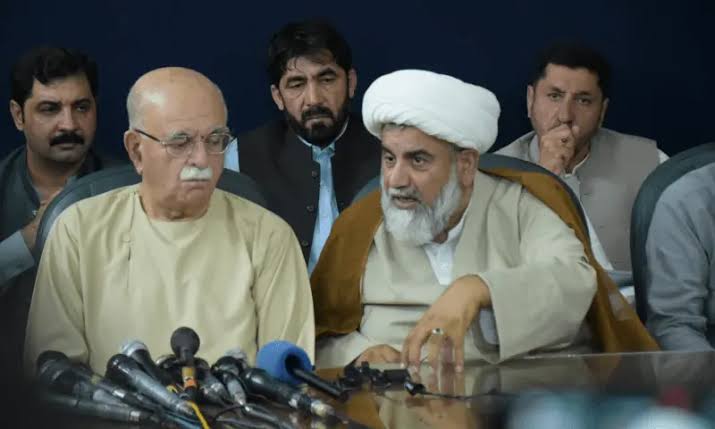
National Assembly Opposition Leader Mehmood Khan Achakzai and Senate Opposition Leader Raja Nasir Abbas jointly filed the petition, which seeks enforcement of fundamental rights and constitutional protections for the detained members.
Besides Afridi, it names eight members of the provincial assembly: Speaker Babar Saleem Swati, Fazal Shakoor Khan, Dr Amjad Ali, Sultan Room, Yameen Khan, Abdus Salam Afridi, Muhammad Azam Khan and Ikram Ghazi. It also names six members of the National Assembly: Junaid Akbar Khan, Dr Amjad Ali Khan, Iqbal Khan Afridi, Fazal Mohammad Khan, Zubair Wazir and Maulana Naseem Ali Shah.
Afridi has not been seen since the Centre imposed governor’s rule and an emergency in the province on 11 October. A federal minister confirmed the next day that he and some of his cabinet members were in preventive custody.
The proclamation was issued by President Asif Ali Zardari under Articles 232 and 234 of the Constitution, after which the federal government assumed control of the province through the governor. Powers have been transferred to Governor Faisal Karim Kundi. The PTI maintains that Afridi “remains and shall continue” to serve as chief minister with the “confidence and support” of its jailed founder, Imran Khan.
The petition asks the court to order the authorities to disclose where the detainees are held and to produce them before it. It also seeks a declaration that their custody is unlawful and without lawful authority, along with “appropriate constitutional relief in the interest of justice and the rule of law”.
The respondents are the federal secretaries of interior and defence, the KP chief secretary, the secretary of the KP Home and Tribal Affairs Department, the provincial inspector general of police, the Peshawar capital city police officer, the Peshawar deputy commissioner and the director general of the Federal Investigation Agency.
The petition describes the case as one of substantial public importance, concerning the supremacy of the Constitution, the sanctity of the democratic mandate and the limits of executive power under Articles 232, 234 and 245. It also invokes the fundamental rights guaranteed under Articles 4, 9, 10, 14, 17 and 19-A.
At its heart is the question of whether a mandate won at the ballot box carries enforceable protection against arbitrary state action meant to obstruct or undermine legislators’ participation in representative governance. It asks whether the arrest, intimidation or coercive restraint of elected members, in circumstances affecting their ability to represent their constituencies, amounts to an indirect disenfranchisement of the electorate.
The petitioners also contend that targeting elected representatives for their political affiliation, parliamentary position or role in opposition politics amounts to discriminatory treatment, political victimisation and an abuse of public authority, contrary to Articles 4, 14, 17 and 25.
They want the court to declare that the Constitution is the supreme law of the land. In their submission, no proclamation of emergency, assumption of provincial executive authority, deployment of the armed forces or other extraordinary measure can give any state authority unfettered power to disregard fundamental rights, constitutional safeguards or the people’s democratic mandate.
The petition further seeks a declaration that the “liberty, dignity, political association and representative functions of elected members” are constitutionally protected, and that any arrest, detention, restriction of movement or coercive action against them is “unlawful, unconstitutional and without legal effect”.
“The electoral mandate of the affected elected representatives cannot be defeated, neutralised or rendered ineffective through arbitrary executive action, political victimisation or the misuse of state machinery,” it states. “The people of KP are constitutionally entitled to effective representation through their duly elected representatives.”
It argues that Articles 232, 234 and 245 must be exercised strictly within their constitutional limits. They cannot be invoked, it says, to justify suppressing political dissent, disabling elected representatives, interfering with parliamentary functions or circumventing fundamental rights. It adds that governor’s rule does not suspend the state’s constitutional obligations or place public functionaries beyond the FCC’s scrutiny.
The filing is the second of its kind in three days. PTI lawmaker Shandana Gulzar approached the FCC on Thursday, seeking the release of Afridi, Swati and other party workers. Her petition also asked for the recovery of Junaid Akbar, the PTI’s provincial president.
The detentions have been contested in the Peshawar High Court (PHC) since the emergency was imposed. Afridi’s brother, Muhammad Amir, petitioned the court on 13 October, alleging that the chief minister was taken from the Chief Minister House on 11 October by unidentified, armed and masked men in the presence of the capital city police officer. The high court referred that petition, with those concerning Swati and Akbar, to its chief justice on 3 November so that a larger bench could be formed.
Two days later, a two-judge FCC bench headed by Chief Justice Aminuddin Khan restrained the PHC from hearing cases on the preventive detention of PTI workers under the Maintenance of Public Order Ordinance. The PHC then dropped around 105 petitions from its 10 November cause lists. They included challenges to the emergency and governor’s rule and to the alleged illegal detention of Afridi, Swati, Akbar and scores of lawmakers.
PTI chairman Barrister Gohar Ali Khan asked the FCC on Thursday to let him intervene in that matter and to modify its 5 November order, so that the high court’s proceedings on governor’s rule and the emergency are not suspended.
Afridi also faces legal trouble elsewhere. A Peshawar anti-terrorism court on 11 November reissued arrest warrants for him in the case of the May 2023 attack on the Radio Pakistan building, extended the interim bail of three former ministers and adjourned the hearing until 17 November. The case relates to the attack, vandalism and arson at the building during the violent protests that followed Khan’s arrest.
Copyright © 2021 Independent Pakistan | All rights reserved