By Staff Reporter
TURBAT: Pakistan’s army chief has visited the southern Balochistan city of Turbat to be briefed on operations against militants, days after two soldiers were killed in an armed drone attack in the province, the military said.
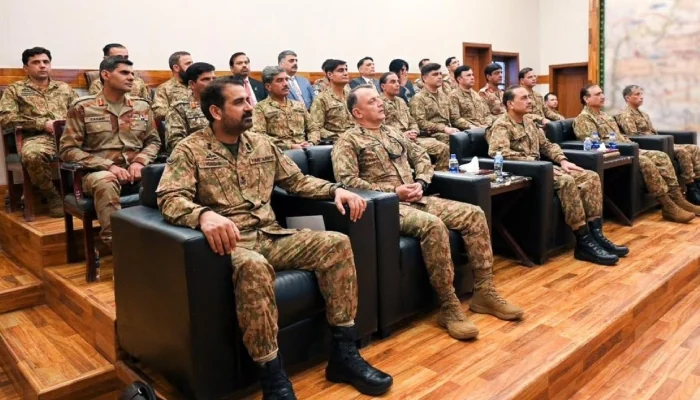
Field Marshal Asim Munir, who holds the posts of chief of army staff and chief of defence forces, was received by the corps commander Balochistan on Thursday, according to a statement from the Inter-Services Public Relations (ISPR), the military’s media wing. He laid a floral wreath at the Shuhada Monument and offered Fateha.
He was then given “a comprehensive briefing on the prevailing security environment, operational preparedness and successful ongoing operations against externally sponsored terrorism”, the ISPR said. Islamabad blames India for supporting the insurgency in Balochistan, a charge New Delhi has repeatedly denied.
Field Marshal Munir was also “apprised of the progress of various ongoing socio-economic development initiatives for people of Balochistan”, the statement said.
Addressing troops, he praised their “high state of operational preparedness, professionalism and unwavering resolve to defend the motherland”, despite difficult operating conditions.
“Field Marshal Syed Asim Munir reaffirmed Pakistan Army’s unwavering commitment to stand shoulder to shoulder with the people of Balochistan in their continued pursuit of peace, prosperity and sustainable development,” the ISPR said.
The visit follows weeks of deadly violence. On 14 November, the military said militants used armed quadcopters against military vehicles on patrol, killing Major Omer Minhas Nasir and Havildar Muhammad Adnan Khan. Security forces killed eight militants, including a suicide bomber, in the Kolpur area and recovered a large cache of weapons and ammunition. The military said it had been carrying out a series of intelligence-based operations in Kolpur, Kardagap and Nushki since 13 November.
On 3 November, security forces killed 17 militants in separate operations in the Kachhi and Kharan districts, though a soldier also died. In Kech district, a suspected militant was killed on 29 October after armed men tried to set up a road blockade.
Before the Kolpur attack, a vehicle bombing at a paramilitary post in Mastung killed two civilians and injured 17 others. The outlawed Baloch Liberation Army claimed responsibility.
The violence presents a problem for Islamabad, which is courting foreign money for Balochistan’s mining, energy and infrastructure sectors, particularly from Saudi Arabia and China. The province, Pakistan’s largest by area, is rich in copper, gold and natural gas, yet remains among the country’s least developed.
Earlier this month, a Saudi business delegation led by Prince Mansour bin Mohammad Al Saud, chairman of the Saudi-Pakistan Joint Business Council, held talks with provincial investment officials on projects in mining, energy and livestock. The meeting took place in Karachi on 11 November.
Bilal Khan Kakar, vice chairman of the Balochistan Board of Investment and Trade, told local media last week that protecting such investors fell to the provincial government. “We are responsible to provide foolproof security to foreign investors, their machinery and investment sites,” he said. He added that the Saudi business community had agreed to create 20,000 jobs for the province’s skilled young people.
The province already hosts the Saindak copper-gold project, which involves Chinese investment, and the multibillion-dollar Reko Diq copper-gold project, which is being developed by Canada’s Barrick Mining Corporation. Separatist militants have repeatedly targeted security forces, government installations and Chinese-linked projects.
Ethnic Baloch separatist groups have fought a decades-long insurgency, demanding independence or greater control over the region’s natural resources. They accuse the state of exploiting Balochistan’s mineral wealth without adequately benefiting local people, allegations Islamabad rejects. Pakistan says the militants do not represent the wider Baloch population. It says development projects aimed at improving livelihoods are central to addressing the province’s grievances.
Militant violence has risen across Pakistan, particularly in Khyber Pakhtunkhwa and Balochistan, since the Afghan Taliban took power in Kabul in 2021. The Centre for Research and Security Studies (CRSS) said the two provinces remained the country’s main hotspots in the second quarter of 2026. Khyber Pakhtunkhwa was the worst affected, with 475 violence-related deaths, more than 61 percent of the national total, and 151 incidents, or 57 percent. Balochistan recorded 265 deaths, or 34 percent, and 94 incidents, or 35 percent.
Field Marshal Munir has visited Balochistan several times since taking command of the army in November 2022. He went to Turbat the following month for briefings on security and operational readiness, and to Gwadar in March 2023 to review security and development work under the China-Pakistan Economic Corridor. He returned to Turbat in August 2025 to review the security situation, counterterrorism operations and development projects in the south of the province.
Copyright © 2021 Independent Pakistan | All rights reserved