By Staff Reporter
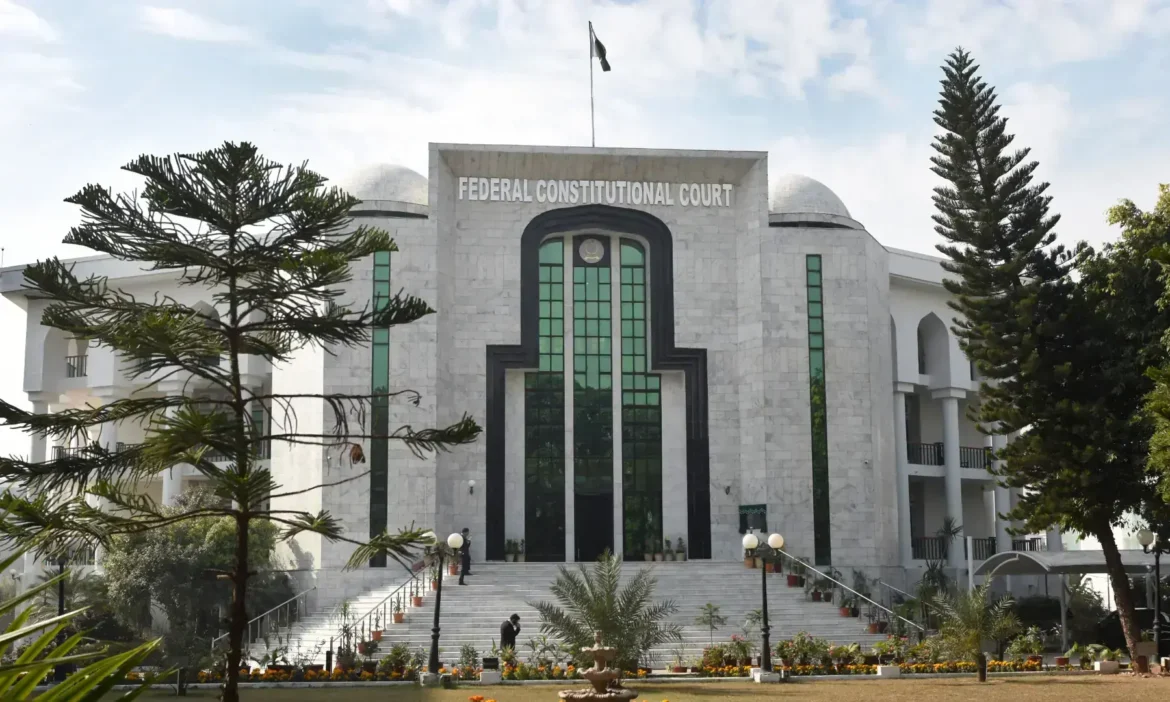
ISLAMABAD: The Federal Constitutional Court set aside high court rulings upholding the infrastructure cess imposed by the Sindh and Khyber Pakhtunkhwa governments, ruling that the provincial laws exceed the legislative powers of the provinces and ending a dispute that dates to 1994.
A two-judge bench led by Chief Justice Aminuddin Khan and including Justice Aamer Farooq heard a batch of 568 petitions from private parties challenging decisions by the Sindh High Court and the Peshawar High Court. The court announced a short verdict on Thursday, three days after it reserved judgment. The bench examined the limits of provincial taxation on imports, exports, customs-related transactions and the movement of goods across provincial boundaries.
The ruling strikes at a revenue stream that has been central to Sindh’s finances. Sindh levies a 1.85% cess on imports, which has generated more than 1.5 trillion rupees over the past five years, according to a Federation of Pakistan Chambers of Commerce and Industry executive committee member. The case covered the Sindh Development and Maintenance of Infrastructure Cess Act, 2017, and the Khyber Pakhtunkhwa Infrastructure Development Cess Act, 2022, including changes made through the provincial Finance Act, 2024.
The Sindh law provided for taxes on goods entering or leaving the province from or for outside the country by air or sea. The Sindh High Court upheld the levy on June 4, 2021. The Khyber Pakhtunkhwa act imposed a cess on the transportation and movement of goods in the province. Section 14 of the 2024 Finance Act raised the rate from 1% to 2%. The Peshawar High Court dismissed 157 petitions against the levy in a Nov. 14, 2025, judgment.
Petitioners argued that the provinces had no constitutional authority to impose fiscal levies on imports, exports and goods within the federal legislative domain, and that the laws encroached on Parliament’s exclusive competence. Lawyers for the Khyber Pakhtunkhwa petitioners said the levy was calculated at 2% of the value determined under the Customs Act, 1969, and collected at the export stage, making it in effect an export duty.
Senior counsel Hafiz Ehsaan Ahmad Khokhar, appearing for the secretary of the Revenue Division and the Federal Board of Revenue, said the levies had to be examined under Articles 141 and 142(a) of the Constitution, read with Entries 27, 43 and 59 of Part I of the Federal Legislative List. Entry 27 covers imports and exports across customs frontiers, inter-provincial trade and commerce, and trade with foreign countries, he said, while Entry 43 assigns customs duties, including export duties, to the federation.
The character of a levy, Khokhar argued, depends on its true nature, taxable event, fiscal incidence, charging provisions and actual operation, not on its label. A provincial charge that adds to the cost of imported or exported goods and works through the customs-clearance process engages federal territory, he said. He also cited Article 163, arguing that the provincial power to tax professions, trades, callings and employments can’t be stretched to cover customs duties or other federal subjects, and that a province can’t gain competence over a federal subject by calling a customs-linked levy an infrastructure cess. The FBR’s counsel also told the court the levy had raised production costs for manufacturers and exporters.
The additional attorney general backed the federation’s position. The Sindh and Khyber Pakhtunkhwa governments defended their laws, saying the cesses were provincial levies to finance infrastructure development and road facilities, not customs or export duties. They argued that provincial assemblies could legislate on the subject under Article 142(c) and that the high court judgments were sound.
The litigation has long hung over importers and the oil industry. The business federation has said about 350 billion rupees linked to the Sindh levy was tied up in litigation. In October 2025, oil marketing companies faced a Sindh government claim of about 180 billion rupees on petroleum imports, dating to 2021, and the dispute at one point left a cargo stuck at the port.
Sindh had already begun to retreat from the levy. The provincial government decided to reduce the cess to 0.80%–0.85% from 1.85%, conceding a demand business groups had pressed for nearly two decades. Traders would pay a share of outstanding amounts in installments, starting with 15% by July 31, 2026, under a settlement plan announced by the federation. The cess on the Export Facilitation Scheme was abolished entirely.
It was not immediately clear what the ruling means for money already collected, for settlements already struck between Sindh and traders, or for the provinces’ budgets.
The appeals were first filed in the Supreme Court and later transferred to the Federal Constitutional Court. The court was created in November 2025 and holds exclusive jurisdiction over constitutional interpretation and disputes between the federal and provincial governments.
Copyright © 2021 Independent Pakistan | All rights reserved