By Staff Reporter
ISLAMABAD: Pakistan’s climate minister has called for terrorism allegations between Islamabad and Delhi to be handled through a transparent, evidence-based mechanism, during the first ministerial visit to India since the two countries’ four-day military confrontation in May 2025.
Musadik Malik, the minister for climate change, said both sides should stop trading accusations and address the region’s problems collectively.
“Rather than focusing on a single incident or bilateral discussions – where the tendency is often to point fingers at one another – it would be far better to address the problems of the entire region through a structured mechanism and based on concrete evidence,” he told the Indian ANI news agency.
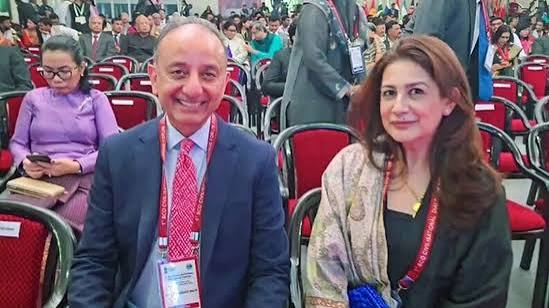
Malik is leading Pakistan’s delegation at the first Shanghai Cooperation Organisation (SCO) Civilisational Dialogue Forum, held at Purana Qila in Delhi from 20 to 22 November. He reached India on Friday and was received at the airport by Pakistan’s chargé d’affaires, Saad Ahmad Warraich. He is due to address the forum on Saturday.
Asked whether Pakistan was unwilling to act against terrorism, he said: “I do not wish to present a narrative of mere victimhood – we are doing our utmost to address the situation…”
He said he did not want to reduce the forum to a bilateral dispute. “The issues we face are not limited solely to those between our two nations; they have become far broader and more extensive,” he said, pointing to challenges in Iran, Central Asia and Afghanistan.
“I do not wish to reduce such a significant, wide-ranging dialogue to a purely bilateral context… However, when the time comes to address the issue of terrorism, you are well aware that thousands of our people have been martyred and we must ensure transparency.”
He said both countries must bring forward evidence when they accuse each other of fomenting terrorism on the other’s territory. Pakistan, he said, had suffered greatly from terrorism, and India had also experienced many such incidents.
“Our objective is to establish a transparent mechanism – a proposal we have put forward on several occasions,” he said. “Such a mechanism would help restore trust and could lead to viable solutions. We, too, desire a lasting solution to all these issues.”
Asked about India’s concerns over cross-border terrorism, he declined to go further. “I think tomorrow, once I give my statement, we’ll have a lot of conversations…” he said.
He is the first Pakistani minister to visit India since Bilawal Bhutto-Zardari attended the SCO meeting in Goa in May 2023. The visit comes two years after India’s external affairs minister, Subrahmanyam Jaishankar, attended the bloc’s meeting in Islamabad.
Relations between the neighbours remain strained, and no formal bilateral meeting between Pakistani and Indian officials has been announced. Pakistan’s Foreign Office said the minister would meet other SCO delegations on the sidelines.
Pakistan has taken over the rotating chairmanship of the SCO Council of Heads of State for 2026-27 and is due to host the organisation’s summit in Islamabad in August 2027.
Speaking informally to reporters, Malik described the forum as a “tremendous opportunity” for multilateral dialogue and said he saw it as a “very welcoming sign”.
“I think cultures and civilisations cut across boundaries, and it is fantastic that we are here and talking about our history, our geography, and our cultures and civilisations,” he said.
Asked whether ties with India would improve, he said: “I think all of our relationships will improve. The region is in flux, as you know. The plates underneath geopolitics are shifting very fast.”
On the shared history of the region, he said: “I think dialogues are between distinct entities. Singularity doesn’t require a dialogue. Singularity only requires a monologue. Dialogue is about diversity. I think between India, Pakistan, Russia, China and Central Asian states, if you go to the excavations, you would find that dialogue taking place just in the fore. I think it’s a very welcome dialogue.”
The forum was proposed by Modi at the SCO leaders’ summit in Tianjin, China, in September 2025. Organisers expect representatives from more than 25 countries, including the 10 SCO members and states with observer or dialogue-partner status. Modi is also scheduled to address it.
Pakistan’s Foreign Office said in an earlier statement that “the Government of Pakistan remains committed to promoting dialogue among civilisations and fostering people-to-people contacts within the SCO framework in a spirit of mutual respect”.
Malik’s arrival drew criticism from Indian opposition politicians. They included the Congress spokesperson Supriya Shrinate, the Congress leaders Surendra Rajput and Pramod Tiwari, Fakhrul Hasan Chand of the Samajwadi Party and Clyde Crasto of the NCP (SP). They accused the governing BJP of inconsistency and “double standards” in inviting Pakistan.
An Indian official said invitations had gone to all SCO member states in line with established multilateral practice. India had first invited Pakistan’s heritage minister, the official said, before Islamabad nominated Malik.
Indian media reports said Malik, accompanied by his wife, would visit the Taj Mahal in Agra, but that a trip to the Nizamuddin Dargah had not received security clearance. He is expected to be accompanied by members of the Pakistan High Commission. Some Indian reports said the forum itself had drawn relatively little discussion in the capital compared with his itinerary.
Copyright © 2021 Independent Pakistan | All rights reserved