By Staff Reporter
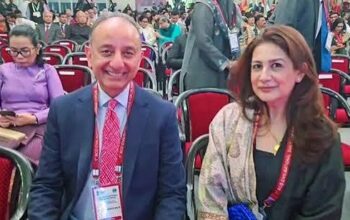
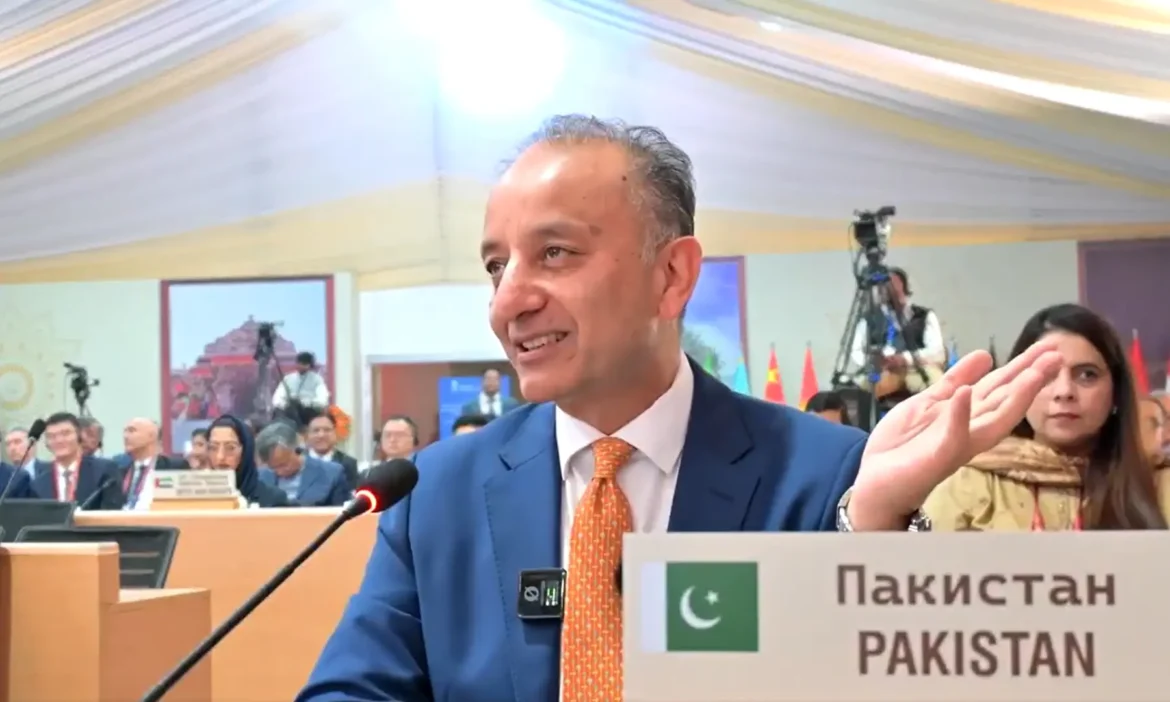
ISLAMABAD: Pakistan’s climate minister has used the first visit by one of its federal ministers to India in more than three years to tell a regional forum in New Delhi that the true enemy of civilisation is climate change, not a rival culture.
Musadik Malik was addressing the Shanghai Cooperation Organisation (SCO) Civilisational Dialogue Forum at Purana Qila, the 16th-century fort in the Indian capital, on Saturday. He is the first Pakistani federal minister to travel to India since Bilawal Bhutto-Zardari, then foreign minister, attended an SCO meeting in Goa in May 2023.
The three-day forum, which runs until Sunday, is the first of its kind. The trip comes against a backdrop of strained relations since last year’s military confrontation between the neighbours.
Dr Malik anchored his speech in the 2022 monsoon floods, which he said killed 1,700 people in Pakistan and submerged a third of the country, including almost all of Sindh. They also brought down the walls of Mohenjo-daro, the 4,500-year-old Unesco-listed site.
“Four days of rain caused Mohenjo Daro’s walls to fall; those walls that no one was able to break for 4,500 years, [climate change] did it,” he said.
He also recalled floods in Nepal, which he said killed more than 1,400 people and left thousands missing. Nepal’s representative had raised the issue at the forum. Humans, Dr Malik added, were an “enemy” too, because they contributed to climate destruction.
He then turned to the name of the ancient city. “Do you know what is the meaning of Mohenjo-Daro?” he asked. “It means mound of the dead.”
The site, he said, had in a sense opened its gates to the living during the floods, sheltering people who had been displaced. Others found refuge in car parks and shopping malls, while mosques, temples, shrines and schools in Balochistan also took in flood victims.
“This is the power of civilisation. This is the power through which nations survive,” he said.
He set out three proposals for the SCO. The first was a network of cultural institutions, with Pakistan’s Lok Virsa and the Pakistan National Council of the Arts as focal institutions. The second was a digital repository to present the region’s historical and natural “gifts” to the world.
“The AI revolution is here, machine-learning has been implemented. Virtual realities are being created,” he said. “So in this new era of technology, isn’t it amazing that we make a digital repository, a virtual reality that can present the unique gifts that nature has given us, the unique gifts that history has given us. And present them to the world.”
The third was a climate-resilient heritage framework. “In the upcoming SCO [summit], we want a climate resilient heritage framework,” he said.
Dr Malik opened in Urdu rather than English, saying he was moved to do so by his proximity to the tombs of the Urdu poet Mirza Ghalib and the Sufi saint Nizamuddin. “It felt a little strange to speak in English. So, with your permission, I would like to speak in Urdu,” he said.
His central argument was that dialogue needs difference. “If there is one identity, one voice, then a monologue is needed. There is no need for dialogue,” he said, likening it to waking up and speaking only to one’s reflection in the mirror.
“There is no beauty in that. Beauty is [in] the vase that has colourful flowers, smell of different kinds. Today, we’re here to celebrate that colourful vase,” he said.
He described Pakistan as a civilisation shaped by many influences, with links to China, Central Asia, Iran and the Middle East. “When we look at our history, all our roads lead to the north; Bukhara and Samarkand and Central Asia and Afghanistan,” he said. “And when we talk about our prayers, our poetry, we are drawn towards the Middle East and Iran or Persia.”
On Friday, after arriving in the Indian capital, he had called the forum a “tremendous opportunity” for multilateral dialogue.
Questions from Indian journalists on terrorism and the suspended Indus Waters Treaty drew little in the way of direct answers. He repeatedly stressed that the talks were multilateral, and called for a transparent, evidence-based mechanism to address terrorism concerns on both sides.
The visit has also become a domestic political issue in India. A BJP spokesman, Nalin Kohli, said Pakistan had received no special invitation and that there could be no dialogue while terrorism continued, while the Congress leader Salman Khurshid accused the government of an inconsistent Pakistan policy.
Neither government has announced bilateral talks.
On the sidelines, Dr Malik met Tajikistan’s culture minister and Mohammad Mahdi Imanipour, president of Iran’s Islamic Culture and Relations Organisation, the Pakistan High Commission in India said. He stressed historical and cultural ties and greater people-to-people exchanges with both. Dunya News reported that he proposed a “Virtual Green University” with Tajikistan to pursue joint work on climate, culture and research.
The SCO was founded in 2001 by China, Russia, Kazakhstan, Kyrgyzstan, Tajikistan and Uzbekistan. India and Pakistan became full members in 2017, Iran joined in 2023 and Belarus became the tenth member in 2024. India’s external affairs minister, Subrahmanyam Jaishankar, visited Islamabad for an SCO meeting two years ago.
Pakistan holds the rotating chairmanship of the SCO Council of Heads of State for 2026-27 and is due to host the organisation’s summit in Islamabad in August 2027. India and Pakistan have fought several wars since 1947, mainly over Kashmir, which both claim in full but administer in part.
Copyright © 2021 Independent Pakistan | All rights reserved