By Staff Reporter
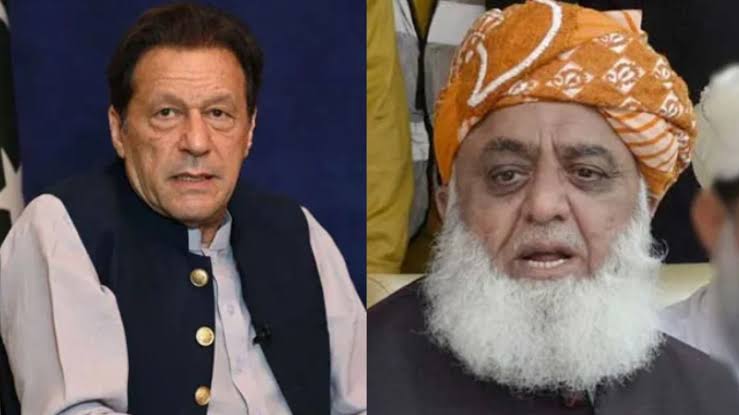
ISLAMABAD: Jailed former prime minister Imran Khan has ordered his party to court the religious party leader Maulana Fazlur Rehman and widen the opposition alliance, as alarm over his health reaches the United Nations.
The instruction, passed out of Adiala jail in Rawalpindi, was relayed to the Pakistan Tehreek-e-Insaf (PTI) core committee at an overnight meeting that began on Monday. The lawyer Latif Khosa told members what Khan had said during a three-hour prison meeting on 11 November, which he attended with fellow lawyer Salman Safdar. Khan’s wife, Bushra Bibi, was also seen at Adiala that day.
“The core committee was informed that Imran Khan had expressed his complete confidence in the opposition leadership,” the party said in a statement afterwards. “He directed that the political alliance be further expanded and that outreach be extended to Maulana Fazlur Rehman and other opposition parties, with the objective of forming a broader political alliance and initiating vigorous political activities.”
Fazlur Rehman leads the Jamiat Ulema-i-Islam-Fazl (JUI-F). He has fallen out with the government since mid-October, accusing the Centre of reneging on its commitments despite his efforts to mediate between the ruling PML-N and the PTI.
Opposition parties have drawn closer since 11 October, when the government imposed emergency and governor’s rule in Khyber Pakhtunkhwa, the province the PTI had governed. Rehman criticised that move. Early this month, leaders of the Tehreek-i-Tahaffuz-i-Ayeen-i-Pakistan alliance, which includes the PTI, met him and agreed to strengthen their coordination in parliament.
Khan’s lawyers said the November meeting also covered his health, the cases against him and a possible 28th constitutional amendment.
His health is now the sharper political question. On 16 November, Khan appealed through Safdar to the country’s top judges to enforce Supreme Court orders on his treatment and prison conditions. He warned that his health was deteriorating and that he could reach a point from which he might not “return alive”. Safdar said he had composed the letter “faithfully and solely” on Khan’s instructions, adding: “The words that follow are his.”
On Sunday, Khan’s personal doctor of more than 30 years, Dr Sultan, told The Telegraph that the PTI founder must see a specialist within days to avoid irreversible heart damage.
“If I had a patient who had this kind of high blood pressure reading, I’d get them to see a good nephrologist or cardiologist as soon as possible, today or tomorrow,” Dr Sultan said. “The blood pressure needs to be brought down within days.”
He suggested that isolation could be contributing to the problem, and said it was “very important to correct and fix blood pressure readings in time so that no serious injuries are sustained by these organs”.
UN human rights chief Volker Türk said in a CNN interview on Friday: “I call for Imran Khan’s release.” On Tuesday, the UN special rapporteur on torture, Alice Jill Edwards, urged Pakistan to bring his detention conditions in line with international standards. She cited reports that he is held in prolonged solitary confinement, locked in his cell for 23 hours a day, and called for his personal physicians to be allowed to visit.
On Monday, the leaders of the opposition in both houses of parliament, Mahmood Khan Achakzai in the National Assembly and Allama Raja Nasir Abbas in the Senate, wrote to the chief justices of the Supreme Court, the Federal Constitutional Court (FCC) and the Islamabad High Court. They sought intervention to protect the lives, health and fundamental rights of Khan and his wife.
“If harm comes to Imran Khan or to Bushra Imran Khan in State custody, the responsibility will rest on the State, but history will also ask what the courts did when they were told, in plain words, by the elected representatives of the people in both Houses of Parliament, that a life was at risk,” the letter said.
The PTI core committee, chaired by party chairman Barrister Gohar Ali Khan, voiced “serious concern” over the medical condition of Khan and his wife. It demanded that both be moved to Shifa International Hospital in Islamabad. It also demanded immediate implementation of the Supreme Court’s 18 August ruling, which directed that Khan be transferred to the private facility.
Khan was taken to the state-run Pakistan Institute of Medical Sciences (PIMS) instead and returned to jail after an examination. The PTI has since filed a contempt petition alleging the order was not followed.
The committee urged the judges to “take immediate serious notice” of Khan’s letter, and called on the chief justice to ensure his personal physicians have unrestricted access. It also asked that he be allowed to see his family and lawyers. His health, it said, required urgent judicial attention, and “any further delay is unacceptable”.
On Saturday, a medical team headed by Dr Arif of PIMS examined Khan and Bushra Bibi separately at Adiala, checking their blood pressure and eyes over about an hour.
Khan’s eyes have been the focus of earlier disputes. In late January he underwent a minor procedure at PIMS. The hospital later confirmed he had received an injection for right central retinal vein occlusion. A report prepared by Mr Safdar for the Supreme Court in February said Khan told officials his right eye was working at only 15 percent capacity. A later medical board found improvement, with right-eye vision up from 6/36 to 6/9, and did not recommend moving him to hospital.
Bushra Bibi was diagnosed in March with posterior vitreous detachment in her right eye. She underwent eye surgery on 16 April. Earlier this month the Islamabad High Court directed proper medical care and hygienic living conditions for her, in line with prison rules.
The core committee also condemned the continued detention of Sohail Afridi, who has been left unable to function as Khyber Pakhtunkhwa’s chief minister since governor’s rule was imposed, and of other PTI lawmakers. It said the extension of detention orders under Section 3 of the Maintenance of Public Order law against elected representatives and workers was “contrary to fundamental constitutional, democratic and human rights”.
It asked the FCC to modify its stay order on Section 3 so that those granted bail by the Peshawar High Court before 5 November, whose release orders remain unimplemented, can walk free. It singled out the rearrest of Taimur Saleem Jhagra, Irfan Saleem and Bangash despite their bail, and denounced what it called politically motivated arrests across Punjab, Sindh, Balochistan and Khyber Pakhtunkhwa.
On the debate over new provinces, Khan instructed that the matter be “deliberated upon in detail at the forthcoming meeting of PTI’s parliamentary party”. Recommendations will then go to him for a final decision.
Khan has been in custody since August 2023. He and Bushra Bibi were sentenced to 17 years in prison on 20 December 2025 in the Toshakhana-II case, which concerns allegations that they unlawfully kept a Bulgari jewellery set given by the Saudi crown prince. Khan is also serving a sentence in the £190m corruption case and faces pending Anti-Terrorism Act trials over the 9 May 2023 protests.
Copyright © 2021 Independent Pakistan | All rights reserved